
Tourism - 1. quarter of 2006
More domestic guests, fewer foreigners
Publication Date: 23. 05. 2006
Product Code: r-9201-06
In Q1 2006, a total of 2.4 million guests arrived at collective accommodation establishments; this was +5.5% up on Q1 2005. The number of foreign guests dropped by -0.3%, in particular due to the postponement of the Easter holiday to April; exceptionally good snow conditions, in contrast, attracted +11.4% more domestic tourists.
* * *
Graph 1
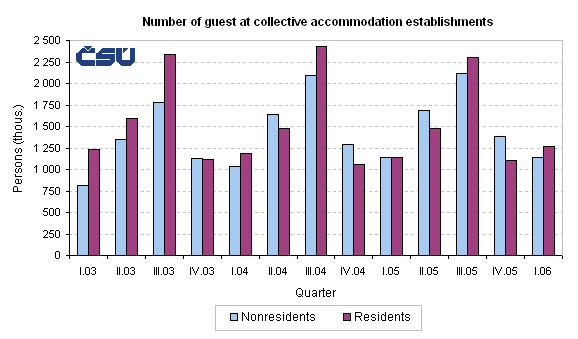
In Q1 2006, a total of 2.4 million guest arrivals was reported at collective accommodation establishments; this was 5.5% up on the Q1 2005. There were 1.1 million foreign guests, i.e. -0.3% fewer than in 2005; domestic tourists totalled 1.3 million (+11.4%). A decrease in foreign guest arrivals at collective accommodation establishments was probably a result of this year’s postponement of the Easter holiday to April; in contrast, the number of resident tourists increased thanks to good snow conditions, which lasted the whole winter season and were convenient for both traditional winter holidays and skiing weekends.
After a long-term growth in the category of 4* hotels, the number of arrivals of foreign guests decreased by -1.5% in Q1 2006, while 5* hotels kept their positive trend and grew by +8.1%. The figures for domestic tourists showed an opposite tendency: their number in 4* hotels increased by +13.2%, while in 5* hotels it dropped by -17.1%. Since the capacity in both hotel categories increased year-on-year, it can be assumed that foreign guests prefer 5* hotels and residents 4*. There were more guests in both categories; however, only in 5* hotels did the number of overnight stays also increase.
As for the country of permanent residence, most tourists came from Germany, Great Britain (even though the number of British guests decreased by -14.0%) and Italy.
As usual, the target destination for foreign tourists was Prague, in which 54.3% of foreigners were accommodated; it was followed by the Královéhradecký Region and Karlovarský Region (8.3% and 7.8%, respectively). Although the lowest number of guests (of all the regions of the Czech Republic) was reported from the Pardubický Region as in previous periods, the highest occupancy growth year-on-year (+29.2%) was there. This can be explained by higher usage of the Pardubice Airport, which serves low-cost airlines, the clients of which started to stay overnight at nearby collective accommodation establishments before their departure to usual destinations within the Czech Republic (or departure abroad).
In Q1 2006, overnight stays of guests reached 8.0 million, which was +1.5% up on Q1 2005. In contrast, for foreign guests (3.8 million overnight stays) a decrease by -1.2% year-on-year was reported.
Net use of rooms of hotels and boarding houses was 36.2% in the Q1 2006. The highest net use was reported, as in the previous year, by 5* hotels (46.2%), even though there was a drop by 4.7 percentage points. In the beginning of the year 2006, four new 5* hotels were opened and two hotels of the category re-opened; because the growth in overnight stays fell behind the growth in capacity by 10.7%, there was a resulting decrease in the net use indicator. Other hotels and boarding houses reached only 33.3% of net use of rooms; however, it was 1.0 percentage point up year-on-year.
Methodological note:
Data on guests at collective tourist accommodation establishments are obtained from the monthly CR1-12 sample survey and the quarterly CR2-04 survey. Data mentioned are sums of the data processed from submitted questionnaires and imputed data on the accommodation establishments that failed to report. Net use of room is the number of overnight stays in a particular period divided by the number of room-days (stated as a percentage).
Contact: Hellerová Alena, phone: (+420) 274052921, E-mail: alena.hellerova@csu.gov.cz
Data source: CZSO direct survey in collective accommodation establishments
End of data collection: 5 May 2006
End of data processing: 15 May 2006
The data are preliminary; revised data for all quarters of 2006 will be known in March 2007.
Quarterly data since 2000 are available in time series ( /produkty/cru_ts ).