
Business cycle survey - July 2005
Confidence of entrepreneurs increasing again?
Publication Date: 29. 07. 2005
Product Code: r-1201-05
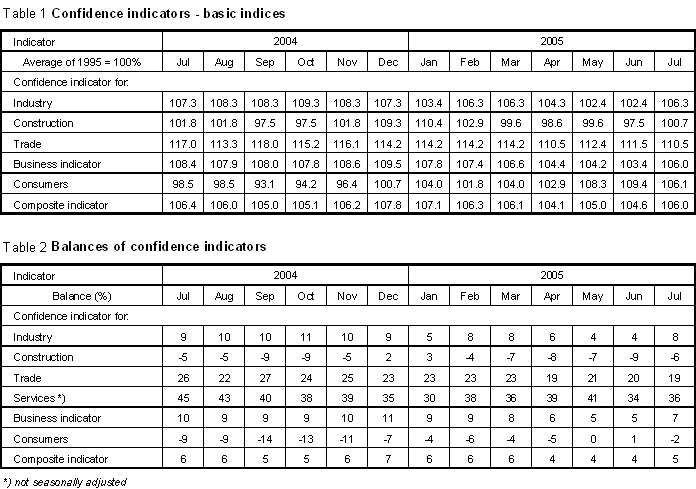
The composite confidence indicator balance increased in July 2005 by 1 point m-o-m, the business confidence indicator balance increased by 2 points (the first m-o-m increase of the business confidence indicator balance since December 2004). The consumer confidence indicator balance decreased by 3 points. In comparison to July 2004, the balance of composite confidence indicator was lower by 1 point; the business confidence indicator balance was lower by 3 points and the balance of consumer confidence indicator was higher by 7 points.
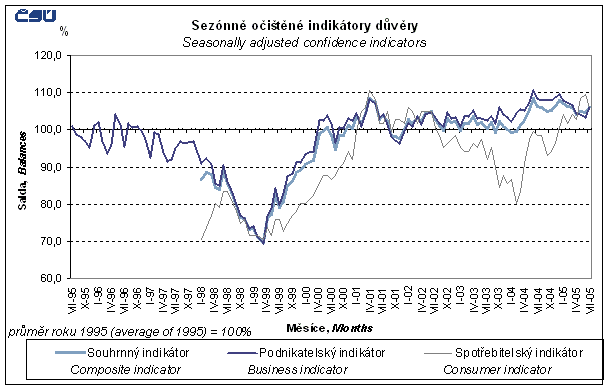
In industry (928 respondents), 41.2% of the respondents considered their economic situation in July good, 55.7% satisfactory and 3.1% bad, which is after seasonal adjustment a better result than in June. The assessment of current total demand (order books) for enterprise output increased compared to the assessment in June (balance 2 points up). The assessment of current foreign demand did not change. Stocks of finished goods decreased, the respondents say (balance 9 points down). For next three months 29.4% of respondents expect an increase in the production activity, 63.5% expect no changes and 7.1% decrease, which after seasonal adjustment translates into 1-point decrease of the balance compared to June. For next three months the respondents further expect the demand to increase (balance 2 points up) and the employment to decrease (balance 5 points down). In next six months, they expect their economic situation to improve (balance 8 points up). All the data are seasonally adjusted.
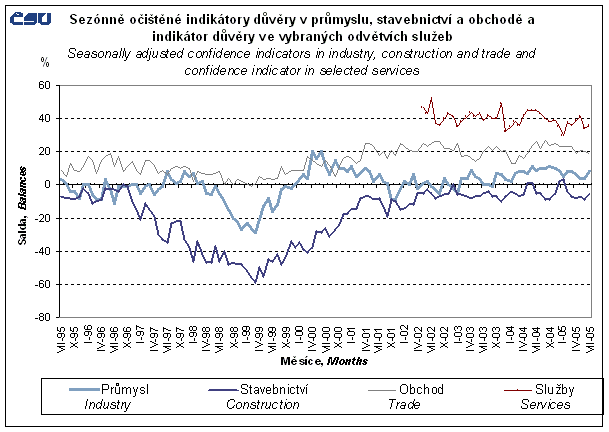
On the whole, the balance of confidence indicator in industry increased by 4 points compared to the previous month. However, compared year-on-year, it is 1 point down on July 2004.
In construction enterprises (564 respondents), 44.2% of the respondents considered the economic situation of their enterprise in July good, 51.4% as satisfactory and 4.4% bad; this is better assessment than in June (balance 1 point up). The assessment of current total demand (order books) for enterprise output increased (balance 3 points up). For next three months respondents expect the employment to increase (balance 5 points up). All the data seasonally adjusted. In next six months the respondents expect mostly maintenance of current economic situation; 73.5% of the respondents anticipate no changes (66.6% in June), 23.8% predict improvement (31.5% in June) and 2.7% expect worsening (1.9% in June). Generally, the balance of confidence indicator in construction increased by 3 points month-on-month and it is 1 point down on July 2004.
Of respondents engaged in trade (318 respondents), 45.4% considered the economic situation of their enterprise in July good, 51.6% as corresponding to the season and 3.0% bad. Month-on-month, this translates into an increase in the balance by 1 point after seasonal adjustment. All in all, trade decreased its stock of inventories (balance 2 points down). Unchanged price development is expected by 88.3% of the respondents, while 5.4% expect prices to grow and 6.3% to drop. In next six months, 37.2% of the respondents predict improvement in the economic situation (37.8% in June), 60.7% anticipate no changes (61.5% in June) and 2.1% expect worsening (0.7% in June). The overall balance of confidence indicator in trade decreased by 1 point month-on-month. In year-on-year comparison it is 7 points down on July 2004.
In selected branches of services (786 respondents), 52.7% of the respondents assessed their current economic situation in July as good, 45.7% as corresponding to the season and 1.6% as bad, which was a better assessment than in June. 33.5% of the respondents expect the demand to rise (order books), while 61.8% anticipate no changes and 4.7% assume that the demand will decrease; this expectation is also better than in June. According to 93.0% of the respondents no changes in price development should occur, 5.3% envisage a rise in prices and 1.7% a drop. The number of employees is expected to decrease (26.5% of the respondents), remain unchanged (62.1%) or to increase (11.4% of the respondents). The overall balance of confidence indicator in selected branches of services increased by 2 points and in the y-o-y comparison it is 9 points down on July 2004.

Contact: Marie Hörmannová, phone (+420) 274052049,
e-mail hormannova@gw.czso.cz
Data source: CZSO business surveys, GfK Praha consumer survey
End of data collection: 22 July 2005
End of data processing: 27 July 2005
For more information see: https://csu.gov.cz
Methodological explanatory notes :
The composite confidence indicator is a weighted average of seasonally adjusted confidence indicators in industry, construction, trade, and of the consumer confidence indicator. The composite business confidence indicator is a weighted average of seasonally adjusted confidence indicators in industry, construction and trade. The confidence indicator in industry has a double weight. Since January 2002, the consumer confidence indicator has been composed of four indicators (expected financial situation of consumers, expected total economic situation, expected total unemployment (with inverted sign) and savings expected in 12 months to come). Since January 2003, the confidence indicators have been presented as basic indices; the base being the average of 1995.
The branch confidence indicators are constructed as averages of seasonally adjusted weighted business cycle balances. The business cycle balance is the percentage difference between the responses “growth (+)” and “fall (-)”. The confidence indicator for industry is the average of seasonally adjusted balances of three indicators (the assessment of total demand, stocks of final production (with inverted sign) and the expected development of production activity). The confidence indicator for construction is the average of two indicators (the assessment of total demand and the expected development of employment). The confidence indicator for trade is the average of three indicators (the assessment of economic situation, stocks (with inverted sign) and the expected development of economic situation). The business cycle survey in selected services has been conducted by the CZSO since May 2002. This is why the time series are not seasonally adjusted. Data for hotels and restaurants are included in selected services. The time series are converted and the data are comparable. The confidence indicator for selected services is the average of three indicators (the assessment of economic situation, the assessment of demand and expected demand). The confidence indicator for selected services is not being included into composite indicators, yet.
The data above were derived in a weighted manner: sales were used as weights for industry, services and trade, whereas construction work of contractors and subcontractors was the weight for construction. The responding groups of enterprises account for more than a half of sales (industry) and volume (construction) and for a quarter of sales in trade.