
Economic activity of the population - 1. quarter of 2008
Product Code: e-3133-08
Employment in the primary sector (agriculture, forestry, fishing) decreased by 6.2 thousand year-on-year to 168.6 thousand persons and made up only 3.4% of the total number of first (main) jobholders. On the other hand, the number of persons employed in the secondary sector (industry, construction) substantially increased by 59.0 thousand to 2 008.4 thousand (40.5% of the total employment). Total increase in this sector considerably exceeded employment increase in the entire tertiary sector (41.3 thousand). This growth was mainly affected by the year-on-year increase of 38.2 thousand in employment that occurred in ‘manufacturing’. The number of employed persons went up most in ‘manufacture of electrical equipment n.e.c.’ (+9.6 thousand), ‘manufacture of basic iron and steel and of ferro-alloys’ (+8.7 thousand), ‘manufacture of motor vehicles’ (+7.7 thousand except motorcycles) and ‘manufacture of other metal products’ (+7.1 thousand). Employment increase in construction (+20.5 thousand) was most marked in ‘building installation’ (+16.5 thousand) and ‘building completion’ 1).
Employment in the tertiary sector (all divisions of services including transport) increased by 41.3 thousand to 2 781.2 thousand (56.1% of total employment), but the number of the employed in the individual divisions developed in a different way. Employment increased most in ‘real estate; renting and business activities’ (+24.3 thousand), ‘financial intermediation’ (+18.0 thousand), ‘transport, storage and communication’ (+17.2 thousand) and ‘wholesale and retail trade; repair of motor vehicles, motorcycles and personal and household goods’ (+10.4 thousand).
In the section ‘real estate; renting and business activities’ the growth was especially in the groups ‘industrial cleaning’ (+4.5 thousand), ‘miscellaneous business activities n.e.c.’ (+4.1 thousand) and ‘architectural and engineering activities and related technical consultancy’ (+4.0 thousand). In ‘financial intermediation’ employment grew the most in ‘monetary intermediation’ (+11.8 thousand). In the section ‘transport, storage and communication’ employment grew especially in ‘telecommunications’ (+4.7 thousand) and ‘post and courier activities’ (+4.1 thousand). In the section ‘wholesale and retail trade; repair of motor vehicles, motorcycles and personal and household goods’ the highest increase was recorded in ‘wholesale of non-agricultural intermediate products, waste and scrap’ (+5.1 thousand) and in ‘wholesale of household goods’ (+4.9 thousand).
On the other hand, employment dropped most year-on-year in the section ‘health and social work’ (-11.5 thousand), especially due to the decreasing number of the employed in ‘human health activities (-18.2 thousand). Total drop of employment in ‘education’ by 7.6 thousand was most apparent in pre-school and basic education (-7.1 thousand) and secondary education (-6.4 thousand).
When interpreting the data, it is necessary to take into consideration that the discrepancies against the business statistics result among other things from the fact that the concept of employees in the LFSS is more general and is not directly related to registered number of employed persons.
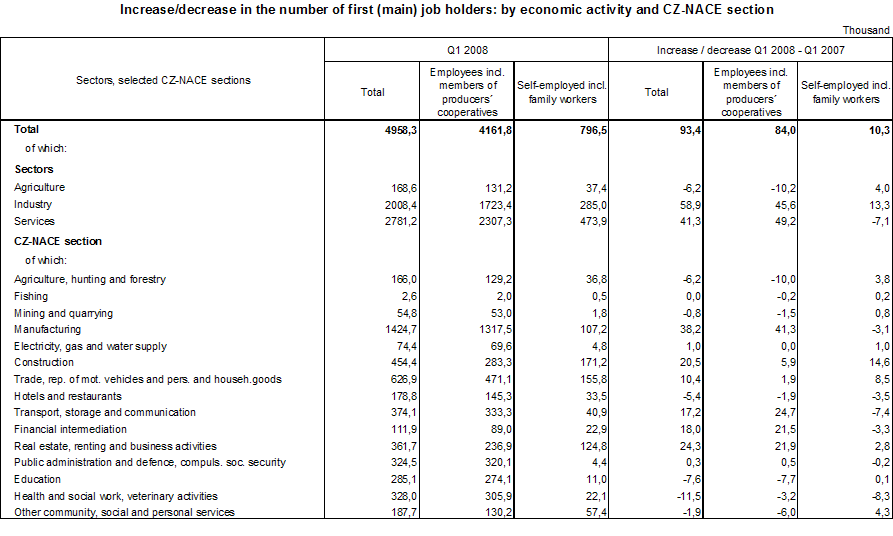
An increase in the total number of self-employed by 10.3 thousand showed itself mainly in the sections ‘construction’ (+14.6 thousand), ‘wholesale and retail trade; repair of motor vehicles, motorcycles and personal and household goods’ (+8.5 thousand) and ‘other community, social and personal service activities’ (+4.3 thousand). In ‘construction’, the highest year-on-year increase in the number of self-employed persons, including family workers, was in ‘building installation’ (+8.2 thousand). These self-employed are own-account workers, i.e. self-employed persons without employees. Also the numbers of self-employed in building construction and in civil engineering were up. In the section ‘wholesale and retail trade; repair of motor vehicles, motorcycles and personal and household goods’ the highest increase of self-employed was in ‘retail trade not in stores’. In ‘other community, social and personal service activities’ the rise was most apparent in ‘other entertainment activities’.
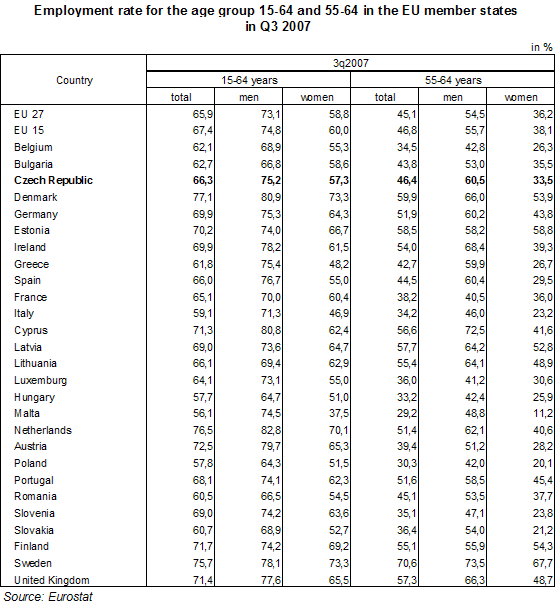
The total employment rate among persons aged 15-64 grew by 0.6 percentage points year-on-year to 66.1%. The relative increase was higher in the employment of men at working age (+0.8 percentage points to 74.9%); female employment was 0.3 percentage points up and reached 57.2%. The employment rate is pushed down by a rapid growth of the number of university students on the one hand; on the other hand, the number of persons in employment is increasing due to the concurrence of employment in the strong birth cohorts from around 1950 and the mid-1970’s and rising retirement age.
Concrete aims for the employment rate in the EU countries until 2010 were determined in the meetings of the European Council in Lisbon in 2000 and Stockholm in 2001. The total employment rate should reach at least 70%, female employment rate at least 60% and elderly employment rate (age group 55-64) at least 50%.
Compared internationally, the Czech Republic is among the countries with the above-the-average employment intensity in the EU. According to the latest complete data for Q3 2007 released by Eurostat, the employment rate of persons aged 15-64 in the Czech Republic was higher than the total for the EU27 but lower than the rate in the EU15. Lower employment rate than in EU15 and EU27 was in the group of women. Female employment rate in the Czech Republic is lower than in the EU15 and lower than in the EU27.
Differences in employment rates between EU countries are considerable, not only if we compare the whole age group 15-64, but also in the male and female components of employment. On the one hand there is a high employment rate in the northern countries and the United Kingdom (e.g. in Denmark it was 77.1% in Q3 2007), on the other hand employment rate in many countries was below 60% (in Hungary only 57.7% in Q3 2007). Compared to our neighbour states, higher employment rate is in Austria and Germany and significantly lower in Poland and Slovakia.
Even bigger differences are in the employment rate of persons aged 55-64. In Malta and Poland it oscillated around 30% and the rate was only slightly higher in Luxembourg, Slovenia, Slovakia, Italy, Hungary and Belgium. Thus a significant number of member states will have problems with the fulfilment of the Lisbon strategy. Twelve member countries already exceeded the required 50% rate; among them are all the northern and Baltic countries.
Reaching at least 50% employment rate among people aged 55-64 will be complicated for the Czech Republic owing to the low female employment rate. The employment rate of women aged 55-64 is lower than not only the average of the EU15 but also the EU27. It is, however, possible to assume that in the following years this rate is going to rise also as a consequence of adjusting the retirement age.
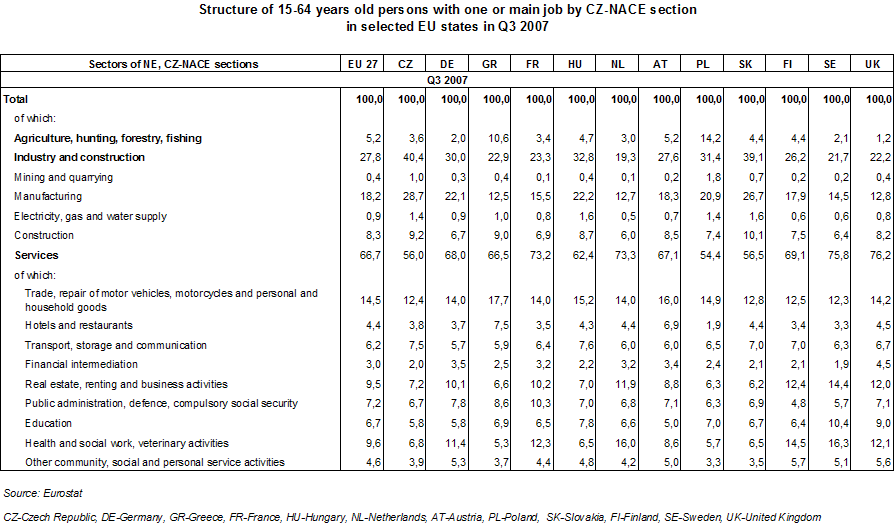
For the Czech economy is typical a high share of secondary sector (industry + construction) employment. This share is the highest among all of the EU27 countries and close to the Czech Republic is only Slovakia. The same holds for ‘manufacturing’ where the share reached 28.7% of total employment in the Czech Republic in Q3 2007. In the Czech Republic, ‘manufacturing’ had by a 10 p.p. higher share in total employment than it had in the EU27 and by over 11 p.p. higher than in the EU15. On the other hand, the Czech Republic’s structure of employment by NACE activity is distinguished by a significantly lower proportion of services than in the EU15 (-14 p.p.) and in the EU27 as well (-11 p.p.). In the CR, lower than average employment proportion is mainly in ‘real estate, renting and business activities’, ‘health and social work’, ‘wholesale and retail trade; repair of motor vehicles, motorcycles and personal and household goods’, ‘financial intermediation’ and ‘education’. The following table shows data on the structure of selected EU states in Q3 2007, for which Eurostat published the latest complete results.
In terms of NACE classification, the differences between EU member states are extraordinarily high. In the Czech Republic, for example, employment in ‘manufacturing’ is four times higher in comparison to employment in ‘health and social work’, but the situation in many countries, especially the northern ones, is quite different. In four countries ‘health and social work’ employed more people than ‘manufacturing’ (Sweden, Denmark, the Netherlands and Luxembourg).
The Czech Republic is among the countries with the highest shares of the self-employed in total employment. In Q3 2007 the percentage of employers and own-account workers (without family workers) in the country reached 15.5% of all first (main) jobholders, while in EU27 it was 14.5% and in EU15 14.1%. Higher percentages were observed only in five Mediterranean states incl. Portugal where, however, individual business in agriculture and tourism-related activities (retail trade, real estate and renting) plays an important role. A high percentage of the self-employed was also recorded in Poland, as a result of a specific situation in the primary sector. Nearly 1.4 million persons working in agriculture, forestry and fishing in Poland were classified as the self-employed or employers (without family workers).
In terms of share of the business sector in employment by sector and CZ-NACE activity, the following is characteristic for the Czech Republic:
– the lowest percentage of the self-employed in the primary sector, together with Slovakia
– the highest percentage of the self-employed in construction, especially of own-account workers, in the EU
– under a relatively low share of persons employed in the tertiary sector in total employment the Czech Republic reports the third highest share of the self-employed in employment in the sphere of services (NACE sections G-Q). This affects mainly the situation in the sections of ‘other community, social and personal service activities’, ‘real estate, renting and business activities’ (both the third highest share of the self-employed in respective employment) and ‘financial intermediation’ (the highest share among the EU member states).
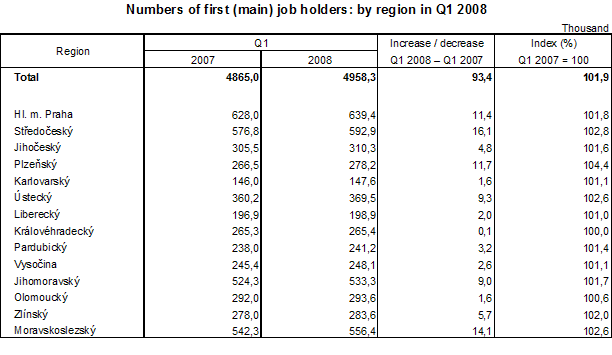
The regional employment in the Czech Republic increased slightly year-on-year in all the regions; the highest increases were recorded in the Středočeský and Moravskoslezský Region. Marked increases were observed also in the Plzeňský, Hl. m. Praha, Ústecký, Jihomoravský and Zlínský Region.
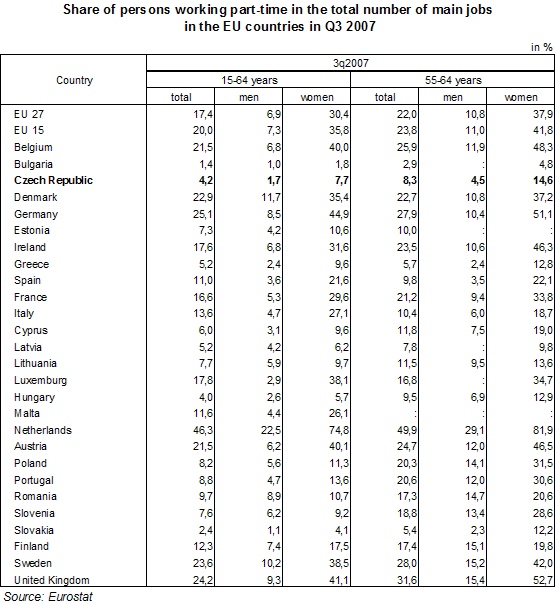
There were 95.1% of persons working full time in their main job in the civil sector of the national economy. Nearly 240.7 thousand persons worked part-time in their main job, most of them were women (179.0 thousand).
The share of persons working full time in their main job is in the Czech Republic the fourth highest among all EU27 member states. Proportion of full-time jobs is higher in Slovakia, Hungary and Bulgaria, the total employment rate is however below the average in all of the three countries. The share of men working full time in the CR was the third highest among the EU27 countries in Q3 2007, women had the fifth highest share.
Especially women appear to have an extraordinary high differentiation of the shares of full-time jobs in employment in individual EU countries. In many countries of the EU15 high number of women uses the opportunity to work part time, particularly in the Netherlands (3/4 of working women aged 15-64 years!) and in the other six countries their share came close or exceeded 40% of the total female employment. The opportunity to work part time is one of the social aspects, which in the long term affects the fertility rate in particular in the Netherlands and in some of the other countries.
The possibility to work part-time creates conditions for increasing retirement age in some countries. This is obvious in Germany, Sweden and the United Kingdom where nearly 30% of all persons aged 55-64 work part-time and in the Netherlands with nearly half of all persons at higher working age. These figures are in contrast with those for the Czech Republic where part-time jobs in the age group 55-64 made up 8.3% in Q3 2007.
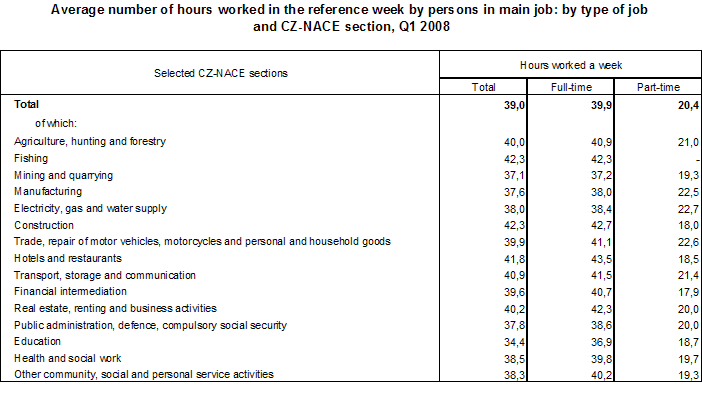
The number of hours actually worked in the reference week reached 39.0 hours, in full-time employment it was 39.9 hours. The differences in working hours of employees are large, both in terms of their professional status and CZ-NACE activity. The self-employed worked 47.0 hours a week on average, full-time employees 38.6 hours and members of producer cooperatives 36.3 hours. In the long term, these differences are apparent both for men and women when generally men work more hours in all of the professional status categories. The most hours in their main job spent employees in construction (42.3 hours), the least employees in education (34.4 hours).
With the growing total employment of the resident population and the economically inactive, the number of the unemployed decreased. The number of unemployed persons (ILO methodology) reached 243.8 thousand on average in Q1 2008, i.e. a fall of 67.5 thousand year-on-year (more than a fifth). The number of the unemployed decreased the most in the age groups 20-24, 40-44 (both by 11.3 thousand); and in the age group 50-54 (by 13.6 thousand). The number of unemployed men (109.3 thousand in total) is still below the number of unemployed women (134.5 thousand). Under the total year-on-year drop in unemployment, male unemployment decreased by 30.1 thousand, and the decrease showed itself in the age groups 20-24, 40-44 and 50-54. Over the same period, female unemployment decreased by 37.3 thousand in total; it dropped in all of the five-year groups of the working age 20-60.
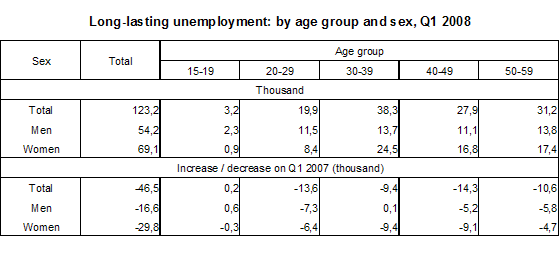
The number of the long-term unemployed (1 year or more) fell by 46.5 thousand in total; the drop occurred in all of the age groups of women and in most five-year age groups of men, the most in the age groups 20-29 and 50-59.
The number of the unemployed with basic education decreased by 8.2% year-on-year to 73.0 thousand, which is connected with a general decrease of the number of Czech residents at working age with the lowest level of education. The number of unemployed persons with secondary education without maturita examination (secondary vocational school graduates in particular) decreased by 31.4% to 101.6 thousand and the number of the unemployed with secondary education with maturita examination decreased by 19.8% to 57.9 thousand. The number of unemployed university graduates dropped by 1.7% to 11.3 thousand and the unemployment of university graduates is still markedly lower when compared to the first three groups.
Unemployment dropped in all of the regions of the country, most in those with high or above-the-average unemployment rates, i.e. in the Ústecký and Moravskoslezský Region, and also in the Jihomoravský Region.
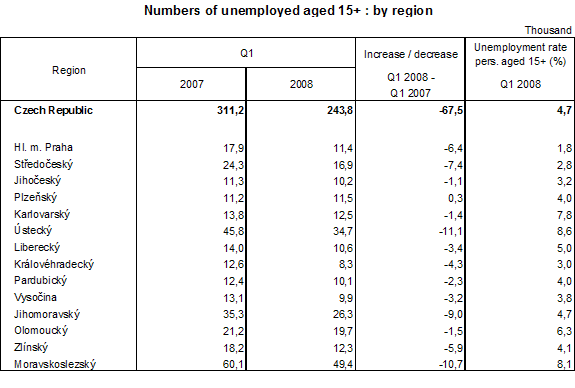
The growth of total employment and the decrease in the number of the unemployed resulted in a relatively high decrease of general unemployment rate of persons aged 15-64 (ILO). In comparison to Q1 2007, the general unemployment rate decreased by 1.3 percentage points to 4.7%. It decreased mainly among the female population (by 1.6 p.p. to 6.0%); the decrease among the male population was 1.2 percentage points to 3.7%.
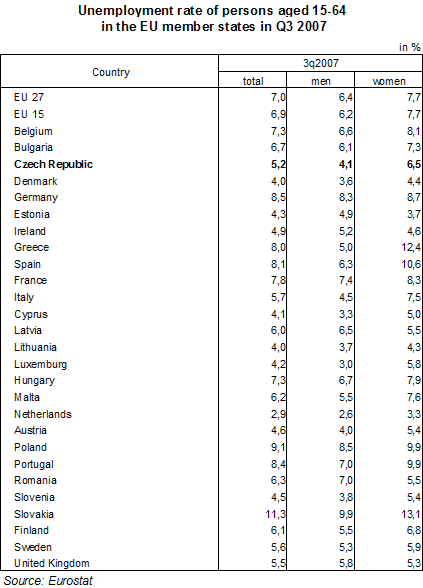
According to the latest data released by Eurostat for Q3 2007, the general unemployment rate in the Czech Republic was markedly lower than in the EU27; besides the relatively low male unemployment rate, also the female unemployment rate in the CR was below the EU27 average. The big decrease of unemployment in the Czech Republic resulted in favourable comparison with the EU27 and the EU15 alike when in Q3 2007 the unemployment rate in the CR was lower than the EU15 average by 1.7 percentage points.
In comparison to the neighbour states, the rate of unemployment in the CR is higher than in Austria but markedly lower than in Slovakia where it remains the highest across the European Union. Also Poland reports markedly higher unemployment, although it decreased most rapidly among all EU member states. Unemployment rate in the CR is noticeably lower also in comparison with Germany mainly due to an unfavourable situation in the long run in the new federal states.
In terms of international comparison, an unfavourable aspect of unemployment in the Czech Republic is persistent high percentage of the long-term unemployed. The proportion of persons out of employment for one year and more in the total number of the unemployed was the fifth highest among all the EU countries in Q3 2007 (50.6% in the CR in comparison to 42.2% in the EU27 and 39.7% in the EU15). The highest proportions of the long-term unemployed were observed, besides Bulgaria and Greece, in neighbouring Germany and especially Slovakia where it reached over 70% of all unemployed persons.
The high percentage of long-term unemployment in the above countries represents a chronic problem relating not only the elderly unemployed; in the young and middle age group 25-49 the proportion of long-term unemployed persons was the highest in the EU. We should note, however, that in the Czech Republic and Slovakia the share of the long-term unemployed in total employment markedly decreased year-on-year.
The number of economically inactive persons aged 15+ (according to the LFSS methodology they are persons who had no job and were not seeking a job during last four weeks or did not meet all conditions for being classified among the unemployed) increased by 74.5 thousand year-on-year and reached 3 710.7 thousand in Q1 2008. This category is primarily affected by numbers of the retired and of persons in schooling or training for their future occupation. The number of basic school pupils stagnated and the number of secondary school pupils including vocational school pupils decreased by 5.4 thousand to 525.8 thousand. The number of university students including higher professional school students grew rapidly by 40.5 thousand to 315.6 thousand. The number of economically inactive normally retired persons not actively seeking job reached 1 923.7 thousand, the number of persons in early retirement 43.2 thousand and the number of disability pensioners 264.3 thousand. These figures cannot accurately correspond to the numbers of pupils and students according to the statistics of the Ministry of Education, Youth and Sports of the CR or to the numbers of pensioners on the records of the Ministry of Labour and Social Affairs of the CR because the pupils, students or pensioners who fulfilled the criterion of being classified among persons in employment or unemployed persons in the reference week are not recorded as economically inactive.
_____________
1 Note: When assessing the distribution of persons in employment by NACE activity, we should take into account methodology of the sample survey which takes place in households only and not in collective accommodation establishments. The data on numbers of employed persons from the LFSS are then statistically corrected to harmonise with data on employment of foreigners in a given NACE activity. According to available data from the Ministry of Labour and Social Affairs and Ministry of Industry and Trade, the numbers of foreigners working in ‘manufacturing’, ‘construction’, ‘wholesale and retail trade; repair of motor vehicles, motorcycles and personal and household goods’, ‘real estate, renting and business activities’ increase rapidly; an overwhelming majority of these foreigners do not live in households.