
Commentary on the development of average wages of employees - 4. quarter of 2005
Product Code: e-3134-05
Analysis of the development of average wages of employees
In Q4 2005, the average gross monthly nominal wage per actual person reached CZK 20 841 and its year-on-year increase amounted to CZK 951. In the business sphere the average wage increased by CZK 962 to CZK 20 646, while in the non-business sphere it went up by CZK 922 to CZK 21 499. The relative increase of the average wage was 4.8%, the growth in the business sphere being 4.9% and in the non-business sphere 4.5%. In the same period, consumer prices went up by 2.4% and the real wage thus rose by 2.3% in total, in the business sphere by 2.4% and in the non-business sphere by 2.1%.
In comparison to the previous quarters of 2005 the relative growth (+4.8%) was the lowest in the whole year (Q1 +5.8%, Q2 + 5.3%, Q3 +6.2%). The last quarter of 2005 thus belongs with its relative growth of average wage to the historically lowest since the formation of the Czech Republic (1993), lower being only in Q2 2004.
Nationwide wage development is heavily shaped by the business sphere as employees of this sphere account for more than three quarters of the set of units under observation. While the wage development in the business sphere is rather fluent and affected by economic results of the companies, it is jump-like in nature in the non-business sphere because it depends to a large extent on legislative measures of the government and on what is permitted by the budget.
In previous years, wage differences between the business and non-business spheres usually became wider always in Q1 and Q3 of a given year - that is to say the average wage in the business sphere was higher than in the non-business one. In Q2 and Q4, the average wage levels then mostly converged, owing to half or a certain part of the additional salary regularly paid in the non-business sphere. In some periods the wage level in the non-business sphere even exceeded the one in the business sphere.
Since the beginning of 2005, the wage development has been influenced by adjustments to salaries and wages of employees in public services and administration. Apart from the normal year-on-year rise in average salaries, salaries in selected professions rose in a differentiated way. The Government Regulation No. 637/2004, Coll. extended the circle of employees whose wage rates are provided according to the scale of increased wage rates (e.g. employees providing social care directly, employees in charge of administrative social care services, employees engaged in work on roads, collection and processing of municipal waste, etc). Furthermore, a new scale of increased wage rates was put in place for employees – members of the Police of the CR, the Prison Service of the CR, the Fire and Rescue Service of the CR, and the Customs Administration of the CR. On 1 January 2005, the payment of the additional salaries was cancelled in the non-business sphere. These latest wage adjustments in particular helped suppress rather large differences in the wage levels between individual quarters in the non-business sphere. The wage development in this sphere therefore becomes smoother, with possible jumps caused to happen in response to legislative measures only. The described development of the nominal wage is shown in columns in Graph 1.
The relative growth of the average wage always depends on the level of the wage in the observed period and also on the base, which is used for comparisons (in our case the comparison to the same period of the previous year). The business sphere shows quite a uniform growth in all quarters of 2005 (Q1 +5.0%, Q2 +5.3%, Q3 +5.5% and Q4 +4.9%). In the non-business sphere, however, the growth in 2005 was a little unsteady (Q1 +8.9%, Q2 +5.5%, Q3 +8.6% and Q4 +4.5%). This is due to the fact that the 2005 year’s wage level was affected by the above-mentioned wage adjustments, whereas the base of Q2 and Q4 2004 was affected by the payment of part of an additional salary (10%, 25% respectively). It is possible to expect that the relative growth in this sphere, as in the nominal wage, will be smoother in 2006.
Graph 1
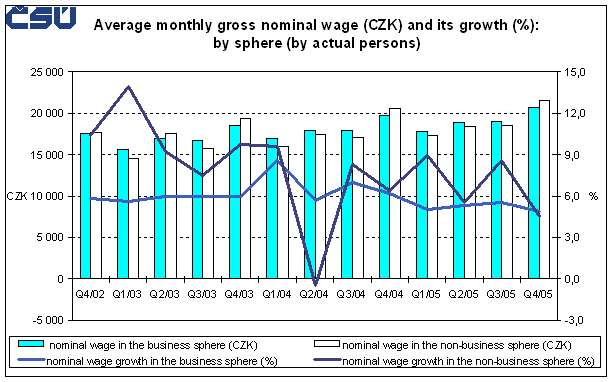
In 2005, the average wage (per actual person) reached CZK 19 030 and its year-on-year growth was 5.5% (CZK 995). The mentioned wage growth was the lowest since 1993. The average wage of employees in enterprises rose by 5.2% (CZK 937) to CZK 19 053. In the non-business sphere it increased by CZK 1 192 (+6.7%) to CZK 18 954.
The development of the real wage is affected apart from the wage growth also by the index of consumer prices – inflation, which acts as a slowing down factor of the real wage growth. Therefore, it is possible that during a period with a high relative growth of the nominal wage the rise of the real wage is low and vice versa. Data provided below suggests that with a decreasing development of the nominal wage growth and with the concurrence of price development the dynamics of the real wage growth is almost the same.
In 2005, consumer prices increased by 1.9%, the real wage thus rose in total by 3.5%. Thus, the real wage growth became the lowest in the last 5 years. While in 2004 the growth of the nominal wage was by 1.1 percentage points higher (+6.6%), the real wage growth was only by 0.2 percentage points higher than in 2005. In the business sphere the real wage grew by 3.2% in 2005, which is the least since 1999. In the non-business sphere the real wage grew by 4.7%, in 2004 it rose by 2.8%.
Given the fact that the non-business sphere employs a higher proportion of part-time workers than the business one, the following comparisons are made with average wage data related to full-time equivalent (FTE) employees as these data take account of the length of work.
In Q4 2005, the average wage per FTE person increased by CZK 1 004 year-on-year (+4.9%) to reach CZK 21 504, rising to CZK 21 136 (+4.9%, CZK 984) in the business sphere and CZK 22 795 (+5.1%, CZK 1 097) in the non-business sphere. The real wage increased by 2.4% in total, in the business sphere by 2.4% and by 2.6% in the non-business sphere.
In 2005, the nominal wage amounted to CZK 19 631, which is by 5.6% more year-on-year. The business sphere saw its average wage grow by 5.2% to CZK 19 511, the non-business sphere by 7.2% to CZK 20 055.The year-on-year growth of the real wage by 3.6% is based on the growth in the business sphere by 3.2% and in the non-business sphere by 5.2%.
Differences in the wage level and in its growth rate between industries (CZ-NACE sections) are well characterized by Graph 2. The graph suggests that the lowest wage level in 2005 existed in ‘hotels and restaurants’, ‘agriculture, hunting and forestry’ and ‘fishing’. The other end of the scale included ‘financial intermediation’, ‘electricity, gas and water supply’ and ‘real estate, renting and business activities’. It is also apparent that two of the three industries with the lowest wage (‘hotels and restaurants’ and ‘fishing’) had the lowest wage growth.
Graph 2
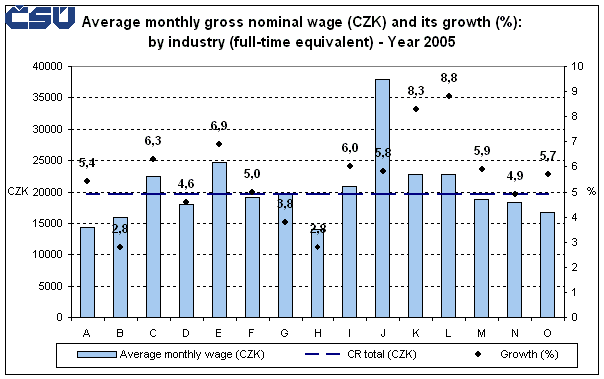
| A | Agriculture, hunting and forestry | B | Fishing |
| C | Mining and quarrying | D | Manufacturing |
| E | Electricity, gas and water supply | F | Construction |
| G | Wholesale and retail trade; repair of motor vehicles, motorcycles and personal and household goods | H | Hotels and restaurants |
| I | Transport, storage and communications | J | Financial intermediation |
| K | Real estate; renting and business activities | L | Public administration and defence; compulsory social security |
| M | Education | N | Health and social work |
| O | Other community, social and personal service activities |  | |
– manufacture of wearing apparel; dressing and dyeing of fur: CZK 10 762 (the average wage in this industry was CZK 8 869 down on the national average, the nominal or relative year-on-year rise being CZK +201 or +1.9 %, respectively);
– manufacture of textiles and textile products: CZK 13 140 (CZK –6 491, CZK +507 or +4.0%);
– hotels and restaurants: CZK 13 962 (CZK –5 669, CZK +378 or +2.8%).
On the other hand, the following were three industries (with the same criterion in force) paying the highest average nominal wage per FTE person:
– computer and related services: CZK 43 490 (the average wage in this industry was CZK +23 859 up on the national average, the nominal or relative year-on-year rise being CZK +2 640 or +6.5%, respectively);
– financial intermediation except for insurance and pension funding: CZK 40 035 (CZK +20 404, CZK +2 266 or +6.0%);
– electricity, gas, steam and hot water supply: CZK 27 263 (CZK + 7 632, CZK +2 072 or +8.2%).
The order in both ends of the ranking according to the level of the average wage basically did not change during the year. The above-mentioned comparisons suggest that earnings of employees in the industry with the highest wage rose 3 times faster year-on-year in 2005 and that the average wage of these employees was about 4 times higher than the average wage of employees in the industry paying the lowest wage. In 2005 inter-industry wage differences became wider compared to 2004; the variation coefficient of average wages (by CZ-NACE division) was 1.7 percentage points up and reached 34.6%.
Publishing, printing and reproduction of recorded media was the industry with the lowest growth or drop of real wage among industries employing at least 20 thousand people - the year-on-year drop in real wage was 0.4%. The average nominal wage in this industry increased year-on-year by 1.5%; it reached CZK 21 353 and was CZK 1 722 above the national average.
On the contrary, the industry (rather significant in terms of employment) with the highest achieved growth of real wage was public administration and defence; compulsory social security – increase by 6.7%. The average nominal wage in this industry recorded a year-on-year growth of 8.8%; it reached CZK 22 714, which is CZK 3 083 above the national average.
The comparison of the wage development made for sectors suggests that the highest average wages have been paid for a long time in financial institutions, insurance companies and pension funds. The 2005 average wage per FTE persons in the financial institutions climbed up to 2 times as much as the national average, and the insurance companies and pension funds paid wages about 1.7 times the national average. In contrast, wages of employees in the sector of households (i.e. wages of unincorporated natural persons) do not even reach two thirds of the national average. In the sector of non-profit institutions serving households wages are about three quarters of the average wage in the whole of the CR. The average wage level, though, is fundamentally affected by the non-financial corporations sector and the government sector. Employees of these sectors make up about 95% of the set of units measured.
__________________
1 The data refer to business sphere enterprises with 20+ employees (in financial intermediation irrespective of the number of employees) and all non-business sphere organizations. They only refer to employees under employment contract with reporting units. Persons performing public office, such as members of Parliament, senators, full-time councillors at all levels, judges, etc. are excluded.