Analysis of the development of construction - 4. quarter of 2004
Publication Date: 11. 02. 2005
Product Code: e-8216-04
Development of the construction in the year 2004: analysis
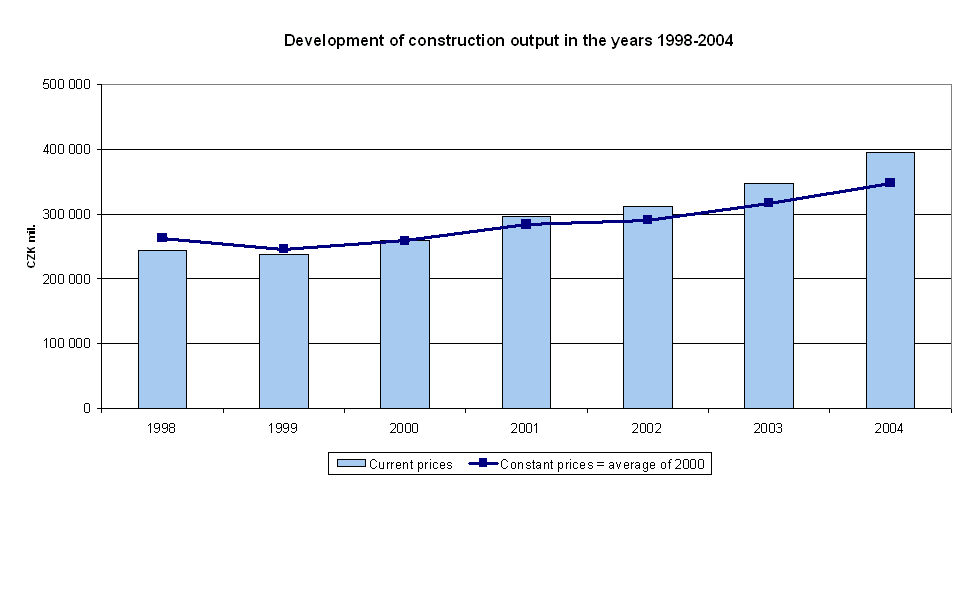
In the year 2004, the construction recorded a growth, different in the individual quarters of the year. The construction output increased 9.7% year-on-year in real terms, most since 1993 (+16.1% in Q1, +16.5% in Q2, +4.5% only in Q3, and +5.0% on Q4).
The growth of construction output was affected by:
- the concentration of work on large civil engineering and building constructions of (by-passes of large towns, railway corridors, Metro and a tram line in Prague, trade and cultural centres);
- the development and implementation of other significant developers’ construction projects, especially of foreign investors; and
- the development of housing construction considerably fostered by the expansion of mortgage-credit and saving-in-building-society markets and by the development of interest rates. The number of granted mortgage credits increased by 30% compared to the year 2003 and the contractual principal increased by 43%.
The construction output had been steadily increasing since June 2003, mostly by a two-digit growth rate, and its growth culminated in April when an unprecedented and unrepeatable rise of more than 60% was recorded. The enterprises had adjusted their invoicing so that they could use, for the last month, the low, 5% taxation and meet the terms and conditions of the contracts they had signed before. This was confirmed by the data reported in May and June in particular (decreases of almost 4%). The data for March and July were also affected, but to a lesser extent. August and September results show that the effect of the change in the VA rate has already faded out and that reported data correspond again to the work actually done.
When assessing the 2004 development in the construction we faced the problem of how to present these non-standard results to the public. The CZSO have reported data affected by the above-mentioned change, but the data obviously do not show the actual development of the volume of construction work. Consequently, the CZSO developed a model calculation which showed how that development would have looked like, if it had not been for the change in the VA rate (see the box below).
Structure of the construction output
A basic characteristic of the construction market structure is a large proportion of production for investments (almost three quarters), i.e. goods with long life, in many cases over 100 years.
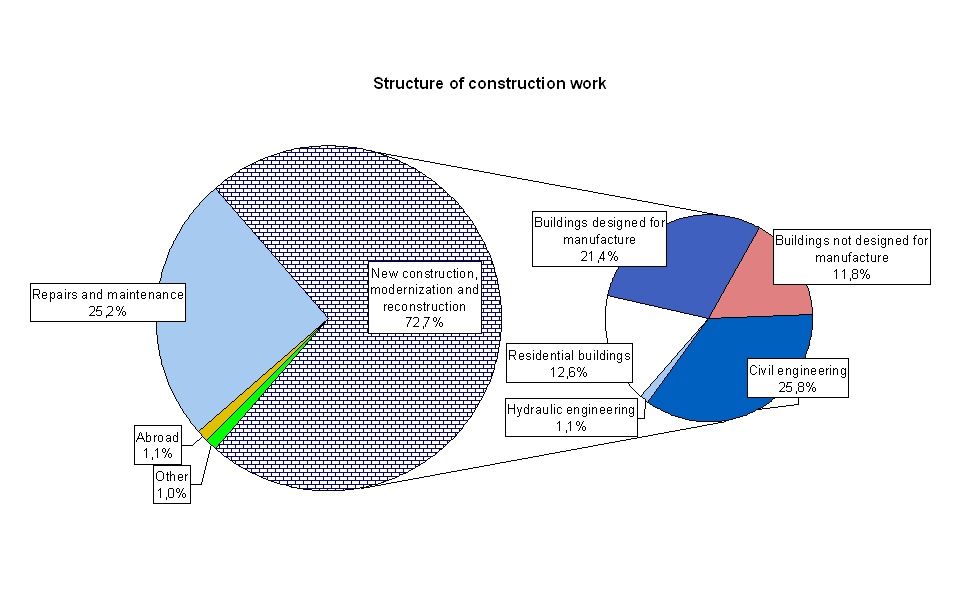
New construction, including reconstruction and modernization of investment nature, made up over 72.7% of total output. It is divided into:
- residential buildings – 12.6% (blocks of flats, family houses, extensions thereof)
- buildings designed for manufacture – 21.4% (factory halls, buildings for agriculture, trade and transport)
- buildings not designed for manufacture – 11.8% (business centres, school and health service buildings, office blocks)
- civil engineering works – 25.8% (roads, motorways, bridges , tunnels)
- hydraulic engineering works – 1.1% (dams, weirs, reservoirs on watercourses, locks).
In the European context, the CR’s structure of construction output shows the following deviations:
- a low proportion of housing construction (which gradually increases, though)
- a low proportion of repair and maintenance
- a high proportion of civil engineering.
Repair and maintenance accounted for 25.2% of total output, other work and work abroad accounted for 1.0% and 1.1%, respectively.
| BOX Simulation of the impact of the change in the VA rate on the development of construction output: March to July 2004 |
| I n connection with the accession of the CR to the EU, the Value Added Act was also amended. The amendment raised the VA basic rate of from 5% to 19% for a selected range of products and services, which also applied to construction work (except for housing construction here the lower rate is in force by 31 December 2007). The change affected the reported data on construction output heavily. Owing to the fact that labour productivity indicators have relatively regular behaviour and an upward trend, the impact of the VA rate change can be estimated by means of a labour productivity forecast. We focused on labour productivity per employee (construction work S divided by the number of employees) and per hour (construction work S divided by the number of hours worked), but in the end we decided to use labour productivity derived from hours worked by manual workers, as it has a higher explanatory power. The Winters-Holt multiplicative method turned out to be most appropriate to forecast labour productivity indicators. Using productivity estimates we got a model value of construction work S for enterprises with 20+ employees. The value was raised by a standard procedure to include an estimate for small enterprises. All at current prises. A total deflator of construction work was applied for deflation and a forecast of seasonal component was used for seasonal adjustment. It turned out that the data for March, which was affected by the VA rate change to a small extent, would have to be simulated, too. From August on, the simulated values became almost equal to the reported ones, and, therefore, the simulation could be terminated. 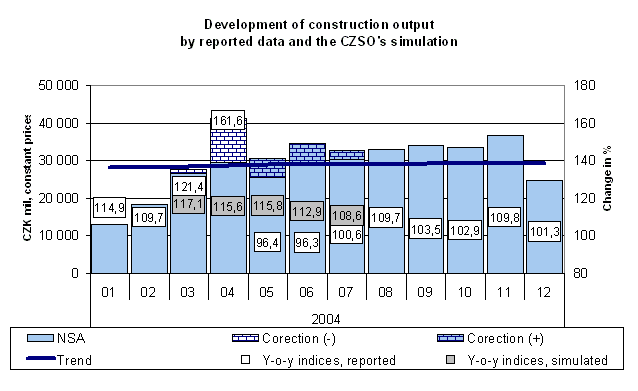 |
Volume of construction output
Construction work carried out in the year 2004 was worth CZK 394 505 million. The construction output of small enterprises (under 20 employees) amounted to roughly a third of the total volume of construction work (estimated by the CZSO). The key enterprise base of the construction embraced 2 404 enterprises with 20+ employees and these carried out construction work worth CZK 278 207 million – an increase of 8.9% CZK 278 207 million year-on-year.
| Enterprises with 20+ employees | 2004 | Index* |
| Construction work of contractors and subcontractors, total; CZK millions, current prices | 278 207 | 108.9 |
| In the CR | 274 070 | 108.4 |
| New construction, reconstruction, modernization | 234 697 | 110.0 |
| Building | 143 441 | 110.4 |
| Civil engineering | 91 256 | 109.3 |
| Repair and maintenance | 36 087 | 98.7 |
| Building | 19 133 | 103.2 |
| Civil engineering | 16 954 | 94.0 |
| Other work | 3 286 | 118.0 |
| Abroad | 4 137 | 149.8 |
Seen from the angle of the size structure of enterprises, the largest increase in the construction work occurred in enterprises with 20-49 employees (+12.1%), followed by enterprises with 100-249 employees (+11.5%) and enterprises with 500+ employees (+9.0%).
Growth and the structure of construction work in the year 2004: by size of enterprise
Size of enterprises by number of employees | Structure by volume of construction work, % | Index, % |
| Total | 100.0 | 109.7 |
Small enterprises 0 - 19 20 - 49 | 44.2 29.4 14.8 | 111.6 111.4 112.1 |
Medium-sized enterprises 50 - 99 100 - 249 | 24.8 11.9 12.9 | 108.1 104.7 111.5 |
Large enterprises 250 - 499 500+ | 31.0 6.5 24.5 | 108.1 104.9 109.0 |
Labour productivity
Labour productivity in small enterprises, measured by the volume of construction work per employee, increased by 5.3% year-on-year. The greatest rise in labour productivity was observed in enterprises employing 200-249 people (+18.3%), while the lowest (+4.3%) in enterprises with 100-199 employees. Enterprises with 50-99 employees were the only that recorded a decrease (-0.6%).
Employment
Total employment in the construction increased in Q4 2004 by 2.9% (as established by the LFSS). The number of employees rose, too, but the number of the self-employed fell down slightly. Of the 2.9%, the employment in construction enterprises with 20+ employees increased by 3.4%. Over the year 2004, the number of employees went up to 158 thousand, of which manual workers involved in construction work accounted for 104 thousand. Broken down by region of the enterprise’s head office, the number of employees increased in the CR’s all regions, but most in the Plzeňský and Jihočeský Regions (+8.9% and 7.4%, respectively) and least in Prague (+1.7%) and the Vysočina Region (1.8%).
Wages
In the year 2004, the average monthly wage of employees in construction enterprises with 20+ employed people grew to CZK 18 125 (+6.2%) and that of manual workers in the construction to 14 842 (+5.6%). Its highest rises occurred in the Liberecký Region (+7.3%) and Prague and the Ústecký Region (+6.8% each), while the lowest were observed in the Moravskoslezký, Pardubický and Vysočina Regions (+5.0%, +5.8% and 5.9%, respectively).
Building permits
The planning and building authorities granted 153 622 building permits in the year 2004, by 2.9% up on the year 2003. The permits were worth about CZK 315.1 billion, which was by 10.1% more than in the year 2003.
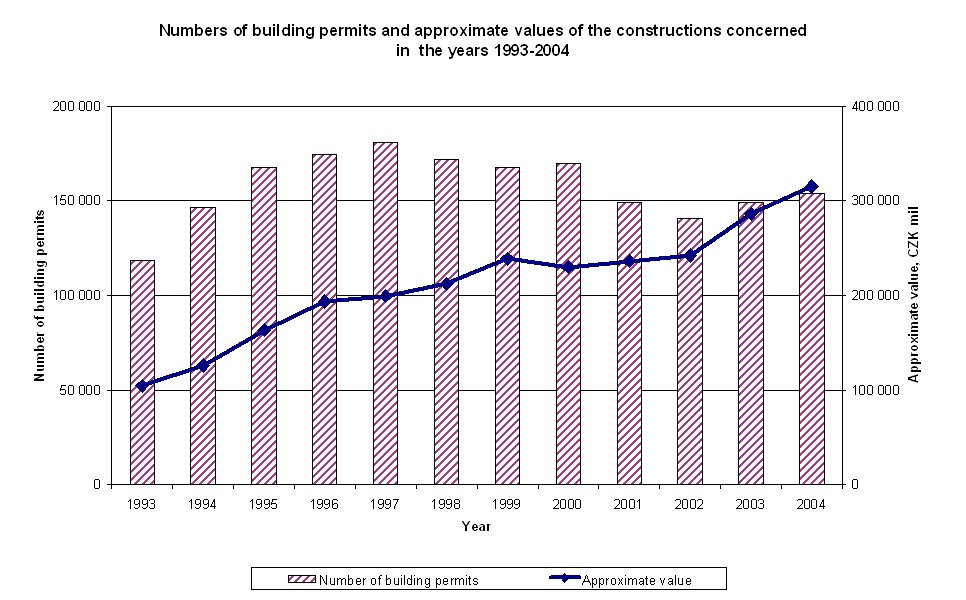
The higher volumes of the approximate values for non-residential buildings were due to the permits granted for large transport infrastructure constructions and business and cultural centres.
Twenty projects permitted for construction were worth over about CZK 1 billion each (mostly transport infrastructure constructions).
Growth and the structure of building permits in the year 2004
Number | Y-o-y index, % | Approximate value | ||
CZK million | Y-o-y index, % | |||
| Residential buildings | 51 464 | 99.1 | 94 592 | 109.9 |
| Non-residential buildings | 29 439 | 103.7 | 99 430 | 102.7 |
| Environmental constructions | 36 065 | 99.0 | 25 002 | 96.1 |
| Other constructions | 36 654 | 112.5 | 96 048 | 124.2 |
Housing construction
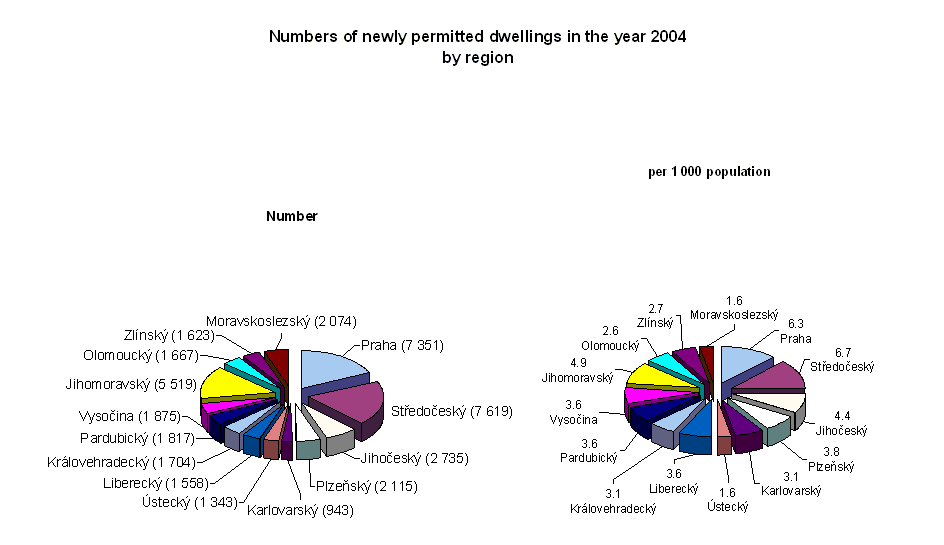
There were 39 944 dwellings permitted for construction by the planning and building offices in the year 2004, which is by 2.6% up year-on-year and most since 1993. New construction should provide 31 067 dwellings (+4.0%), primarily in residential buildings (30 618 dwellings). A total of 8 877 new dwellings should be obtained through renewals and enhancements (-2.1%). Of the total newly permitted dwellings, 37 186 will be built in residential buildings (+444 dwellings). The number of newly permitted dwellings in non-residential buildings is on a considerable increase (+570), renewals and enhancements being the methods particularly applied here. They include, e.g., dwellings in polyfunctional buildings, conversion of barracks, manufacturing capacities, etc. into dwellings.
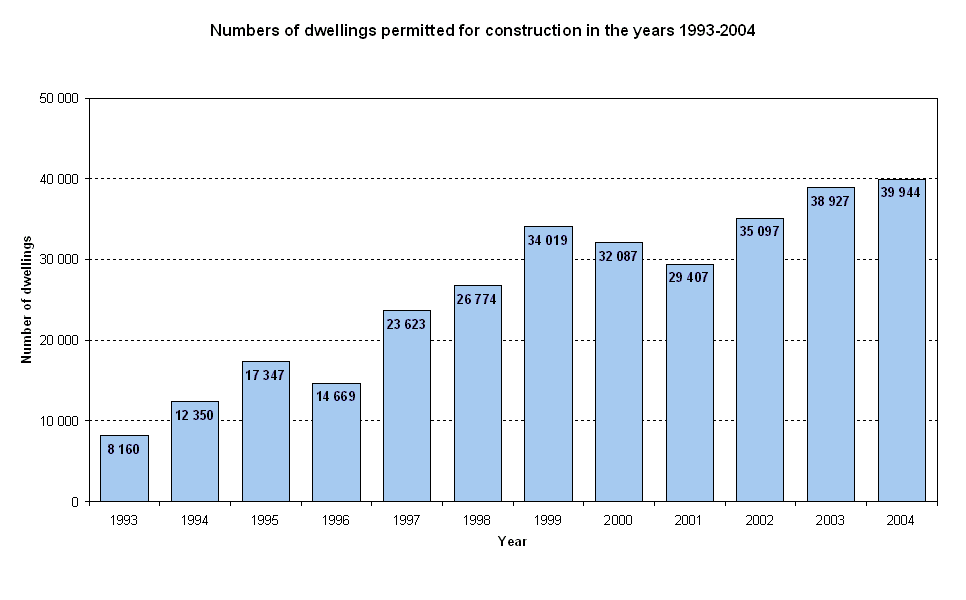
The approximate value of newly permitted dwellings in residential buildings reached CZK 77.0 billion, 10% up on the year 2003. The average acquisition value of a new dwelling in a new residential building thus amounts to CZK 2.3 million, as against CZK 1.2 million for a new dwelling obtained through renewal or enhancement.
Territorially and in the long run, most dwellings have been built in the surroundings of large towns, esp ecially around Prague and in the Středočeský Region. In the year 2004, the construction of 14 970 new dwellings was commenced in these localities. The fewest dwellings will be erected in the Karlovarský Region (943) or, if related to the number of inhabitants, in the Ústecký and Moravskoslezský Regions.