
Analysis of the development of average wages of employees - Second part of 2008
Product Code: e-3134-08
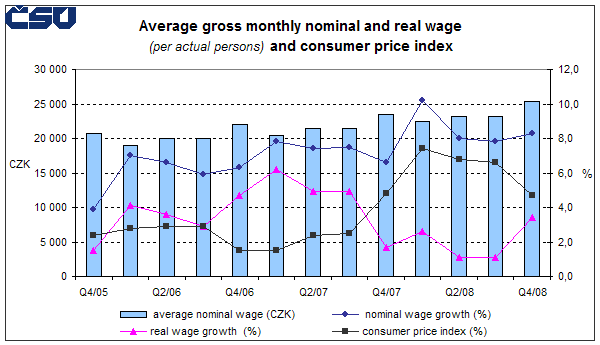
In Q4 2008 the nominal average gross monthly wage 2 per actual person reached CZK 25,381 and in the year-on-year comparison the increase was CZK 1,946. In the business sphere the average wage increased, y-o-y, by CZK 2,051 to CZK 25,536, in the non-business sphere by CZK 1,580 to CZK 24,839.
Results for Q4 2008 confirmed the trend of relatively big growth of wages beginning already in 2007 and culminating in Q1 2008 when the average wage increase was 10.2%, y-o-y. In Q2 and Q3 the growth rate gradually slowed down to 8.0% and 7.8%, respectively, and in the last quarter of 2008 a 8.3% growth was recorded. In contrast to the previous quarters, the average wage values and increases in the business and non-business sphere came closer. In the business sphere wages rose y-o-y by 8.7%, in the non-business sphere by 6.8%.
The real wage growth is, in addition to the nominal wage growth, affected also by the growth of price level (inflation) expressed by the consumer price index. In 2008 inflation hit its high in Q1 (7.4%) while in Q2 and Q3 it decreased gradually (6.8% and 6.6%, respectively) down to 4.7% in Q4. The real wage in total increased in Q4 by 3.4%, y-o-y; in the business sphere it rose by 3.8% and in the non-business sphere by 2.0%, which was the first increase of the real wage over the whole year. Actually, in the previous quarters of 2008 the real wage increase in the non-business sphere fell into negative values.
For the development of nominal wage, real wage and consumer price index see Graph 1, more detailed information on /produkty/pmz_cr.
Graph 1
Minimum wage accounts for CZK 8,000 showing no changes from January 2007.
Nationwide wage development is shaped mainly by the business sphere since their employees make more than three quarters of the set of units measured. While the wage development in the business sphere is more fluent and is affected mainly by economic results of the companies, it is jump-like in nature in the non-business sphere. Since 2005, the payment of so-called other salaries was cancelled in the non-business sphere. Thereby, marked differences in the wage level between individual quarters were suppressed and the wage development started to be smoother and wage levels and its growth rate in both spheres were more balanced. In Q1 2008 differences between both spheres became more obvious again when average wages in the non-business sphere started to fall behind the wages in the business sphere showing a relatively marked disparity. The trend continued also in the next two quarters of 2008 although a moderate mitigation of differences became obvious. Due to bigger wage growth in the non-business sphere the wage levels between both spheres came closer and so did the rate of their y-o-y increments. The nominal wage development and relative increments by spheres are shown in Graph 2.
Graph 2
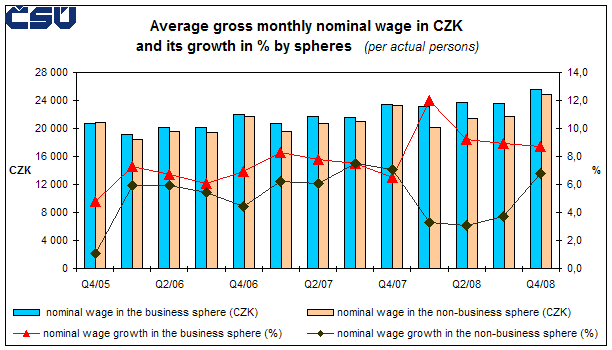
In Q1-Q4 2008 the nominal average gross monthly wage reached CZK 23,542, which was by CZK 1,848 more, year-on-year. The relative increase was 8.5%, y-o-y, which was the biggest growth since 2001. It was pulled up by the business sphere (growth by 9.6%) and, in contrast, slightly slowed down by the non-business sphere (+4.4%). In the business sphere the average wage increased, y-o-y, by CZK 2,105 to CZK 23,961, in the non-business sphere by CZK 919 to CZK 22,037.
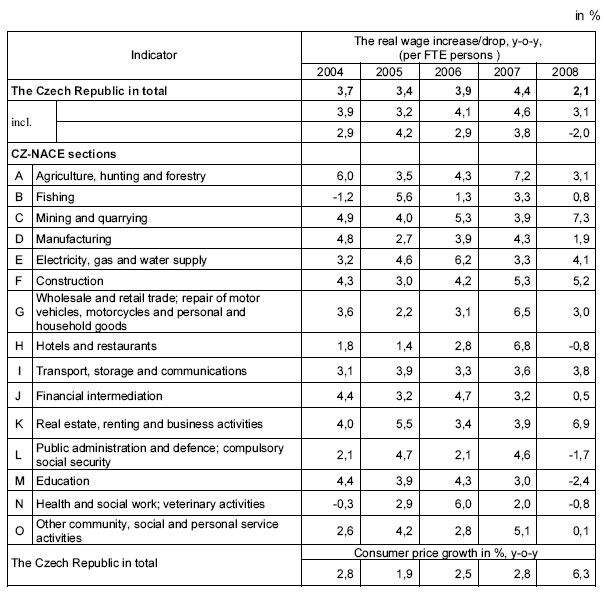
Given the fact that the consumer prices in 2008 increased by 6.3%, relatively important part of the wage growth was depreciated by growing prices. Despite a big wage growth the real wage increased by only 2.1%, which is the lowest value for the last 10 years. Worse results was last seen by the end of the 1990´s when, on one side, strongly accelerating wage spiral dragged the inflation into upward spiral, on the other side. Over the whole 2008 the real wage grew by 3.1% in the business sphere while in the non-business sphere it showed a 1.8% drop.
* * *
Given the fact, that the non-business sphere employs a higher proportion of part-time workers than the business one, the following comparisons are made with the average wage data related to full-time equivalent (FTE) employees as these data take account of the length of work.
In Q4 2008, the average nominal gross monthly wage per FTE persons increased, y-o-y, by CZK 1,981 (+8.2%) and reached CZK 26,188. In the business sphere the increase was CZK 2,082 (+8.6%) rising to CZK 26,152 and in the non-business sphere to CZK 26,317 (+6.5%, CZK 1,610). The real wage increased, y-o-y, by 3.3% in total, in the business sphere by 3.7%. In the non-business sphere, as opposed to the previous three quarters, the real wage increased by 1.7% due to bigger wage growth and lower inflation.
Over the whole year 2008 the average nominal gross monthly wage per FTE persons reached CZK 24,282, which is by 8.5% more, in the year-on-year comparison. In the business sphere the wage increased by 9.6% to reach CZK 24,536 and in the non-business sphere by 4.2%, to reach CZK 23,337. While in the business sphere it was the biggest growth – a figure not seen since 1998, in the non-business sphere the growth showed the smallest figures since 2000. The real wage increased by 2.1% in total, in the business sphere by 3.1% while in the non-business sphere it dropped by 2.0%.
Differences in the wage level and in its growth rate between industries (CZ-NACE sections) are characterized in Graph 3.
Graph 3
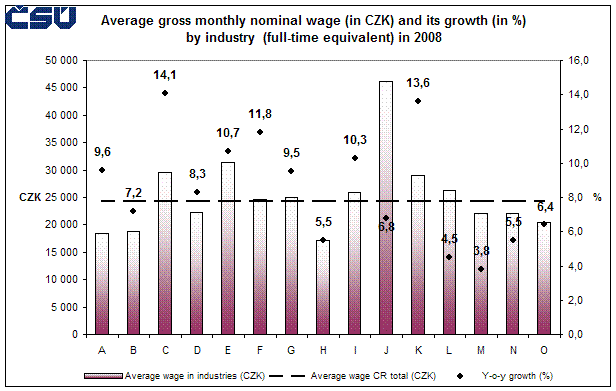
| A | Agriculture, hunting and forestry | B | Fishing |
| C | Mining and quarrying | D | Manufacturing |
| E | Electricity, gas and water supply | F | Construction |
| G | Wholesale and retail trade; repair of motor vehicles, motorcycles and personal and household goods | H | Hotels and restaurants |
| I | Transport, storage and communications | J | Financial intermediation |
| K | Real estate, renting and business activities | L | Public administration and defence; compulsory social security |
| M | Education | N | Health and social work; veterinary activities |
| O | Other community, social and personal service activities |
The y-o-y increases/drops of the real wage broken by industries (CZ-NACE sections) are shown in the following table.
When comparing divisions more important from the aspect of employment (employing a minimum of 20 thousand persons 3 ) the comparison at the CZ NACE divisions (more detailed classification on a two digit code) suggests that at both ends of imaginative ladder there are in individual reference periods the same industries with more or less stable ranking.
Over the last five years the highest nominal average wage was recorded in 'computer and related activities' (CZK 51,750 in 2008). Other industries where employees receive best wages are the following: 'financial intermediation except insurance and pension funding' (CZK 47,293) and 'electricity, gas, steam and hot water supply'' (CZK 36,273). The most dynamic average wage growth in these three industries was reported for 'electricity, gas, steam and hot water supply' rising by almost 45%, i.e. by approximately CZK 11 thousand since 2004. Just at this end of the ladder the ranking showed no changes over the whole 5 years.
When comparing divisions irrespective of the number of employees the lowest average nominal wage was observed over the last 5 years most often in 'manufacture of wearing apparel; dressing and dyeing of fur' (in 2004-2006). In the next two years the division 'textiles and textile products' moved from the last but one place to the last one. The reason was not that the employees of the previously mentioned division would earn more (wages remain the lowest in absolute sum) but the annual drops in the number of employees caused that this division does not belong to more important ones in terms of size.
Over the whole five year period the last three places of the ladder were alternatively occupied, besides two above mentioned divisions, also by: 'agriculture, forestry and related service activities'; 'hotels and restaurants' and in the last years also by the 'manufacture of furniture and manufacturing n.e.c.'. The lowest average wage in 2008 was recorded in 'manufacture of textiles and textile products' amounting to CZK 16,146. Compared with 2004 it grew by almost 30% but in absolute sum by only CZK 3,500. For the purpose of comparison: total wage increased over the last 5 years also by approximately 30%, however, in absolute sum, it was by more than CZK 5,500.
When comparing divisions irrespective of the number of employees 3 the highest nominal wage in 2008 (in air transport – CZK 70,998) was 5.6times higher the lowest nominal wage (in 'manufacture of wearing apparel; dressing and dyeing of fur' – CZK 12,703). The y-o-y growth of the average wage in the division where employees earn best wages was 23.4%, in the division with the lowest wages 6.8%, in absolute sums by CZK 13,500 and about only CZK 800, respectively. It means that the average wage in the division with the lowest wages does not even reach the level of the y-o-y wage increase in the division where employees earn the biggest wages.
The inter industry wage differences (per FTE persons) increased relatively markedly year-on-year, the variation coefficient of average wages ( by CZ NACE divisions) was 3.7 percentage point up reaching 39.1 %. Big difference between individual industries was recorded mainly in Q2 and Q4 when the variation coefficient increased by 5.5 percentage points y-o-y, in Q3 by 5.0 p.p., only in Q1 the difference was not so significant, with the variation coefficient rising by 1.5 p.p.
In 2008, the average nominal wage in enterprises and organisations employing 250+ employees reached CZK 25,825 (per FTE persons), in enterprises with 1000+ employees it reached CZK 27,227. In enterprises with 50-249 employees the average wage accounted for CZK 23,047, in enterprises with 20-49 employees CZK 22,537. It should be noted again that all the above mentioned statistical data refer to a set of reporting units which does not include enterprises with less than 20 employees, financial institutions and organisations of non-business sphere irrespective of the number of employees. In relative terms, in bigger enterprises employees earn more than in smaller enterprises.
The average monthly wage both in private and public 4 sector moderately exceeded CZK 24,000. However, in private businesses the wages largely depend on the fact whether the business is owned by domestic or foreign owner. In companies where majority owner is foreign capital the average wage was approximately by CZK 7,300 higher than the wage in private domestic companies. However, the growth rate of wages was in individual sectors different. While in public sector the average wage increased, y-o-y, by 6.0%, a significantly bigger growth in private sector (+9.6%) was more contributed to by domestic companies (growth by 10.2%) compared to foreign companies (+8.2%).
The y-o-y increase of the volume of wages (wages excl. other personal expenses) for sets of reporting units excluding enterprises employing less than 20 employees accounted for over CZK 79.2 billion, which is by 9.2% more, given the current growth of the number of employees (per FTE persons) by 0.6%. In the business sphere the volume of wages increased by 10.5%, the number of employees by 0.8%. In the non-business sphere the number of employees dropped by 0.1%, the volume of wages increased by 4.1%.
1 The data refer to business sphere enterprises with 20+ employees (in financial intermediation irrespective of the number of employees) and all non-business sphere organizations. They only refer to employees under employment contract with reporting units. Persons performing public office, such as members of Parliament, senators, full-time councillors at all levels, judges, etc. are excluded.
2 In this connection it is appropriate to remind what does the average gross monthly wage mean. It concerns the share of wages and salaries (incl. premium pays, directs remunerations and bonuses, refund of wages etc.) per one employee regardless the fact whether this employee has a university degree and responsibility for the operation of the whole company or is a person working in the same company as a blue-collar. From this point of view it does not show, what salary does each concrete employee receive. It is also important to be aware of the fact that an employee receives net salary, while the gross wage is such, from which the employer pays appropriate amounts on health and social insurance, policy of employment and advance income tax. Whether the average gross monthly nominal wage reaches whatever level, it is important to take into account the fact that results of the structural statistics, when data on earnings of individual employees are available state that approximately two thirds of employees have a lower wage than the national average. In the publication “Structure of Earnings Survey 2007“, offering the information not only about the average wage but also about the median level of the gross wage (e.g. by sex, age, employment etc), which reports on the employee wage in the middle of the wage distribution (the publication is available on: /produkty/struktura-mezd-zamestnancu-2007-blbwqbyco7).
3 the survey does not include enterprises with less than 20 employees
4 public sector includes: general government and public non-financial enterprises, public financial institutions