
Přihlásit se k odběru
Přejete si dostávat informaci o vydání tohoto produktu přímo do své e-mailové schránky?
Objednat tištěnou verzi
Tento produkt je možné zakoupit také v tištěné verzi.
Tištěnou verzi lze zakoupit za: 58 Kč.
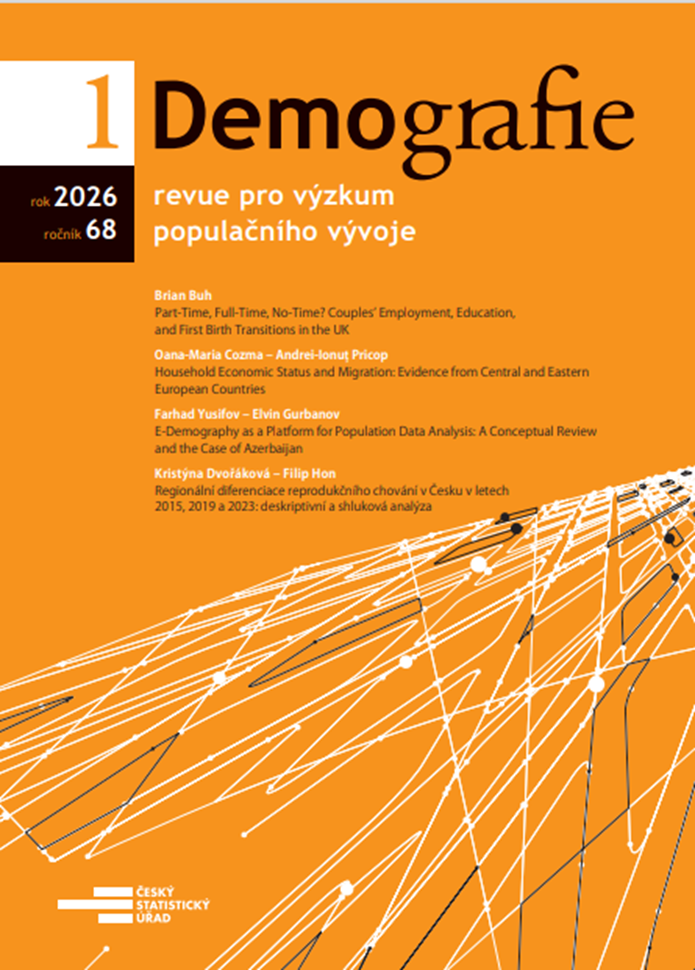
Články
- Part-Time, Full-Time, No-Time? Couples’ Employment, Education, and First Birth Transitions in the UK
Více Zavřít Brian Buh
Demografie, 68(1): 5–24
https://doi.org/10.54694/dem.0374
Abstract
In low-fertility countries, couples’ employment patterns may influence the transition to parenthood, potentially moderated by educational attainment. Using data from the UK Household Longitudinal Study (2009–2023), this study investigates how couples’ employment status and education relate to the likelihood of having a first child. Results show that among most dual-earner couples, the probability of first birth is similarly high whether both partners work full-time or women work part-time. Conversely, men’s part-time work and single-earner couples are associated with a lower likelihood of becoming parents. No strong evidence supports differences 7in parenthood transition based on couples’ educational attainment. While couples with secondary education exhibit a trend where women’s part-time work corresponds with higher first birth probabilities, wide confidence intervals indicate substantial variability, limiting firm conclusions about education’s moderating role.Keywords
First Birth, Part-time work, Couples’ employment, Understanding Society, Labour force participation - Household Economic Status and Migration: Evidence from Central and Eastern European Countries
Více Zavřít Oana-Maria Cozma – Andrei-Ionuț Pricop
Demografie, 68(1): 25–35
https://doi.org/10.54694/dem.0377Abstract
Migration has been a defining phenomenon in Eastern Europe since the fall of the Iron Curtain and has intensified with the free movement of people within the European Union. This paper examines the relationship between migration and household economic conditions, an area that has received limited empirical attention. Using panel data for 11 Central and Eastern European EU member states from 2013 to 2023, the study analyses how household financial indicators influence net migration balances. The empirical analysis applies panel regression techniques, including pooled OLS, random effects, and fixed effects models. The results show that household net financial assets and household investment rates are significant predictors of migration outcomes, while household savings and debt exhibit weaker or insignificant effects. These findings suggest that household-level economic resources and investment capacity play an important role in shaping migration dynamics in Eastern Europe. By connecting standardized household economic indicators to migration patterns, the paper provides new comparative evidence with relevant implications for migration and economic policy in the region.Keywords
Household Economic Indicators, Migration, Panel Data Analysis, Eastern European Countries, Financial Assets and Investment
Zprávy
Přehledy
- E-Demography as a Platform for Population Data Analysis: A Conceptual Review and the Case of Azerbaijan
Více Zavřít Farhad Yusifov – Elvin Gurbanov
Demografie, 68(1): 42–51
https://doi.org/10.54694/dem.0375Abstract
Electronic demography (e-demography) refers to the application of digital technologies and big data in demographic research and population-related decision-making. This study explores the concept, importance, and evolution of e-demography through a comprehensive review of the literature and a comparative assessment of international practices. Particular emphasis is placed on the role of government registers in the development of e-demography systems and the implementation of digital platforms. The study presents Azerbaijan as a practical context by briefly describing the population register and the Azerbaijan Service and Assessment Network (ASAN) Service digital platform as enabling components for e-demography-oriented applications. In addition, the study discusses how e-demography complements classical demographic infrastructure (including vital statistics) and it outlines key challenges and opportunities, such as data quality, interoperability, privacy protection, and institutional capacity. The results highlight the role of digital transformation in demographic management and underscore the potential of global best practices to inform the development of e-demography in Azerbaijan. Implications include enhancing e-government service quality, increasing citizen satisfaction, and improving oversight of socio-political processes. Future research will focus on expanding socio-demographic analyses and applying advanced analytical methods.Keywords
Electronic demography, Population register, Government registers, Big data, Digital footprints, Artificial intelligence, Machine learning, Internet of Things, ASAN Service - Regionální diferenciace reprodukčního chování v Česku v letech 2015, 2019 a 2023: deskriptivní a shluková analýza
Více Zavřít Kristýna Dvořáková – Filip Hon
Demografie, 68(1): 52–71
https://doi.org/10.54694/dem.0379Abstract
This article examines regional differences in reproductive behaviour across Czech districts in 2015, 2019, and 2023. Its aim is to describe spatial disparities in selected indicators, assess their temporal stability, and identify groups of districts with similar reproductive patterns. The analysis draws on data from the Demographic Yearbook of Districts published by the Czech Statistical Office and uses descriptive statistics, correlation analysis, and hierarchical cluster analysis based on components derived through principal component analysis. The results confirm there is substantial spatial variability in the observed indicators as well as stable relationships between them. The cluster analysis identified five groups of districts, with the Northwestern Region forming the most internally homogeneous cluster, characterised by a low maternal age at first birth, a high share of nonmarital births, elevated levels of induced abortions for non-medical reasons, and a higher proportion of third‑ and higher‑order births. The remaining clusters represent distinct types of reproductive behaviour, collectively demonstrating the considerable diversity of reproductive patterns across Czechia.Keywords
Reproductive behaviour, Regionalisation, Cluster analysis