
Tourism - 4. quarter of 2006
Weather influenced occupancy
Publication Date: 16. 02. 2007
Product Code: r-9201-06
In Q4 2006, +1.1% more guests arrived at collective accommodation establishments compared with Q4 2005. The number of foreign guests was +0.6% up; the number of domestic tourists grew by +1.8%. Occupancy of collective accommodation establishments increased by +2.9% in 2006; it was more than in 2005.
* * *
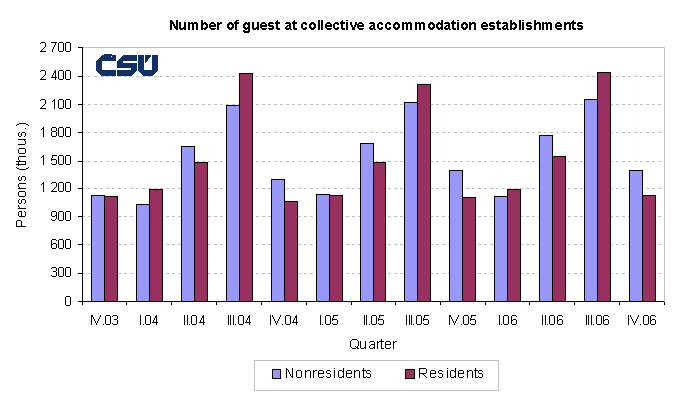
In Q4 2006, a total of 2.5 million guests arrived at collective accommodation establishments; this was +1.1% up on Q4 2005. There were 1.4 million foreign guests (non-residents), i.e. +0.6% more than in Q4 2005; domestic tourists (residents) totalled 1.1 million (+1.8%).
The weather, that was not typical for described quarter, favoured this time city and spa tourism than the visits in the mountains. The highest relative growth in guests’ arrivals was in Karlovarsky Region (+11.7%) due to both residents and non-residents. There was the third highest increase among all regions in the capital Prague due to arrivals of residents (by +17.6%), while number of non-residents was slightly above an average. Among the regions representing city and spa tourism ranked Vysocina Region owing to the high level of guests’ arrivals; in this case it was particularly caused by domestic tourists too (the growth in arrivals was by +7.5%). The capital Prague and Vysocina Region reported almost the same level of increase (+3.1% and +3.5%, respectively) but when evaluated in absolute value there was ten times less growth in Vysocina Region (there were 29 921 guests up year-on-year in the capital city; and only 2 588 guests more in Vysocina Region). In contrast, already mentioned weather was unfavourable to Kralovehradecky Region, which usually attracts tourists, who keen on winter sports in particular, at the end of the year. The number of guests decreased in this area by -5.9% compared with Q4 2005 (i.e. by 10 thousand guests’ arrivals); non-residents arrived -9.6% less and residents by -3.9%.
In Q4 2006, the most foreign guests (by the country of residence) arrived from Germany although the number of Germans decreased by -5.0% year-on-year. Tourists from Great Britain remained at the second place in Top 10 ranking in spite of a decrease by -12.8%; the same situation was in Q3 2006. Dutchmen, who spend predominately summer holiday in the Czech Republic, were replaced by Italians at the third place. They are used to travelling to our republic, especially to Prague, to celebrate the end of the year (there were +10.1% more Italians year-on-year in Prague in December 2006).
In Q4 2006, overnight stays of guests reached 7.3 million, which was only +0.8% up on Q4 2005. Lower year-on-year growth in overnight stays than in guests’ arrivals was influenced by residents, whose average number of overnight stays decreased at such level that total number of overnight stays was even lower (by -1.6%) than in Q4 2005.
Net use of rooms of hotels and boarding houses was 40.0% in Q4 2006 (+0,4 percentage point year-on-year). The highest net use was reported, as in the Q4 2005, by five-stars hotels (61.5%), which was 0.6 percentage points down. Other hotels and boarding houses reached 38.7% of net use of rooms; it was +0.4 percentage point up year-on-year.
* * *
The year 2006 was in favour of tourism, even though different types of accommodation establishments benefited in different periods or in different regions in the Czech Republic. Total number of arrivals at collective accommodation establishments grew by +2.9% and number of overnight stays by +2.8%. There was the highest increase in the category of 5* hotels due to an extended capacity (guests’ arrivals were +10.1% up and overnight stays +14.6%) and then in the category of 4* hotels (by +5.3% and +5,4%, respectively). Cold weather in August caused a decrease in arrivals and overnight stays in campsites (by -1.3% and -2.3%, respectively).
By analysing particular quarters, the most successful was Q2 2006 not only because of the highest growth in the Czech Republic as a whole (by +4.7%) but also that there was not reported any decrease among the regions. The worst result (both in arrivals and overnight stays) was in Q4 2006.
Domestic guests checked in at collective accommodation establishments more often (their number of arrivals was +4.4% up and overnight stays +3.0%) than foreign tourists (growth by +1.6% and +2,5%, respectively) in 2006. Nevertheless, there were more guests’ arrivals of non-residents than residents in the whole year (50.6%). Longer average number of overnight stays of residents had an impact on higher share of residents in total number of overnight stays (51.5%).
A majority of foreigners visited as usual the capital Prague (57.5%), whereas citizens only from five countries out of 51, that are collected, had the share lower than 40%. The most tourists came from Germany, Great Britain, USA and Spain (from half of million to two hundred thousand); of which only 32.6% of Germans visited Prague, unlike 90.7% of Spaniards and 89.5% Brits. The lowest number of non-residents was in Pardubicky Region (0.9%). The share of domestic tourists in Prague was only 7.0% but they were still at the third position among nations. The lowest share of residents was reported in Karlovarsky Region (3.0%), on the other hand they mostly visited Jihocesky Region (12.2%).
Interesting information can be extracted from analysing interrelationship between monthly data and data broken down by country of residence. Traditionally, most tourists arrive from Germany; they spend here 3.7 nights in average (the shortest time is recorded in December and the longest in February). There were the highest number of Germans in September 2006 and in May 2005. During summer time they probably prefer holiday at the seaside. Guests from Great Britain were still at the second position in Top 10 in every quarter last year despite decreasing number of arrivals by -13.8%. Brits particularly came for short time visits, 2.7 nights in average, and the average of their trips remained stable in particular months. Italians and Americans behaved similarly; Americans spent in the Czech Republic little bit longer time (the average was 3.0 nights). The longest visits during the year were recorded for Russians; with an exception of December (4.2 nights) they spent here more the 5 nights in every month. In August and January 2006, than highest number of Russians was registered. As for the Dutchmen, the highest number of tourists arrived in July and longest average of nights was recorded in February (4.9 nights).
Methodological note:
1) Data on guests at collective tourist accommodation establishments are obtained from the monthly CR1-12 sample survey and the quarterly CR2-04 survey. Data mentioned are sums of the data processed from submitted questionnaires and imputed data on the accommodation establishments that failed to report. Net use of room is the number of overnight stays in a particular period divided by the number of room-days (stated as a percentage).
Text not edited for language.
Contact: Vančura Pavel, phone: (+420) 274052096, E-mail: pavel.vancura@csu.gov.cz
Data source: CZSO direct survey in collective accommodation establishments
End of data collection: 2 February 2007
End of data processing: 9 February 2007
The data are definitive; further revision is not planned.
Quarterly data since 2000 are available in time series
( /produkty/cru_ts ).