
The position of the Czech labour market in the EU - 2008
Publication Date: 06. 05. 2009
Product Code: e-3157-08
a) Employment
In the EU the Czech Republic belongs to the countries with employment intensity which is above the average. The latest complete data released by Eurostat for Q3 2008 say that the employment rate for the 15-64 age group is higher in the Czech Republic than the total for the EU27. However, female employment rate is in the Czech Republic still below the EU27 average.
Concrete aims for employment rate in the EU countries until 2010 were determined in the meetings of the European Council in Lisbon in 2000 and Stockholm in 2001. The total employment rate should reach at least 70%, female employment rate at least 60% and elderly employment rate (age group 55-64) at least 50%.
There are considerable differences in employment rates between EU countries, not only in terms of the wide age group 15-64, but also the male and female employment components. On the one hand there is a high employment rate in the northern countries and the United Kingdom (e.g. 78.3% in Denmark in Q4 2008); on the other hand employment rate in some of the countries was below 60% (e.g. 56.7% in Hungary in Q4 2008). Comparing neighbouring countries to the Czech Republic, higher employment rates in the long term are in Austria and Germany and significantly lower in Poland and Slovakia.
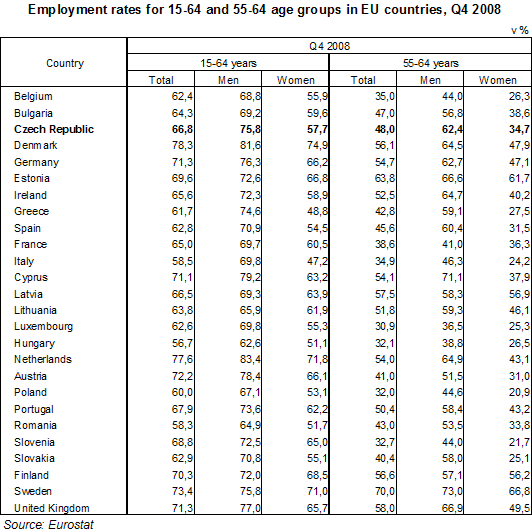
employment rate for the EU in total not published, data for Malta were not available
Even bigger differences are in the employment rates of persons aged 55-64. In Poland, Slovenia, Hungary, Luxembourg and Italy it was slightly above 30%. A number of member states will thus have difficulty fulfilling the Lisbon strategy. Twelve member states have already exceeded the required 50% rate; all the northern and Baltic countries are among them.
Reaching 50% employment rate among people aged 55-64 can be complicated for the Czech Republic owing to a lower female employment rate. The employment rate of women aged 55-64 is still below the EU15 average and below the EU27 average. It is, however, assumable that in the next years the employment rate in the age group 55-64 will further rise, especially as a consequence of adjusting the retirement age.
A high percentage of employment in the secondary sector (industry + construction) is typical of the Czech economy. This percentage is second to none in the EU27 and only Slovakia is close to it. In the Czech Republic and Slovakia alike two in five employed persons work in the secondary sector. The underlying reason is extraordinarily high employment in manufacturing in both countries. Besides the Czech Republic and Slovakia, data for Q4 2008 say that high percentages of employment in the secondary sector are in Estonia, Romania and Hungary where they reached nearly a third of total employment. These three countries are hit by the deteriorating economic situation.
In contrast, employment in the sector of services is significantly lower in the Czech Republic in comparison to the EU15 and the EU27 alike. Below-the-average employment is in the Czech Republic recorded especially in the sections health and social work and real estate, renting and business activities. Differences in employment structure between EU member states are extraordinarily high. In the Czech Republic, for example, employment in manufacturing is 4.3 times higher than employment in health and social work, but the situation in many countries, especially the northern ones, is quite different. In four countries health and social work employed more people than manufacturing (in the United Kingdom, Denmark, the Netherlands and Luxembourg).
The comparability of employment structure between EU countries in 2008 was rather complicated due to the introduction of the NACE Rev. 2 classification replacing NACE Rev. 1.1. Many of the EU countries have not available 2008 data according to NACE Rev. 1.1 and changes in employment structure in the Czech Republic are not directly comparable with the EU27 total. Despite that, the table below shows data for Q4 2008 documenting considerable differences in employment structure between EU countries. These differences are causing problems to be dealt with in the next years.
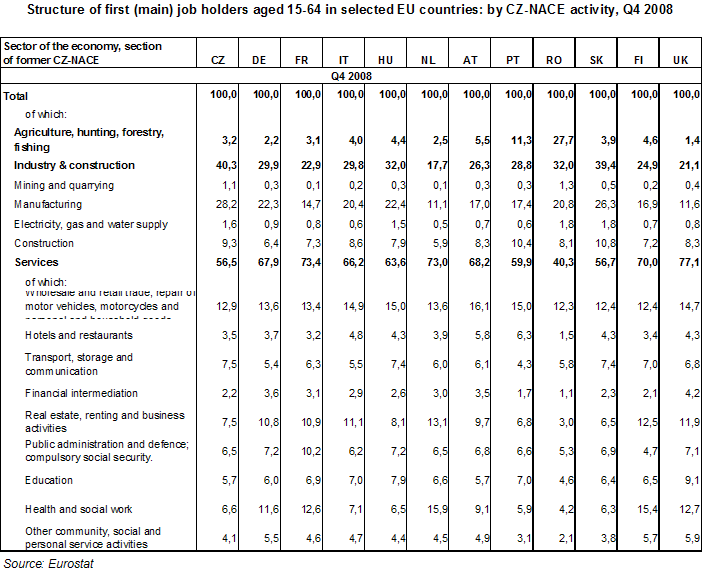
The calculations by CZSO are based on absolute data for individual countries. As the CZ-NACE Rev. 2 classification has replaced the NACE Rev. 1.1, certain employment instances were not retroactively classified according to the more detailed structure of CZ-NACE Rev. 1.1. In Eurostat database, data by NACE activity for six countries were not according to NACE Rev. 1.1, data for six countries were not according to NACE Rev. 2; some of the latter data have a significant impact on the total EU economic statistics (e.g., Germany, Italy, the Netherlands). This was the reason for using NACE Rev. 1.1 for the purposes of international comparison.
The Czech Republic belongs to the countries with a high share of self-employment. This results primarily from extraordinary high numbers of own-account workers in certain CZ-NACE activities, especially in construction. In Q4 2008 only eight EU countries recorded higher shares of the self-employed and own-account workers in total employment in comparison to the Czech Republic. They are mainly the Mediterranean countries with high shares of employment in tourism and retail trade (Spain, Italy, Cyprus, Greece and Portugal). In two countries (Poland and especially Romania) the reason for high percentages of the self-employed is a very high number of small farms in the primary sector. The last country where the percentage of the self-employed is higher than in the Czech Republic is Ireland where business activities in the tertiary sector are significantly represented.
The share of family workers in total employment is low in a majority of the EU member states and has no significant impact on total employment. Countries with the strong position of the primary sector such as Romania, Greece and Poland are an exception.
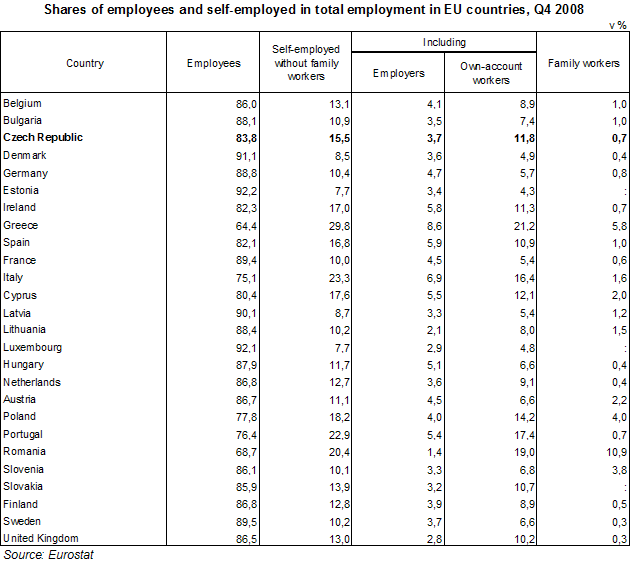
structure of professional status for the EU in total not published, data for Malta were not available
The share of persons working full time in their main job in the Czech Republic is the third highest among the EU27 countries. The shares of full-time jobs are higher in Slovakia and Bulgaria, but the total employment rate in both countries is below the average. The share of men working full time in the Czech Republic was the second highest among the EU27 countries in Q4 2008, women had the sixth highest share.
Extraordinary high differences in the shares of full-time jobs in employment between EU countries are a distinct feature of female employment. In many countries of the EU15 high numbers of women use the opportunity to work part time, particularly in the Netherlands (three quarters of all working women aged 15-64 years), and in other five countries the share of part-time jobs exceeded 40% of total female employment. The opportunity to work part time is one of the social aspects which in the long term affect the fertility rate and the length of active working life especially in the Netherlands and in some other countries. Just the frequent use of part-time job considerably increases the working activity of people aged around sixty.
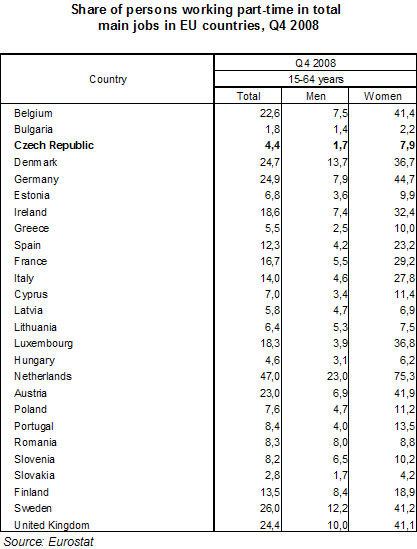
Share of part-time jobs for the EU in total not published, data for Malta were not available
The number of hours worked is also affected by the number of second jobs. The Czech Republic belongs to the countries with a relatively low number of second jobs, which is related to a high number of persons in full-time main job. Second jobs play a more important role especially in the northern countries and the Netherlands where high percentages of part-time second jobs are characteristic. However, the average numbers of hours worked in second job are markedly lower than in main job.
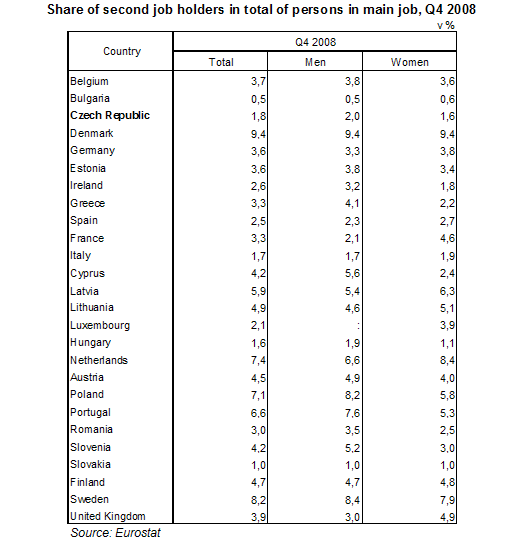
Share of second jobs for the EU in total not published, data for Malta were not available
b) Unemployment
The general unemployment rate in the Czech Republic is lower in comparison to the EU25 average; in the Czech Republic the male and female unemployment rates are relatively low and below the average, respectively. Compared to the neighbouring countries, the unemployment rate is higher than in Austria but markedly lower than in Slovakia (unemployment rate in Slovakia is one of the highest across the EU). A considerably higher rate is recorded in Poland too. Unemployment rate in the Czech Republic is noticeably lower than in Germany due to the long-term unfavourable situation in the new Länder.
It should be noted that the data presented cover Q4 2008 when the consequences of the economic crisis began to be apparent in individual countries with a certain delay. While in half of the countries the unemployment rate in last Q4 2008 was below that in Q4 2007, it grew heavily in some of the other countries. Unemployment rate increased substantially mainly in Spain and nearly doubled in the three Baltic countries.
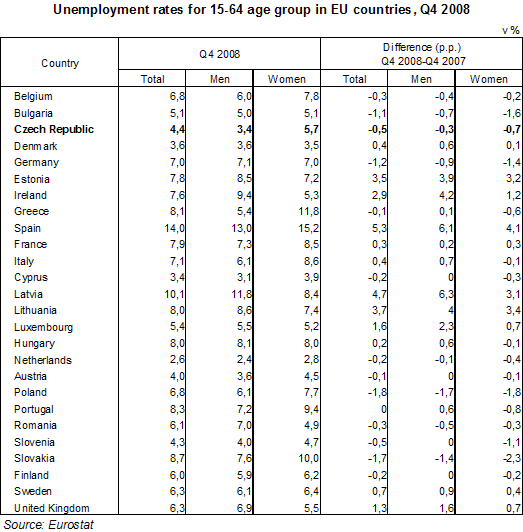
Unemployment rate for the EU in total not published, data for Malta were not available
According to the extrapolation models released by Eurostat, the unemployment rate in the EU grew strongly in Q1 2009 – seasonally adjusted rate up to 8.3% in March 2009 in the EU27 (7.8% in January and 8.1% in February 2009; the rate in March 2008 was just 6.7%). These calculations suggest that the number of the unemployed exceeded 20 million in the EU27. A slightly higher unemployment rate is in the EU15 where the economic crisis hit the labour market earlier than in the countries of Central and Eastern Europe.
Compared internationally, the high share of the long-term unemployed remains a negative aspect of the unemployment trend in the Czech Republic. Among all the EU countries, the Czech Republic had the fifth highest share of persons unemployed for one year or more in the total number of the unemployed in Q4 2008. The highest shares were recorded, besides Bulgaria, in neighbouring Germany and especially in Slovakia where the long-term unemployed made up nearly two thirds of total unemployment. High shares of the long-term unemployed in these countries are a chronic problem applying not only to elderly persons in employment.