
Services - 2. quarter of 2004
Publication Date: 23. 08. 2004
Product Code: e-9006-04
Services in the 2nd quarter of 2004
The 2nd quarter proved the previous development; sales grew by 4.8% y-o-y, which was a growth comparable with the average figure for 2003.
In terms of quarter-on-quarter comparison , seasonally adjusted sales rose by 1.6% at constant prices. Total retail trade, which is the most important with respect to volume, increased by 1.1%, transport, post and telecommunications by 1.4%, and selected market services by 3.6%.
Table 1 Sales indices (corresponding period of preceding year = 100, constant prices)
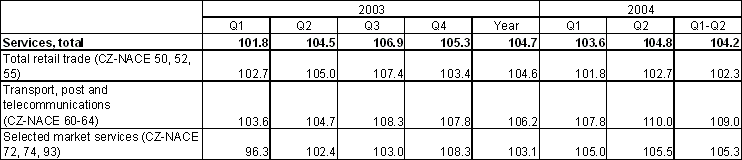
The three basic service industries, i.e. ‘total retail trade’, ‘transport, post and telecommunications’, and ‘selected market services’, reported y-o-y growth in the 2nd quarter of 2004, whose dynamics in individual industries were different. Total retail trade , accounting for nearly three fifths of the sales, grew by 2.7% , which was more than in the preceding quarter, but less than in 2003. On the other hand, transport, post and telecommunications raised their growth rate against both the preceding quarter and 2003. Sales in selected market services rose roughly by the same rate as in the 1st quarter of 2004 and more than in the whole 2003.
Table 2 Sales indices (corresponding period of preceding year = 100, constant prices)
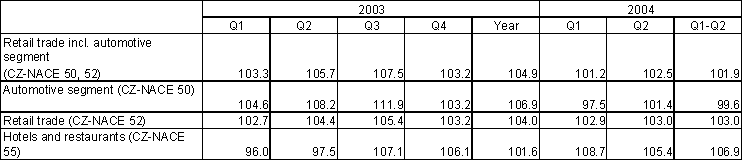
The automotive segment saw by 1.4% higher sales in the 2nd quarter. Both sale of automotive fuel and sale of motor vehicles increased; however, the latter fell by 1.3% in the 1st to 2nd quarters of 2004. While comparing data on the number of new motor vehicles sold on the Czech market (Automotive Industry Association – AIA), we find a discrepancy against data on sales, which arises, inter alia, from the fact that, unlike AIA data, the sales index includes not only sale of new cars but also sale of used cars. In addition, sale of motor vehicles reflects also structural changes in sale, which would suggest that more expensive cars were sold. The situation in ‘repair of motor vehicles’ did not change, compared to the 1st quarter; sales were by 1.5% lower y-o-y. In the 1st and 2nd quarters of 2004, the trend of retail trade was primarily influenced by sale of other goods than food. Sale of food was up 1.3%, which was less than in the 1st quarter, and could be affected, inter alia, by forward buying of food due to uncertain expectations related to future development after joining the EU. In contrast to preceding quarters, the growth of ‘sale in non-specialised stores’ slowed down (0.4%), significantly influenced by the development in May. Conversely, ‘sale of food, beverages and tobacco in specialised stores’ grew throughout the quarter. Sale of other goods than food, beverages and tobacco (+4.4%) went up more in specialised stores than in non-specialised ones. Seasonal discounts and end-of-season sales attracted probably more buyers in stores selling ‘textiles’, ‘clothing’ and ‘footwear’ (+14.4%). Rising sales in stores with ‘electronics’, ‘electrical household appliances’, ‘hardware’, ‘furniture and household articles n.e.c.’(+11.4%) could partly be affected by a gradual shift in the behaviour of customers who seem to be starting to prefer buying these goods in specialised stores where they have professional attention of sellers and can choose from a wide range of goods. Hotels and restaurants raised their sales by 5.4%, predominantly due to higher sales in ‘hotels’ (+21.9%). To a certain extent, this growth was affected by many people coming to the ice-hockey championship at the end of April and beginning of May. On the other hand, ‘restaurants’ recorded a slight decrease (-0.3%), with sales growing in April only. The demand dropped in May and June, because meals became more expensive (this service was shifted under the basic VAT rate) and there were rather cold weather conditions not in favour of much drinking.
Table 3 Sales indices (corresponding period of preceding year = 100, constant prices)
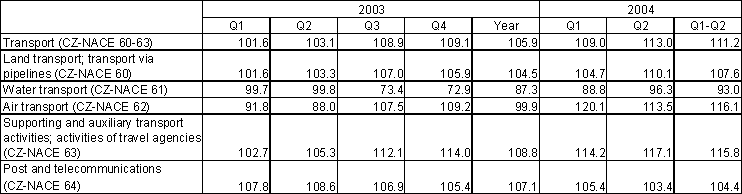
Transport saw a marked rise in sales (+13.0%), which added to the rate achieved in preceding quarters. The growth, reported by all kinds of transport, was partly due to enterprises’ pre-invoicing of many items, in response of different VAT rate in a number of transport activities as from 1 May 2004. The highest quarterly y-o-y growth of ‘transport by road’ since the survey began (+11.1%) was affected by expanding construction on the one hand, and by increasing intensity of external trade on the other. The rise in ‘air transport’ (+13.5%) was by more than 6 percentage points lower than in the 1st quarter, but still considerably higher than in 2003. ‘Transport via railways’ was up 5.5%. A high growth (+17.1%) was seen in ‘supporting and auxiliary transport activities’, which are closely linked particularly to road and air transport. Post and telecommunications grew largely thanks to ‘post activities’ (+7.5%), where charges for monthly payments of household bills were introduced. The slowdown of growth of ‘telecommunications’ started in the 3rd quarter of 2003 continued, sales growing by 2.9%.
Table 4 Sales indices (corresponding period of preceding year = 100, constant prices)

Sales in computer and related activities were up 13.2% in the 2nd quarter of 2004, which was the highest figure recorded in this CZ-NACE division since the beginning of the survey. The driving force of this increase was ‘software consultancy and supply’ (+19.0%), which is most important in terms of volume; on the other hand, ‘maintenance and repair of office, accounting and computing machinery’ and ‘database activities’ continued decreasing. Other business activities raised their sales by 4.3%, predominantly owing to sales in April (+15.5% y-o-y). Decisive for the dynamics in the 2nd quarter were ‘architectural and engineering activities’ and ‘investigation and security activities’. A considerable rise was reported also for ‘labour recruitment and provision of personnel’, which is less important in terms of volume; this CZ-NACE group has been on the increase since 2000. ‘Miscellaneous business activities n.e.c.’ were the only group measured where sales dropped. Other service activities, predominantly of personal nature , saw markedly falling demand; sales decreased by 5.8% y-o-y. Higher prices resulting from changes in VAT rates lowered the sales of ‘hairdressing and other beauty treatment’ by 10.2%.
Since the 2nd quarter of 2004, the sales index of services (total) published by the CZSO is derived in a combined manner - i.e. sales in industries where prices are measured inclusive of VAT also include VAT, and sales in industries where prices are measured exclusive of VAT are free of VAT. Up to the 1st quarter, sales inclusive of VAT were taken for all industries of services, and indices both including and excluding VAT did not virtually differ. After the VAT rates were changed (significantly for services), the sales index with VAT for all of the industries would provide incorrect results. The change in the methodology of calculation was also applied to previous periods. Except for the 1st quarter of 2004, these changes are insignificant.
CZ-NACE 50, 52, 55, 60, 61, 62, 63, 64, 72, 74, 93 – Services
CZ-NACE 50, 52, 55 – Total retail trade
CZ-NACE 50, 52 – Retail trade incl. automotive segment
CZ-NACE 50 – Automotive segment
CZ-NACE 52 – Retail trade
CZ-NACE 60, 61, 62, 63, 64 – Transport, post and telecommunications
CZ-NACE 72, 74, 93 – Selected market services

