
Quarterly National Accounts - 4. quarter of 2008
GDP growth in the fourth quarter of 2008 hindered by external trade
Publication Date: 11. 03. 2009
Product Code: r-5003-08
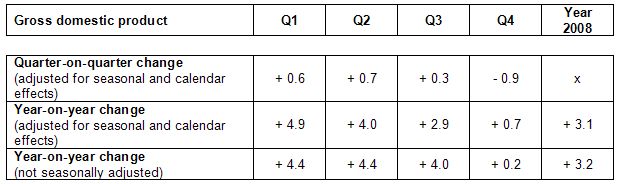
In Q4 2008 gross domestic product adjusted for price, seasonal and calendar effects was up by 0.7% in comparison to Q4 2007 and down by 0.9% in comparison to Q3 2008. Real GDP for the year 2008 grew by 3.1%.
* * *
The performance of the Czech economy measured by real GDP development adjusted for seasonal and calendar effects grew by 0.7% year-on-year in Q4 2008. The preliminary GDP estimate of 13 February has been corrected downwards by 0.3 percentage points (p.p.) due to information on value added produced in the banking and government sectors that arrived after the preliminary estimate was made. In comparison to Q3 2008 GDP fell by 0.9% (the previous quarter-on-quarter GDP decrease was recorded in Q3 1998).
Seasonally adjusted total employment (according to the national accounts methodology) in Q4 2008 dropped by 6 thousand persons (-0.1%) q-o-q and increased by 16 thousand persons (+0.3%) y-o-y.
In total for the year 2008 GDP grew by 3.1% y-o-y, i.e. by 0.4 p.p. less than the preliminary estimate expected. According to an estimate, total employment in the Czech economy was 5 268 thousand persons on average in 2008, which was up by 61 thousand persons (+1.2%) in 2007.
Real GDP growth in 2008 (in %)
Fourth quarter of 2008 (constant prices)
The profound global changes caused by financial crisis resulted in a markedly different domestic economic development in Q4 2008 compared to Q1÷Q3 2008. Moreover, indicators of GDP by production and expenditure approach were affected by the high comparative basis and by wide differences in working time in the second half of the year in comparison to the corresponding periods of 2007 (Q3 2008 was by four working days longer and Q4 2008 by two working days shorter). All this was made apparent in sizeable differences between seasonally adjusted (SA) and not seasonally adjusted (NSA) indicators. To eliminate the effect of especially calendar variations, a more convenient method of adjustment was used 1.
On the supply side of the economy the y-o-y GDP growth of 0.7% was boosted by increase in gross value added (GVA) by 1.1% (constant prices) and pushed down by decrease in taxes on products (VAT and excise taxes) by 2.5%.
A positive contributor to total GVA growth (constant prices) in Q4 2008 was agriculture (including forestry and fishing), but GVA at current prices in agriculture did not grow as the increase of output volume was completely compensated for by a sharp fall in prices. GVA was up also in ‘wholesale and retail trade; repair of motor vehicles, motorcycles and personal and household goods’. Decreases were recorded in manufacturing, business activities and financial intermediation.
Among the biggest contributors to the growth of aggregate demand were final consumption expenditure (contribution 1.2 p.p.) and partially changes in inventories (contribution 0.5 p.p.); external trade, which was the substantial source of growth in the first three quarters of the year, counteracted in Q4 2008 (contribution -1.1 p.p.).
Especially households (+2.8%) contributed to the increase of 1.7% in total final consumption expenditure. Above-the-average increases (constant prices) were recorded for expenditure on food, telecommunications, cars and automotive fuel.
Gross fixed capital formation grew by a mere 0.3%; a considerable increase of investment in machinery and transport equipment was nearly compensated for by a sharp fall in housing construction. Inventories dropped by only CZK 2.8 billion (current prices, NSA) in Q4 2008, which contributed favourably to GDP growth due to a higher decrease in Q4 2007 (CZK -9.0 billion).
Exports and imports of goods were below the 2007 figures. External trade contributed negatively to GDP growth because the volume of exports of goods decreased more (-8.4%) than the volume of imports (-6.2%).
Year 2008 (constant prices)
In the year 2008 real GDP is estimated to have grown by 3.1% and GVA by 3.5%. Nearly 40% of the growth of the latter was due to y-o-y increase in employment and over 60% due to increase in total labour productivity. The underlying reason for GDP growing less than GVA was a decrease in taxes on products.
On the supply side of the economy the biggest contributors to total y-o-y GVA growth were wholesale and retail trade, including sale of automotive fuel and repair of motor vehicles (y-o-y increase 15.3%, contribution to GVA growth 1.9 p.p.), manufacturing (increase 4.2%, contribution 1.2 p.p.) and agriculture, including forestry and fishing (increase 16.6%, contribution 0.4 p.p.). Y-o-y GVA decreases (constant prices) were registered in construction and business activities.
On the demand side of the economy final consumption expenditure (+1.5 p.p.) and external trade (+1.9 p.p.) contributed to GDP growth. A negative effect was recorded for gross capital formation (-0.3 p.p.).
In the framework of final consumption expenditure (y-o-y increase 2.2%), household expenditure grew by 2.9% and government expenditure by 0.9%.
Gross fixed capital formation was up by 3.1% y-o-y (constant prices); especially investment in transport equipment (+14.6%) and machinery (+8.7%) rose. A sharp decrease was observed in investment in housing (-11.7%). Inventories grew considerably less in comparison to 2007 (by CZK 36.6 billion in 2008 as against CZK 75.6 billion in 2007, current prices).
In external trade, total exports (+6.5%) grew more than total imports (+4.4%). External trade surplus rose from CZK 180.9 billion in 2007 to CZK 185.2 billion in 2008 (current prices).
Nominal GDP grew by 4.9% and reached CZK 3 705.7 billion in the year 2008. The overall price level measured by the GDP implicit deflator rose by 1.7% y-o-y.
* * *
Seasonally adjusted EU27 GDP was down by 1.3% y-o-y in Q4 2008 according to Eurostat’s estimate. Among the main trading partners of the Czech Republic, GDP grew in Slovakia (+2.7%) and Poland (+3.1%) and fell in Germany (-1.6%) and Hungary (-1.0%).
Contact: Jan Heller, phone (+420) 274 052 865, e-mail: jan.heller@csu.gov.cz
Related time series: /produkty/hdp_ts
Selected tables: http://www.czso.cz/eng/edicniplan.nsf/p/50n1-el
1 The “direct” method of adjustment was used until now – GDP was adjusted for calendar and seasonal effects just in total. For this GDP estimate was preferred the “indirect” method which is widely used in highly developed countries where sufficiently long time series are available. Adjustment for calendar effects is applied to GDP by kind of activity and the resulting total is adjusted for seasonal effects.