Producer price indices - 2. quarter of 2004
Product Code: e-7032-04
Producer price indices in the 2nd quarter of 2004
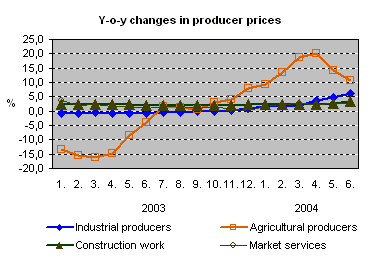
Agricultural producer prices grew by 13.8% y-o-y , which was roughly the same increase as in the 1st quarter of 2004. Plant product prices went up considerably faster (+32.6%) than animal product prices (+4.9%). The former was mainly affected by higher prices of cereals (+35.3%) and potatoes (+84.3%, on the increase since the 2nd quarter of 2003). Further, fruit prices rose by 16.1% in total, affected by apples. Prices of vegetables were by 8.1% higher (+18.1% in the 1st quarter). Animal product prices were up particularly due to higher prices of poultry (+5.1%) and eggs (+23.7%). Prices of pigs grew by 6.2%, as against a decrease of 5.9% in the 1st quarter. Also prices of cattle for slaughter and milk went up by 1.8% (-0.7% in the 1st quarter) and 1.5% (-1.6% in the 1st quarter), respectively.
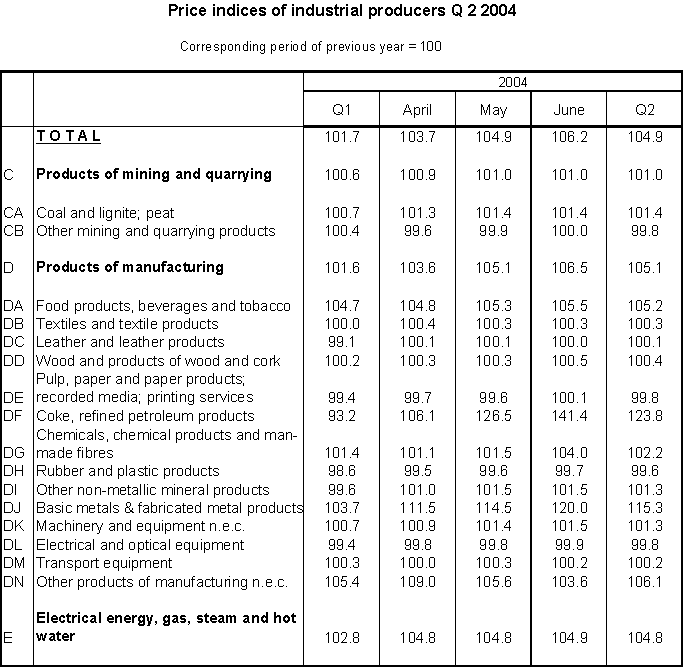
In the course of the 2nd quarter of 2004, industrial producer prices continued growing m-o-m , and the dynamics of their growth strengthened particularly in June to reach 1.1%, as against 0.8% registered in the preceding three months. The continuing growth of metal prices and rise in coke and refined petroleum products prices was the decisive factor affecting the growth of the total price level.
Industrial producer prices accelerated their y-o-y rate of growth in the 2nd quarter. They grew by 4.9% in total (+1.7% in the 1st quarter), keeping on increasing that started in November 2003 (two years of decreases preceded, by 0.3% in 2003 and 0.5% in 2002). The growth accelerated in June, with 6.2% (most since May 1998).
The main cause of the unprecedented y-o-y price growth in 2004 was a sharp price increase in manufacture of basic metals and fabricated metal products, which reached 15.3% in the 2nd quarter of 2004, of which 20.0% in June. Considerably higher than in the 2nd quarter of 2003 were especially prices of basic iron, steel and ferro-alloys – by 32.9% (+43.5% in June), other first processed iron and steel – by 24.4% (+28.2% in June), tubes etc. – by 17.4% (+24.4% in June), and basic precious metals and other non-ferrous metals – by 9.9% (+10.6% in June). Prices of these commodities reflected growth of metal prices on the world markets, which resulted in sharply rising import prices of metal ores (+32.3%) and iron and steel (+8.8%) in April; they grew again in May. Also prices of other manufactured goods n.e.c. rose – by 6.1% on average in the 2nd quarter (this applies to metal secondary raw materials, whose prices went up by 43.9% in April).
A considerable y-o-y price increase in coke and refined petroleum products was another important factor causing the growth of the price level; the prices grew by 23.8% in the 2nd quarter, of which by 41.4% in June (prices of both petroleum and coke products went up). While petroleum Brent sold at 25.28 USD/barrel on the London market in May 2003, it exceeded 30 USD/barrel at the beginning of 2004 and reached 37.06 USD/barrel in June.
Growing prices of food products, beverages and tobacco (+5.2% on average in the 2nd quarter) contributed significantly to the total rise in industrial producer prices.
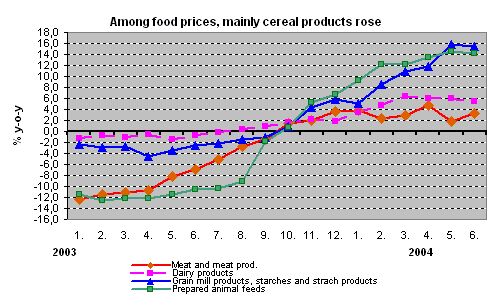
Among individual groups of food, the highest increases were reported for prices of grain mill products, starches and starch products (+14.4%), prepared animal feeds (+14.1%) and other food products (+7.3%, of which prices of bread, fresh pastry and cakes +14.1%). The development of these prices was closely connected with the price of food wheat, which reached 4 612 CZK/tonne in April 2004, while it sold at 3 190 CZK/tonne in June 2003. It responded to a low harvest of 2003 and to higher prices on the world markets. Prices of wheat sold on the world markets (Chicago) grew to 375.53 USc/bushel in May 2004 from 317.33 USc/bushel a year earlier.
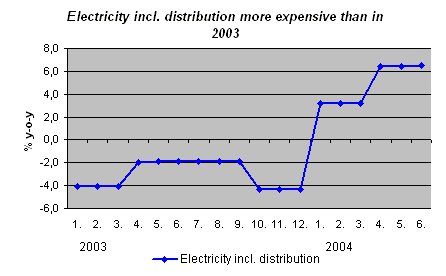
The total price level was further pushed up by prices in branch electrical energy, gas, steam and water (+4.8% on average y-o-y in the 2nd quarter). Prices went up in all groups within this branch, of which mainly prices of electricity and water.
Prices of electricity incl. distribution were 6.4% up y-o-y in the 2nd quarter of 2004 (compared with unusual development in 2003, when, for the first time after 12 years, regulated prices went down for all customer categories in January 2003). Water prices kept on rising, being by 5.1% higher on average in the 2nd quarter.
Other industrial branches saw smaller price increases in the 2nd quarter of 2004. Growth ranging between 1.3% and 2.2% was observed in four industrial branches: chemical products and man-made fibres (+2.2%), coal, lignite and peat (+1.4%), machinery and equipment (+1.3%), and other non-metallic mineral products (+1.3%).
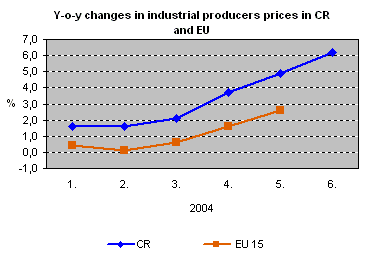
Compared with EU25, industrial producer prices in the Czech Republic grew faster in 2004. While they rose by 2.6% y-o-y in May in EU25, the Czech Republic reported +4.9%. Increases in some countries were even higher: 10.0% in Hungary, 6.9% in Latvia, and 5.6% in Cyprus, all in May 2004, y-o-y.
In the same month, Germany registered +1.6%, France +2.3%, and the United Kingdom +3.3%.
Prices of construction work grow evenly in the long term, reaching +2.9% y-o-y in the 2nd quarter. Prices of construction material inputs were by 5.1% higher, primarily due to reinforcing steel.
The y-o-y price increase in market services accelerated to 2.5% in the 2nd quarter of 2004. The decisive effect on the development of the total price level had particularly real estate, renting and business services (+3.3%). Within this section, especially prices of advertising services (+8.2%) and computer and related services (+6.0%) were up. Prices in financial intermediation services, except insurance and pension funding services, grew by 3.0% y-o-y in the 2nd quarter, particularly due to higher prices of monetary intermediation services (+6.9%); leasing prices fell by 2.8%. Prices in insurance and pension funding services rose by 1.6% (prices of property fire insurance +4.6%, motor vehicle insurance +1.2%, farm crops insurance +3.1%; theft insurance prices did not change). Prices of post and telecommunication services were by 0.6% higher in total. Prices of inland goods transport grew by 0.7%, affected by prices of goods transport by road (+2.6%), whereas prices in railway goods transport stagnated.