
Industry - March 2007
Double-digit growth of industry continued for three months to March
Publication Date: 15. 05. 2007
Product Code: r-8001-07
In March 2007, seasonally adjusted industrial production increased by 2.3%, compared to February 2007. Industrial production grew by 12.7% year-on-year. Sales from industrial activity at constant prices rose by 13.2% year on year. Industrial new orders increased by 6.3% year-on-year.
* * *
Seasonally adjusted industrial production in March 2007 was up by 2.3% month-on-month. The trend grew by 1.3% (Table 5).
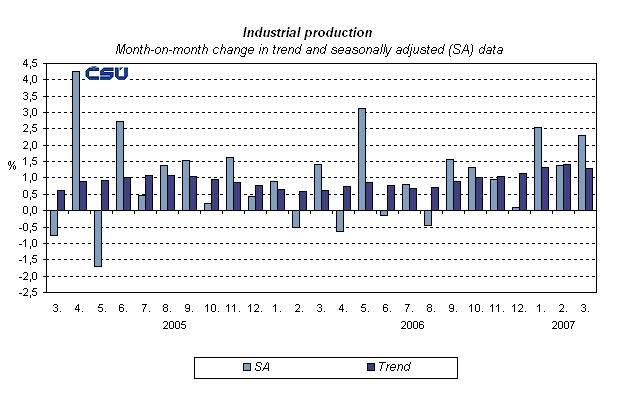
The year-on-year index of industrial production reached 112.7% in March (or 114.6% working days adjusted, WDA). March 2007 had one working day less than March 2006. Seasonally adjusted index was 113.5%. The double-digit growth of industrial production continued the 3rd month. The growth of industrial production (Table 6) was most affected by ‘manufacture of electrical and optical equipment’ (+29.0%, contribution to the growth of industry in total 3.7 p.p.), ‘manufacture of transport equipment’ (+12.2%, contribution 2.6 percentage points) and ‘manufacture of machinery and equipment’ (+27.8%, contribution 1.7 p.p.). Decreases were recorded for ‘electricity, gas and water supply’ (-4.3%, contribution -0.3 p.p.), ‘manufacture of basic metals and fabricated metal products’ (-0.5%, contribution -0.1 p.p.) and ‘manufacture of food products; beverages and tobacco’ (-0.7%, contribution -0.1 p.p.).
In March, industrial production rose in all the main industrial groupings: in ‘consumer durables’ (+36.9%), ‘capital goods’ (+16.0%), ‘intermediate goods’ (+12.2%), ‘energy’ (+6.9%) and ‘consumer non-durables’ (+3.9%).
Sales from industrial activity at constant prices (of the year 2000) rose by 13.2% (+14.4% at current prices), or by 15.3% WDA, or by 14.6 SA, year-on-year. The increase of sales from industrial activity was most contributed to by ‘manufacture of electrical and optical equipment’ (+25.0%, contribution to the growth of industry in total 3.9 percentage points), ‘manufacture of transport equipment’ (+12.3%, contribution 2.7 p.p.) and ‘manufacture of machinery and equipment’ (+27.8%, contribution 2.1 p.p.). Sales from industrial activity decreased in ‘electricity, gas and water supply’ (-7.7%, contribution -0.5 p.p.), ‘manufacture of food products; beverages and tobacco’ (-0.7%, contribution -0. 1 p.p.) and ‘mining and quarrying of energy producing materials’ (-1.2%, contribution -0.02 p.p.)
Direct export sales of industrial enterprises increased by 17.0% at constant prices (+18.8% at current prices), and their proportion in total sales of industrial enterprises stood at 51.3% (at current prices).
Sales from industrial activity of foreign-controlled enterprises were up by 16.9% at constant prices (+18.5% at current prices), and their proportion in total sales stood at 61.5% (current prices). Direct export sales of industrial foreign-controlled enterprises increased by 17.8% at constant prices (+19.9% at current prices) and made up 76.7% of total sales of these enterprises (current prices).
The average number of persons employed*) in the industry went up by 2.9% in March 2007 (+33.2 thousand persons) year-on-year. Increases were registered in ‘manufacture of electrical and optical equipment’ (+7.8%), ‘manufacture of transport equipment’ (+7.7%) and ‘manufacture of rubber and plastic products’ (+7.3%). Employment decreased most in ‘manufacture of textiles and textile products’ (-6.5%), ‘manufacture of leather and leather products’ (-5.9%) and ‘mining and quarrying of energy producing materials’ (-5.4%).
The average monthly nominal wage in the industry rose by 7.1% year-on-year and reached CZK 20,443. The average hourly wage increased by 11.1% and stood at CZK 134.6. Labour productivity in the industry (sales per employee) rose by 9.1% and hourly labour productivity by 14.0%.
Industrial new orders in selected CZ-NACE activities concluded in March 2007 reached the value of CZK 162.0 billion (current prices), of which non-domestic industrial new orders made up CZK 106.7 billion. The y-o-y index of industrial new orders in total stood at 106.3%, the index of non-domestic industrial new orders was 107.4%. Non-domestic industrial new orders grew most in ‘manufacture of office machinery and computers‘ (+106.7%, contribution to the growth of industry in total 3.7 percentage points), ‘manufacture of basic metals and fabricated metal products‘ (+34.2%, contribution 2.6 p.p.) and ‘manufacture of machinery and equipment‘ (+12.6%, contribution 1.7 p.p.). Non-domestic industrial new orders dropped in ‘manufacture of radio, television and communication equipment and apparatus’ (-31.1%, contribution -3.1 p.p.), ‘manufacture of motor vehicles, trailers and semi-trailers’ (-7.0%, contribution -2.3 p.p.) and ‘manufacture of textiles and textile products’ (-2.3%, contribution -0.1 p.p.).
* * *
According to Eurostat News Release, the working days adjusted index of industrial production in the EU27 rose by 4.0% in February 2007 compared to February 2006. Among the EU27 member states for which data were available, the highest increases were registered in Ireland (+22.4%), Slovakia (+15.5%) and Poland (+12.9%). In Germany a 6.8% growth was recorded. The biggest decrease was recorded in Finland (-3.6%).
Analysis - Development of the industry in the first quarter of 2007
Note
Contact: Jan Ernest, tel: (+420) 274054188, e-mail: jan.ernest@csu.gov.cz
Data source: CZSO direct survey in enterprises with 20+ employees
End of data collection: 4 May 2007
End of data processing: 10 May2007
Related publication: 8001-07 Industry of the Czech Republic ( /produkty/prumysl-ceske-republiky-prosinec-bifzzwj49k )
*) Starting from January 2007, in accordance with Eurostat methodology, monthly data on numbers of employed persons are published by the Czech Statistical Office as part of the short-term industrial statistics. Unlike the average registered number of employees published before, the new indicator includes also persons working under agreement for work performed outside the employment relationship and other employed persons who participate in work for the company without having an employment relationship with the company. The new figure represents full-time equivalent (FTE). This change has an impact on average wage and labour productivity calculations. Year-on-year comparability of the data published is ensured.