
External trade - 4. quarter of 2006
Product Code: e-6032-06
External trade in the year 2006
In 2006 external trade 1 recorded the best results since the beginning of the independent Czech Republic. Exports and imports reached the highest values in the history of the Czech Republic. The value of exports exceeded that of imports for the second time since 1993 and the trade balance showed a surplus 2 . The turnover of external trade in 2006 was five times higher than in 1993, exports per capita increased more than fivefold 3 ; the Czech Republic strengthened its position in world expo rts 4 .
Compared with the year 2005, in 2006:
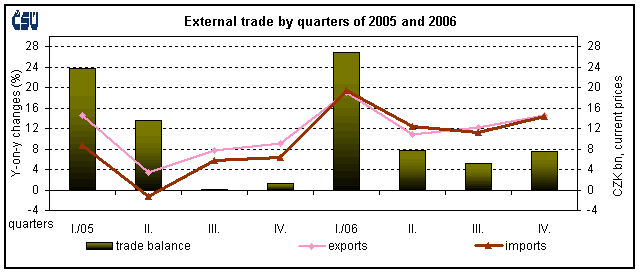
- growth rates of exports and imports were higher and reached double-digit figures - 14.6% and 14.4%, respectively. High growth of exports and imports was observed particularly in the first quarter (19.1% and 19.4%, respectively), respective increases were 10.9% and 12.5% in the second quarter, 12.3% and 11.2% in the third quarter, and 16.3% and 15.1% in the fourth quarter. External trade turnover was higher by 14.5% (CZK +536.4 billion), and reached CZK 4 234.9 billion; exports, which grew by CZK 272.5 billion, made up 50.8% of the turnover growth, and imports, being higher by CZK 263.9 billion, 49.2%. Due to the appreciation of CZK against USD and against EUR, exports and imports valued in USD and EUR rose faster. In comparison to the year 2005, exports and imports in USD were up by 21.8% and 21.7% respectively and in EUR by 20.4% and 20.2% respectively;
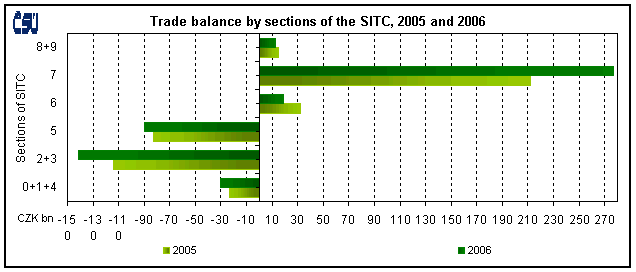
- external trade balance showed a surplus of CZK 47.3 billion (exports covered 102.3% of imports), i.e. by CZK 8.7 billion higher, and was above zero in all the four quarters. By group of countries, surplus grew in trade with EU25 states (by CZK 58.5 billion) and with European transition economies (by CZK 5.5 billion), whereas deficit increased with other states 5 (by CZK 32.2 billion), CIS 6 countries (by CZK 14.4 billion) and developing economies (by CZK 8.3 billion). In terms of commodity structure, trade balance deteriorated in all sections of the SITC except ‘machinery and transport equipment’ where surplus grew year-on-year (by CZK 64.6 billion). A marked rise (by CZK 28.7 billion) was recorded for deficit in ‘mineral fuels, lubricants and related materials’, which remained the highest (CZK 138.9 billion) among all SITC sections, followed by deficit in ‘chemicals and related products’ (CZK 89.7 billion);
In comparison to the EU25 the dynamics of the Czech Republic’s external trade were higher; compared to the new EU member states, the growth of the CR’s external trade was roughly at the same level. Data released by Eurostat on 17 January 2007 available for January-October 2006 show that EU25 exports and imports in EUR were up by 12.4% (EU15 +11.7%) and 14.3% (EU15 +13.7%) respectively year-on-year on average in that period. Exports and imports of the 10 new EU member states were higher by 21.2% and 21.1% respectively year-on-year on average. In the same period the share of the 10 new EU member states in total EU25 exports increased from 7.7% to 8.3% year-on-year and their share in total EU25 imports grew from 8.4% to 8.9% year-on-year. The EU25 trade balance reached a deficit of EUR 72.8 billion in January-October 2006 (of which the EU15 deficit was EUR 47.1 billion and the 10 new member states deficit EUR 25.7 billion). The Czech Republic as the only one among the new EU member states registered a trade surplus in January-October 2006.
- by group of countries, the position of the EU25 in total exports and imports weakened. In spite of that, with the share of 83.9% in total exports and 70.0% in total imports, EU25 states played a key role in the external trade of the Czech Republic. Slight strengthening of the position of EFTA states 7, CIS countries, European transition economies and other states in total exports was a favourable aspect. In imports, the shares of developing economies and other developed market economies 8 decreased; the position of CIS countries and other states strengthened significantly, of European transition economies moderately;
- in terms of commodity structure, growth (albeit considerably varied) was apparent in exports and imports in all SITC sections. A highly above-the-average increase (which determined the dynamics of total exports) was observed only for exports of ‘machinery and transport equipment’, which strengthened their position in total exports from 50.8% to 53.1%. The remaining SITC sections recorded below-the-average increases, which weakened their shares in total exports. An above-the-average growth of imports was recorded for ‘mineral fuels, lubricants and related materials’ and ‘machinery and transport equipment’. These sections of the SITC raised their share in total imports at the expense of all the other SITC sections.
The external trade results in 2006 were influenced by a number of factors (positive and negative ones).
Among the positive factors were in particular:
- growth of industrial production. In January-November 2006 the index of industrial production reached 110.3, of which the index of manufacturing was 111.1. The biggest year-on-year increase was registered for ‘manufacture of transport equipment’, followed by ‘manufacture of machinery and equipment n.e.c.‘, ‘manufacture of electrical and optical equipment’ and ‘manufacture rubber and plastic products’. The growth of output in ‘manufacturing’ 9 had a decisive share in the year-on-year growth of total exports. In 2006 exports of manufacturing industries stood at CZK 2 064.4 billion, which was by 14.7% (CZK +264.1billion) more year-on-year, and their share in the year-on-year growth of total exports was 96.9%.
The most important SITC division for exports of manufacturing industries was road vehicles (SITC 78) with an 18.9% year-on-year growth of exports. Exports of road vehicles made up 17.0% of total exports in 2006 (16.4% in 2005), of which exports of motor cars (SITC 781) accounted for 9.0% (8.1%) and exports of parts and accessories of the motor vehicles (SITC 784) for 6.8% (7.1%). Higher exports of ‘motor cars’ and ‘parts and accessories of the motor vehicles’ contributed with 15.0% and 5.1% respectively to the increase of total exports. Trade surplus in motor cars grew from CZK 107.5 billion in 2005 to CZK 143.4billion in 2006 and trade surplus in parts and accessories of the motor vehicles remained nearly the same (an insignificant increase from CZK 56.2 billion to CZK 56.4 billion). Among other important SITC divisions of mechanical engineering, high increases were recorded for exports of ‘office machines and automatic data-processing machines’ (SITC 75) and ‘telecommunications and sound-recording equipment’ (SITC 76); however, because also respective imports grew more, trade surplus in ‘office machines and automatic data-processing machines’ hardly changed (CZK 30.6 billion in 2006 as against 30.4 billion in 2005) and surplus in ‘telecommunications and sound-recording equipment’ even dropped (from CZK 5.4 billion in 2005 to CZK 0.4 billion in 2006). Above-the-average growth of exports of ‘general industrial machinery and equipment, n.e.s.’ (SITC 74) resulted in the second highest surplus (CZK 39.4 billion) among SITC divisions of mechanical engineering;
- economic development in the EU member states. According to Eurostat’s estimate, euro area GDP increased by 2.6% year-on-year in 2006, which is the fastest growth since 2000. The favourable economic development in EU member states that are key markets for the Czech Republic was supported inter alia by economic growth in the United Kingdom and especially in Germany; the latter produces nearly a third of the euro area GDP and is a dominating trading partner of the Czech Republic. In 2006 the growth of the German economy accelerated to 2.5% and this acted in favour of higher exports to Germany. Whereas in 2005 exports to Germany increased by 0.9% year-on-year, the corresponding growth in 2006 was 8.1%. Due to a faster increase of exports to some of the other member states (mainly to France, Italy, Hungary, Poland and Belgium) and resulting increase of these states’ share in total exports, Germany’s share dropped. Nevertheless, Germany was the destination for 31.7% of the Czech Republic’s total exports.
The main negative effects were:
- unfavourable terms of trade 10. Export prices dropped by 1.0% on average in January-November 2006 compared with January-November 2005 and import prices were higher by 1.0% on average in the same period. External trade prices were mainly influenced by the price movements in the world market and by the strengthening of CZK against both EUR and USD. In January-December 2006, compared with January-December 2005, CZK appreciated by 5.1% on average against EUR and by 5.9% on average against USD. World prices of industrial raw materials and food increased by 26.2% 11 in total year-on-year in January-December 2006; their growth was predominantly affected by increasing prices of petroleum and natural gas (+20.1% and 33.5% respectively year-on-year). Just the higher prices of petroleum and natural gas had a negative impact on the trade balance and markedly reduced the trade surplus. In 2006 trade deficit in ‘petroleum, petroleum products and related materials’ reached CZK 107.5 billion (up by CZK 14.0 billion year-on-year) and trade deficit in ‘gas, natural and manufactured’ CZK 59.3 billion (up by CZK 13.7 billion year-on-year). A prevailing influence on the increase of trade deficit in ‘petroleum, petroleum products and related materials’ and ‘gas, natural and manufactured’ was the growth of prices. This is documented by the fact that between 2005 and 2006 imports of these commodities did not change significantly in terms of volume (-1.8% and +0.2% respectively) but grew by 13.1% and 30.2% respectively in terms of value;
- further growth of high trade deficit with Russia (from CZK 71.0 billion to CZK 83.4 billion) and particularly with China (from CZK 86.9 billion to CZK 118.8 billion). However, the structure of each of the two deficits is completely different. Whereas trade deficit with Russia is affected by imports of fuel and energy sources and by their prices, the deficit with China grows through imports of ‘office machines and automatic data-processing machines’, ‘telecommunications and sound-recording equipment’ and ‘electrical machinery, apparatus and appliances, n.e.s.’.
A closer look at external trade in 2006 shows that:
- exports to all main groups of countries grew. Above-the-average dynamics were observed (excluding exports to EU25 states and developing economies) for exports to CIS countries, European transition economies and other states. Also the trend of exports to EFTA states (mainly to Switzerland and Norway) was favourable. More than four-fifths (82.9%) of the absolute increase in total exports are (although the growth was slightly below the average) attributable to a CZK 225.8 billion increase in exports to EU25 states. The total growth of exports to EU25 states reflected various dynamics of exports to the individual states. Exports to most of the states grew above the average (e.g. to France, Italy, Hungary, Belgium, Poland and the United Kingdom); lower dynamics were recorded for exports to Slovakia, Germany (yet the absolute growth of CZK 51.1 billion was among the highest ones) and Austria. Among other countries, worth mentioning are higher exports to Russia, Ukraine, Romania and India and lower exports to the United States;
- imports from all main groups of countries were higher. Above-the-average increases were reported especially for imports from other states, European transition economies and CIS countries, whereas imports from EU25 states, other developed market economies 12 and other developed market economies (predominantly overseas ones). and developing economies were below the average. The dynamics of imports from EU25 states were lower and varied considerably from one EU25 state to another, yet the absolute growth of imports amounting to CZK 167.3 billion made up 63.4% of the growth of total imports. Highly above-the-average increases were recorded for imports from Poland, Hungary, the United Kingdom, France, Denmark, Finland and Portugal, below-the-average growth was apparent e.g. for imports from Belgium, Spain, the Netherlands, Italy, Slovakia, Austria and Germany; a decrease was observed for imports from Sweden. Among other countries, worth mentioning are higher imports from China, Russia, Norway, Romania, Japan, Azerbaijan and Taiwan and lower imports from Ukraine;
- the trade balance was a result of trade surplus with EU25 states (CZK 330.5 billion) and with European transition economies (CZK 36.9 billion) on the one hand, and trade deficit with non-EU25 developed market economies (CZK 54.2 billion), developing economies (CZK 45.6 billion), CIS countries (CZK 98.3 billion) and other states (CZK 120.6 billion) on the other hand.
In trade with EU25 states, surplus grew especially with France, Germany, Slovakia, Belgium, the United Kingdom and Spain; surplus decreased markedly with Poland; a turn from the deficit into a surplus improved the balance with Sweden and Italy. Among other countries (non-EU25), a high deficit (as mentioned above) occurred in trade with Russia and China; deficit with Japan, Taiwan, Azerbaijan, Malaysia and Korea increased; surplus with the United States decreased and surplus with Ukraine and Romania rose; a turn from the deficit into a surplus improved the trade balance with Switzerland.
Commodity structure of external trade saw changes in 2006, in comparison to 2005, which were noticeable in:
- machinery and transport equipment by a highly above-the-average growth of exports and imports and hence by a higher share of these products in total exports and imports. Higher exports by CZK 187.2 billion represented 68.7% of increase of total exports and higher imports by CZK 122.6 billion made up 46.5% of increase of total imports. Trade surplus in ‘machinery and transport equipment’ reached CZK 276.9 billion (CZK +64.6 billion year-on-year). The growth of the surplus is attributable to exports of ‘road vehicles’ and ‘general industrial machinery and equipment n.e.s.‘ in particular. Surplus in ‘road vehicles’ grew by CZK 36.2 billion and surplus in ‘general industrial machinery and equipment n.e.s.’ by CZK 12.4 billion. Trade balance in ‘other transport equipment’ improved (a turn from the CZK 6.3 billion deficit into a CZK 7.2 billion surplus);
- manufactured goods classified chiefly by material by below-the-average dynamics of exports and average growth of imports, hence by weakening of their position in total exports (from 21.7% to 20.9%) and maintaining of their share in total imports (20.5%). Surplus of external trade in these goods decreased year-on-year (from CZK 32.0 billion to CZK 19.1 billion). This drop was mainly affected by increases of trade deficit in ‘non-ferrous metals’ (from CZK 29.5 billion to CZK 44.4 billion) and ‘iron and steel’ (from CZK 8.3 billion to CZK 13.9 billion). The highest surplus was concentrated in ‘manufactures of metals’ (CZK 31.2 billion), ‘non-metallic mineral manufactures’ (CZK 29.0 billion) and ‘rubber manufactures’ (CZK 19.1 billion);
- miscellaneous manufactured articles, commodities and transactions not classified elsewhere in the SITC by a decrease of surplus (from CZK 14.9 billion to CZK 12.5 billion) due to a slightly lower growth of exports than growth of imports. Only trade surplus in ‘prefabricated buildings; sanitary, etc., fixtures, n.e.s.’ grew (from CZK 11.6 billion to CZK 14.1 billion). Surplus in ‘furniture and parts thereof’ dropped from CZK 24.0 billion to CZK 21.3 billion. Trade deficit in ‘articles of apparel and clothing accessories’, ‘footwear’ and ‘miscellaneous manufactured articles, n.e.s.’ increased;
- chemicals and related products by below-the-average dynamics of exports and imports. Trade deficit in these products grew by CZK 7.2 billion. The biggest deficit kept concentrating in ‘medicinal and pharmaceutical products’ (CZK 30.8 billion), but it was down by CZK 2.6 billion year-on-year. Trade deficit in ‘plastics in non-primary forms’ increased from CZK 12.3 billion to CZK 15.8 billion and deficit in ‘plastics in primary forms’ grew from CZK 15.9 billion to CZK 17.1 billion;
- crude materials, inedible, and mineral fuels by the highest growth rate of imports among all SITC sections and by below-the-average growth of exports. This trend, which was under the strong pressure of high prices of mineral fuels, led to a year-on-year increase of trade deficit in these products from CZK 4.4 billion to CZK 141.5 billion;
- agricultural and food crude materials and products by the lowest relative and absolute growth of exports and imports among all SITC sections. Higher (although below-the-average) growth rate of imports than that of exports resulted in deterioration of the passive balance (from CZK 23.7 billion to CZK 30.0 billion). Trade deficit grew especially in ‘meat and meat preparations’ (from CZK 7.3 billion to CZK 8.2 billion), ‘vegetables and fruit’ (from CZK 16.3 billion to CZK 17.5 billion) and ‘tobacco and tobacco manufactures’ (from CZK 1.3 billion to CZK 2.7 billion respectively); trade surplus in ‘cereals and cereal preparations’ decreased.

Notes:
1) All data are at current prices. Data for 2005 are final and refer to 28 August 2006 closing date. Data for January-September 2006 are updated referring to 29 November 2006 closing date; data for October 2006 are preliminary referring to 29 November 2006 closing date; data for November 2006 are preliminary referring to 2 January 2007 closing date; and data for December 2006 are preliminary referring to 29 January 2007 closing date.
2) External trade balance from the beginning of the independent Czech Republic to 2006 (in CZK billion):
| Year | 1993 | 1994 | 1995 | 1996 | 1997 | 1998 | 1999 | 2000 | 2001 | 2002 | 2003 | 2004 | 2005 | 2006 |
| Trade balance | -4.5 | -39.5 | -99.6 | -153.0 | -150.4 | -80.2 | -64.4 | -120.8 | -117.4 | -70.8 | -69.8 | -26.4 | 38.6 | 47.3 |
| - y-o-y change |  | -35.0 | -60.1 | -53.4 | 2.6 | 70.2 | 15.8 | -56.4 | 3.4 | 46.6 | 1.0 | 43.4 | 65.0 | 8.7 |
4) The share more than doubled in comparison to 1993 and stood at 0.79% (estimate).
5) China, North Korea, Cuba, Laos, Mongolia and Vietnam.
6) The Commonwealth of Independent States.
7) The European Free Trade Association.
8) Non-EU25 and non-EFTA states.
9) Items CZ-CPA 15 to CZ-CPA 36.
10) The import and export price indices in the CR are published later than data on external trade of the CR.
11) See the World Price Indices of Industrial Raw Materials and Food in December 2006, CZSO, January 2007.
12) Developed market economies excluding the EU25 states = EFTA states