External trade - 3. quarter of 2005
Product Code: e-6032-05
External trade in the 1st-3rd quarters of 2005
External trade 1 in Q1-Q3 2005, in comparison to Q1-Q3 2004, was accompanied by:
- a higher turnover of 6.2 %, i.e. rise by CZK 156.9 billion. External trade turnover reached CZK 2 696.2 billion, exports having a prevailing part (69.3%) in its year-on-year increase and imports 30.7%. Year-on-year increases in exports and imports were 8.6%, i.e. CZK 108.8 billion, and 3.8%, i.e. CZK 48.1 billion, respectively. Different development in individual quarters was behind the total dynamics of exports and imports in Q1-Q3 2005. In Q1 2005 exports reported a year-on-year growth of 16.4% and imports 9.7%, in Q2 2005 exports grew by 4.2% and imports fell by 1.0% year-on-year, in Q3 2005 exports were up by 6.6% and imports up by 3.8% year-on-year. The development in Q2 and Q3 2005 was affected, to a certain extent, by higher comparing bases of Q2 and Q3 2004. All months of Q1-Q3 2005 were characterised by faster dynamics of exports than dynamics of imports. A higher growth was recorded in Q1-Q3 2005 for external trade in terms of EUR and USD. Due to the appreciation of CZK against these currencies, exports and imports in terms of EUR rose by 16.5% and 11.3%, respectively, and in terms of USD by 20.3% and 14.9%, respectively;
In particular the growth of exports (in spite of a slowdown) was favourable also in comparison to the dynamics of EU25 exports, which is documented by data of Eurostat released on 20 October 2005 available for January-July 2005. In that period, EUR-based EU25 exports grew by 5.6% (EU15 exports by 4.9%) on average year-on-year and EU25 imports by 7.2% (EU15 imports by 7.0%). Exports of the 10 countries that became EU member states on 1 May 2004 were by 15.2% higher on average year-on-year and imports of these countries were up by 9.8% on average year-on-year. In the above-mentioned period, these countries accounted for 7.5% of EU25 total exports and 8.2% of EU25 total imports. In January-July 2005, EU25 trade balance reached a surplus of EUR 5.2 billion (of which EU15 surplus EUR 18.6 billion and the 10 new member states deficit EUR 13.4 billion). The Czech Republic was the only new member state that recorded active external trade in the same period.
- a trade balance improvement of CZK 60.7 billion. In Q1-Q3 2005, external trade surplus stood at CZK 45.3 billion 2 (3.3% of total exports) as against the deficit of CZK 15.4 billion in the corresponding period of 2004. However, behind this figure are gradual decreases in the surplus in individual quarters. Whereas in Q1 2005 the active balance amounted to 6.1% of exports and in Q2 2005 still 3.2% of exports, in Q3 2005 it was only 0.7% of exports.
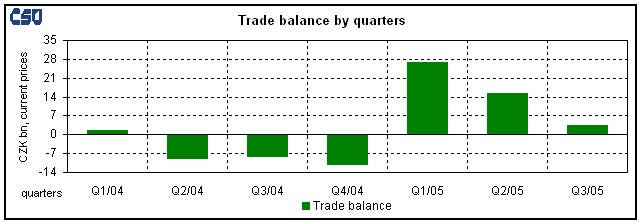
Among the positive ones were in particular:
- foreign direct investment (FDI) inward flows in the last years. Whereas in the past production plants newly built with the help of FDI in the area of manufacturing were more demanding for imports of machinery and equipment and put a strain on the trade balance, nowadays the output of these newly built production plants increasingly results in higher output of manufacturing. Manufacturing output has an important share in the current favourable development of exports of goods demanded abroad and at the same time opens the way for some sub-deliveries to domestic production, which reduces the need of imports. This particularly applies to the boosting output of new production plants in the area of motorcar industry, manufacture of electrical machinery and equipment, but also to manufacture of rubber and plastic products, manufacture of metals and fabricated metal products. FDI inward flows continue in 2005 and in January-August net FDI inward flows reached CZK 185.5 billion (according to CNB data). Nevertheless, this figure was affected by the sale of government holding in Telecom and Unipetrol to external investors;
- development of industrial production. In January-August 2005, the industrial production index reached 105.6, direct export sales at current prices grew by 8.0% year-on-year, of which by 8.1% in manufacturing. The growing output of manufacturing industries 3 (predominantly of the above-mentioned newly built production plants) had a decisive share in the year-on-year increase in exports. Exports of manufacturing industries in January-September 2005 were up by CZK 99.0 billion year-on-year and their share in the growth of total exports was 91.0%. The surplus of external trade in products of manufacturing reached CZK 123.0 billion in Q1-Q3 2005, which was by CZK 81.3 billion more year-on-year.
The most important item of exports of manufacturing industries were road vehicles which had a share of 16.1% in total exports in Q1-Q3 2005 as against 15.0% in the corresponding period of 2004, among them in particular passenger cars (a share of 7.8% as against 6.8%) and motor vehicle parts and accessories (a share of 7.2% as against 7.1%). Passenger cars had a share of a fifth in the growth of total exports and motor vehicle parts and accessories 8%. The surplus of external trade in passenger cars increased from CZK 46.8 billion in Q1-Q3 2004 to CZK 74.5 billion in Q1-Q3 2005 and surplus of trade in motor vehicle parts and accessories from CZK 42.0 billion to CZK 43.3 billion. From among products of mechanical engineering, a high increase was also recorded for exports of office machinery and automatic data processing machines, which led to an improvement of the surplus of trade in these products by CZK 16.7 billion. A positive influence on increasing exports was the growing output of ‘chemicals, chemical products and man-made fibres’ and ‘rubber and plastic products’, which at the same time made possible to reduce imports of these products. This in total affected lower deficit of trade in ‘medicinal and pharmaceutical products’, ‘plastics in primary forms’, ‘plastics in non-primary forms’ and ‘chemical materials and products, n.e.s.’ (in total by CZK 5.4 billion);
- lower imports of machinery and equipment, in particular of ‘machinery specialized for particular industries’, ‘metalworking machinery’ and ‘general industrial machinery and equipment, n.e.s.’, due to a change in the structure of domestic investment demand. Imports of these items were by CZK 13.8 billion lower year-on-year;
- improving external trade balance with states where the deficit was very high in the past. For example, some of the EU25 states, such as Italy or France, but also China, Japan and the United States can be mentioned.
External trade balance was negatively affected by:
- export and import prices 4 . In January-August 2005, export prices dropped by 0.7% and import prices were lower by 0.1%, all year-on-year. Fluctuations of external trade prices were primarily influenced by the development of prices in the world market and by appreciation of CZK against EUR and USD. In January-September 2005, compared to the corresponding period of 2004, CZK strengthened by 7.4% on average against EUR and by 10.7% on average against USD. In the January-September period, CZK was weakest against EUR in 1999 (EUR 1 = CZK 37.063) and against USD in 2001 (USD 1 = CZK 37.379). In January-September 2005, world prices of industrial raw materials and food grew by 39.9% 5 in total year-on-year. This growth was strongly affected by prices of petroleum and natural gas in the world market, which were up by 49.6% year-on-year. Just the higher prices of petroleum and natural gas had a negative impact on trade balance and considerably lowered the achieved surplus of the total trade balance. In Q1-Q3 2005, balance of external trade in ‘petroleum, petroleum products and related materials’ ended in deficit CZK 62.9 billion, as against deficit CZK 44.9 billion in Q1-Q3 2004, and trade in ‘gas, natural and manufactured’ run deficit CZK 34.3 billion, as against CZK 23.4 billion. On higher deficit of trade in ‘petroleum, petroleum products and related materials’ had a greater influence (CZK 15.4 billion) higher prices, the effect of higher volume was CZK 2.6 billion, deficit of trade in ‘gas, natural and manufactured’ was due to higher prices (CZK 9.2 billion) and due to higher volume (CZK 1.7 billion). The unfavourable impact of prices of mineral fuels was somewhat cushioned by appreciation of CZK against USD;
- domestic consumer demand. In January-August 2005, retail sales at current prices rose by 2.6% year-on-year (of which food by 2.8 % and non-food goods by 2.5 %). There were higher imports of some kinds of food products and miscellaneous manufactured articles in order to meet internal demand. In Q1-Q3 2005, significant increases were reported for example for imports of meat and meat products, dairy products and eggs, vegetables and fruit, sugar and sugar preparations, tobacco and tobacco manufactures (in total by CZK 8.1 billion), furniture and parts thereof, wearing apparel and accessories and footwear (in total by CZK 7.4 billion). These selected commodity groups affected year-on-year deterioration of the trade balance by CZK 3.4 billion;
- import of fighters Jas-Gripen for CZK 10.3 billion, which took place in April 2005 (CZK 4.4 billion) and in August 2005 (CZK 5.9 billion);
- economic situation in the world and particularly in the Euro-zone states where economic growth remains sluggish. Improvement in the economic development of the Euro-zone observed in Q1 2005 (1.3%) seems to have been only temporary because GDP in Q2 2005 grew less (by 1.1%). Economic growth in the Euro-zone was marked particularly by the development in Germany, which has the highest share in external trade of the Czech Republic.
A more detailed view of external trade in Q1-Q3 2005 shows that, in terms of year-on-year comparison:
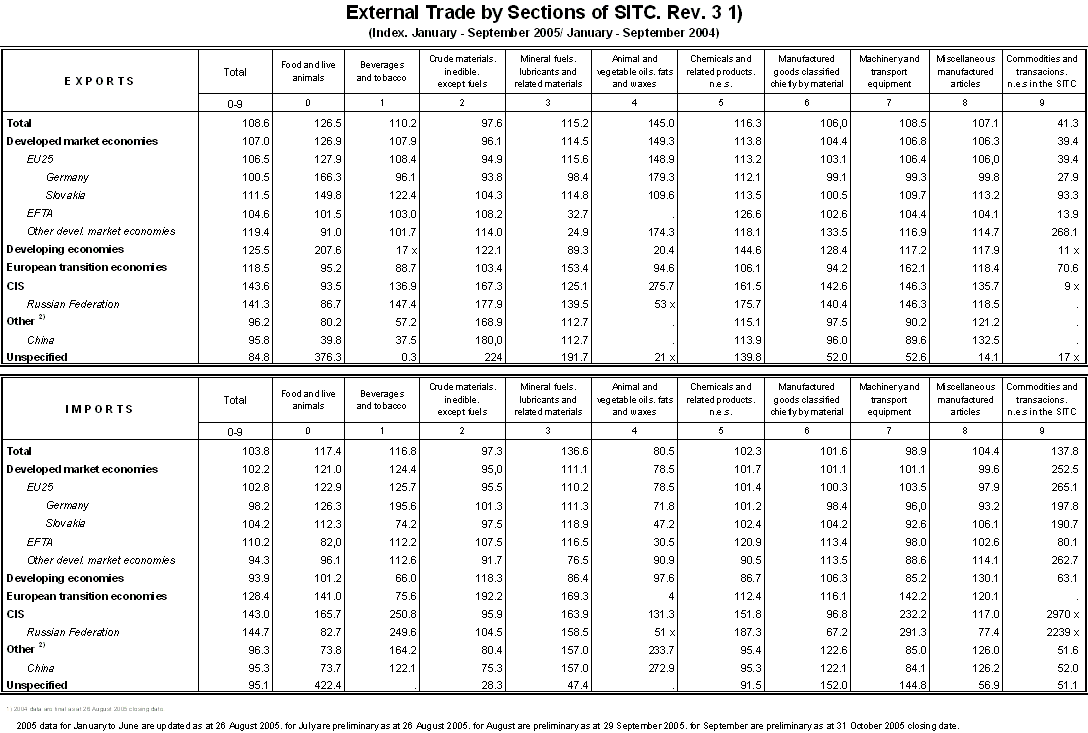
- exports to all main groups of countries (except for ‘other states’ 6 ) rose. High relative increases in exports were obvious in exports to CIS countries, developing economies and European transition economies and strengthened the position of these groups of countries in total exports (from 7.6% to 9.0%). The highest absolute increase in exports (although the growth rate was below-the-average) is attributable to higher exports to developed market economies and the EU25 states by CZK 81.6 billion and CZK 70.8 billion, respectively. An above-the-average increase was recorded for exports to other developed market economies (in particular to the United States and Japan). The total rise in exports to the EU25 states reflected considerably different dynamics of exports to individual states. Exports to most of the EU25 states were on the increase, exports to Germany actually stagnated, and decreases were recorded for exports to the Netherlands and to Austria. In relation to other states, worth mentioning are higher exports to Russia and to the Ukraine and markedly lower exports to China;
- imports from developed market economies, CIS countries and European transition economies were higher, whereas imports from developing economies and ‘other states’ fell. The growth of imports from developed market economies by CZK 22.9 billion resulted mainly from higher imports from the EU25 states by CZK 25.9 billion, imports from other developed market economies dropped by CZK 3.0 billion (in particular from the United States and Japan). Increase in imports from the EU25 states was below the growth was recorded particularly for imports from Sweden and the Netherlands, and also from Hungary, Poland, Belgium and Slovakia, decreases were observed for imports from Germany, the United Kingdom, Italy and France. As to imports from other states, worth mentioning are lower imports from China and higher imports from Russia and the Ukraine;
- active external trade balance resulted from an increase in surplus of trade with developed market economies by CZK 58.7 billion and with European transition economies by CZK 2.7 billion and from lower deficit of trade with developing economies by CZK 14.9 billion and with ‘other states’ by CZK 2.3 billion. Deficit of external trade with CIS countries was up by CZK 17.8 billion. The highest surplus resulted from trade with developed market economies (CZK 169.5 billion) and the EU25 states (CZK 214.5 billion) because the balance of trade with other developed market economies was passive (by CZK 45.1 billion). Surplus of the balance of trade with the EU25 states was by CZK 44.9 billion higher year-on-year. The highest increases were observed in surplus with Germany (by CZK 10.0 billion), Slovakia (by CZK 9.1 billion) and the United Kingdom (by CZK 7.0 billion), deficit dropped significantly in trade with Italy (by CZK 6.8 billion), and a turn from deficit to surplus amounted to an improvement in balance of trade with France by CZK 17.6 billion. Considerable deterioration was recorded for positive balance with the Netherlands (by CZK 21.1 billion) and Sweden (by CZK 4.2 billion). Among other states, high deficit was run in trade with China (CZK 57.7 billion), although it was by CZK 2.8 billion lower year-on-year, and with Russia (CZK 50.1 billion), which grew by CZK 15.9 billion year-on-year. Deficit fell in trade with Japan (by CZK 4.6 billion) and with the United States (by CZK 11.9 billion).
Changes in commodity structure of external trade in Q1-Q3 2005, in comparison to Q1-Q3 2004, were noticeable in:
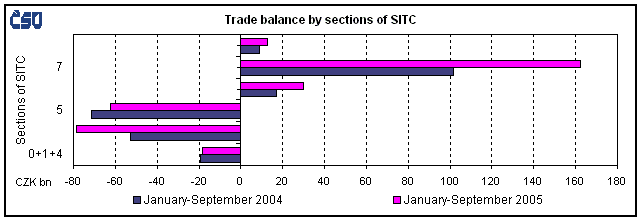
- machinery and transport equipment by growing exports by 8.5%, i.e. CZK 54.4 billion. Higher exports of machinery and transport equipment accounted for nearly 50% of increase in total exports. On the other hand, imports of machinery and equipment were down by 1.1%, i.e. CZK 5.9 billion. Surplus of trade in machinery and transport equipment reached CZK 162.1 billion and was by CZK 60.3 billion up;
- manufactured goods classified chiefly by material by below-the-average dynamics of exports (6.0%) and in particular of imports (1.6%). Surplus of balance of trade in manufactured goods classified chiefly by material rose by CZK 12.8 billion;
- miscellaneous manufactured articles by higher surplus by CZK 3.7 billion thanks to exports growing faster (6.8%) than imports (4.5%);
- chemicals and related products by a high increase in exports (by 16.3%) and low increase in imports (by 2.3%). While the passive balance of trade in these products decreased by CZK 8.9 billion, it still reached CZK 62.3 billion;
- crude materials, inedible, and mineral fuels by the highest rise (effected by mineral fuel prices) in imports (by 24.4%, i.e. CZK 30.5 billion) among all SITC sections and below-the-average (6.5%) rise in exports. This development led to year-on-year deterioration of passive balance in this SITC section by CZK 25.8 billion;
- agricultural and food crude materials and products by the highest growth rate of exports among all SITC sections (24.3%) and a highly above-the-average growth of imports (15.5%). Higher growth of exports than imports showed itself in a moderate decrease of deficit (by CZK 0.8 billion).
| Sections of SITC, Rev. 3 | Sections of SITC, Rev. 3 | ||
| 0+1+4 | agricultural and food crude materials and products | 6 | manufactured goods classified chiefly by material |
| 2+3 | crude materials, inedible, and mineral fuels | 7 | machinery and transport equipment |
| 5 | chemicals and related products | 8+9 | miscellaneous manufactured articles, commodities and transactions not classified elsewhere in the SITC |
1 All the data are at current prices. Data for 2004 are final referring to 26 August 2005 closing date, data for January-June 2005 are updated referring to 26 August 2005 closing date, data for July 2005 are preliminary referring to 26 august 2005 closing date, data for August 2005 are preliminary referring to 29 September 2005 closing date, and data for September 2005 are preliminary referring to 31 October 2005 closing date.
2 External trade balance for January-September 2005 reached the best level, if compared with annual data, in the history of the Czech Republic.
| Year | 1993 | 1994 | 1995 | 1996 | 1997 | 1998 | 1999 | 2000 | 2001 | 2002 | 2003 | 2004 | 2004 | 2005 |
Q1-Q3 | ||||||||||||||
| Balance, CZK billion | -4.5 | -39.5 | -99.6 | -153.0 | -150.4 | -80.2 | -64.4 | -120.8 | -117.4 | -70.8 | -69.8 | -26.4 | -15.4 | 45.3 |
3 Items CZ-CPA15 to CZ-CPA36.
4 Import and export price indices in the CR are published later than data on external trade of the CR.
5 See World Price Indices of Raw Materials and Food in September 2005, CZSO, October 2005.
6 China, North Korea, Cuba, Laos, Mongolia and Vietnam.