External trade - 1. quarter of 2007
Product Code: e-6032-07
External trade in the first quarter of 2007
In the first quarter of 2007 external trade 1 continued growing at a double-digit rate. In comparison to the first quarter of 2006:
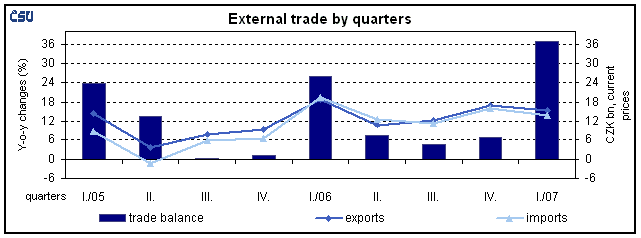
- increase in exports was by 1.5 p.p. higher than increase in imports - exports grew by 15.3% year-on-year and reached CZK 591.0 billion, imports rose by 13.8% year-on-year and stood at CZK 554.0 billion. External trade turnover was higher by 14.6% (CZK 145.7 billion) year-on-year and reached CZK 1 145.0 billion; the turnover growth was due to increases in exports by CZK 78.4 billion (a 53.8% share in the growth) and imports by CZK 67.3 billion (a 46.2% share). Due to the appreciation of CZK in particular against USD and also against EUR, exports and imports in these currencies grew faster - exports and imports in USD by 28.2% and 26.6% respectively, exports and imports in EUR by 17.6% and 16.1% respectively;
- external trade balance reached a surplus of CZK 37.0 billion (the rate of coverage of imports by exports was 106.7%), which was by CZK 11.1 billion more year-on-year. By group of countries 2 , trade surplus rose with EU27 member states (by CZK 21.0 billion), surplus with European transition economies decreased by CZK 1.0 billion, trade deficit with CIS 3 countries improved by CZK 4.8 billion, trade deficit deteriorated with other states 4 (by CZK 10.5 billion) and with developing economies (by CZK 3.8 billion). By commodity section, the trade balance improved year-on-year due to a CZK 10.8 billion decrease of deficit in ‘crude materials, inedible, and mineral fuels‘, a CZK 6.7 billion increase of surplus in ‘machinery and transport equipment’ and a CZK 2.2 billion increase of surplus in ‘miscellaneous manufactured articles‘; on the other hand, the external trade balance deteriorated due to a CZK 4.3 billion decrease of surplus in ‘miscellaneous manufactured articles’, a CZK 3.7 billion increase of deficit in ‘chemicals and related products’ and a CZK 0.6 billion increase of deficit in ‘agricultural and food crude materials and products’;
- by group of countries, the position of EU27 member states strengthened in both total exports and total imports. With the shares of 86.1% in total exports and 71.5% in total imports, these states played a key role in the external trade. A positive feature was that the shares of the EFTA 5 states and other states in total exports moderately increased. With the exception of CIS countries, EFTA states and other developed market economies 6 , imports from all other groups of countries grew, most markedly imports from other states;
- by commodity section, exports and imports grew in all SITC sections (except ‘crude materials, inedible, and mineral fuels’). Above-the-average increases, which significantly determined the dynamics of total exports, were registered for exports of ‘machinery and transport equipment’, whereby their share in total exports rose from 53.8% to 54.1%, and for exports of ‘manufactured goods classified chiefly by material’. Imports of ‘manufactured goods classified chiefly by material’ and ‘machinery and transport equipment’ rose more than the average. These two SITC sections raised their shares in total imports at the expense of all other sections of the SITC. A year-on-year decrease in imports was observed for ‘crude materials, inedible, and mineral fuels’ whose share in total imports dropped by 2.5 p.p. year-on-year.
In comparison to external trade of the EU27 and external trade of the new member states, the dynamics of external trade in the Czech Republic was higher at the start of 2007. Data for January 2007 released by Eurostat on 17 April 2007 say that EU27 (EU15) exports rose by 10.0% (9.0%) and EU27 (EU15) imports by 7.8% (6.3%) on average year-on-year. Exports and imports of the 12 new member states were higher by 19.7% and 23.3% respectively on average year-on-year. In January 2007 the share of the 12 new member states in total EU27 exports increased to 9.7% from 8.8% in January 2006 and their share in total EU27 imports grew to 10.6% from 9.2% in January 2006. The EU27 trade balance reached a EUR 10.2 billion deficit in January 2007 (EU15 deficit was EUR 6.6 billion and 12 new member states’ deficit EUR 3.6 billion). As the only one among the new EU member states, the Czech Republic recorded a trade surplus in January 2007.
The external trade results in the first quarter of 2007 were affected in particular by:
- the continuing growth of industrial production. In January-February 2007 the y-o-y industrial production index reached 113.0, of which 115.1 in ‘manufacturing’. The biggest year-on-year increase was recorded in ‘manufacture of electrical and optical equipment’ (+32.4%). The rise in manufacturing 7 (especially in its divisions to which massive foreign direct investments boosted by investment incentives were directed) had a decisive share in the year-on-year increase of total exports. In the first quarter of 2007 manufacturing exports were by 16.0% higher year-on-year and accounted for nearly 97% of total exports.
The most dynamic items of manufacturing exports in the first quarter of 2007 were ‘telecommunications equipment’ and ‘office machines and automatic data-processing machines’. ‘Road vehicles’ retained the strongest position in exports. Exports of road vehicles made up 17.6% of total exports in the first quarter of 2007 (18.8% in Q1 2006), of which exports of passenger cars 9.1% (10.4%) and exports of ‘parts and accessories for motor vehicles’ 7.3% (7.4%). The surplus of external trade in road vehicles rose from CZK 54.2 billion in the first quarter of 2006 to CZK 55.5 billion in the first quarter of 2007, of which surplus in passenger cars decreased from CZK 42.5 billion to CZK 41.0 billion and surplus in parts and accessories for motor vehicles grew from CTK 15.6 billion to CZK 18.3 billion. The high rise in exports of ‘telecommunications equipment’ (+44.0%) and ‘office machines and automatic data-processing machines’ (+26.3%) was simultaneous with a marked increase of their imports (+57.1% and +44.0% respectively), which resulted in lower surpluses in these items year-on-year (down CZK 1.0 billion and CZK 1.8 billion respectively). An above-the-average rise in exports of ‘machinery specialized for particular industries’ led to a higher surplus in this item by CZK 1.3 billion, and a drop in imports of ‘electrical machinery and apparatus’ turned the deficit of CZK 1.3 billion into a surplus of CZK 3.9 billion;
- favourable terms of trade figures. 8 Export prices in January-February 2007 were up by 1.9% year-on-year on average and import prices were down by 1.6% on average. External trade prices were affected predominantly by prices in the world market and by the strengthening of CZK against EUR and against USD. In January-March 2007, in comparison to January-March 2006, CZK appreciated by 2.0% against EUR on average and by 11.2% against USD on average. The world prices of raw materials and food increased by 2.8% 9 year-on-year in the first quarter of 2007. This moderate growth was influenced by a year -on-year fall in petroleum prices (-6.7%) and a year-on-year increase in natural gas prices (+6.8%); world prices of the predominating majority of commodities grew more than the average (e.g., world prices of metals +39.0%, textile raw materials +9.0%, and food and oils +15.6%). Just the prices of petroleum and natural gas had, together with the insignificantly higher and lower respectively volume of their imports, a favourable impact on the trade balance. Trade deficit in ‘petroleum, petroleum products and related materials’ stood at CZK 22.3 billion in the first quarter of 2007 (down by CZK 3.0 billion year-on-year) and deficit in ‘gas, natural and manufactured’ was CZK 13.9 billion (down by CZK 2.4 billion year-on-year);
- economic growth (although milder) in the world and especially in the EU member states, in particular in Germany (GDP up by 2.4%). A strong economic growth in 2007 is predicted also for Slovakia. With the shares of 32.1% and 8.4%, these two states were among the most important destinations of Czech exports in the first quarter of 2007. Economic growth in the EU27 could, for the first time since 2000, surpass that in the United States, which should weaken year-on-year (GDP up by 2.3%); this would slow down economic growth in the world (4.9%). It is China and India that will support world economic growth.
A more detailed view of external trade by group of countries in the first quarter of 2007 compared with the first quarter of 2006 reveals that:
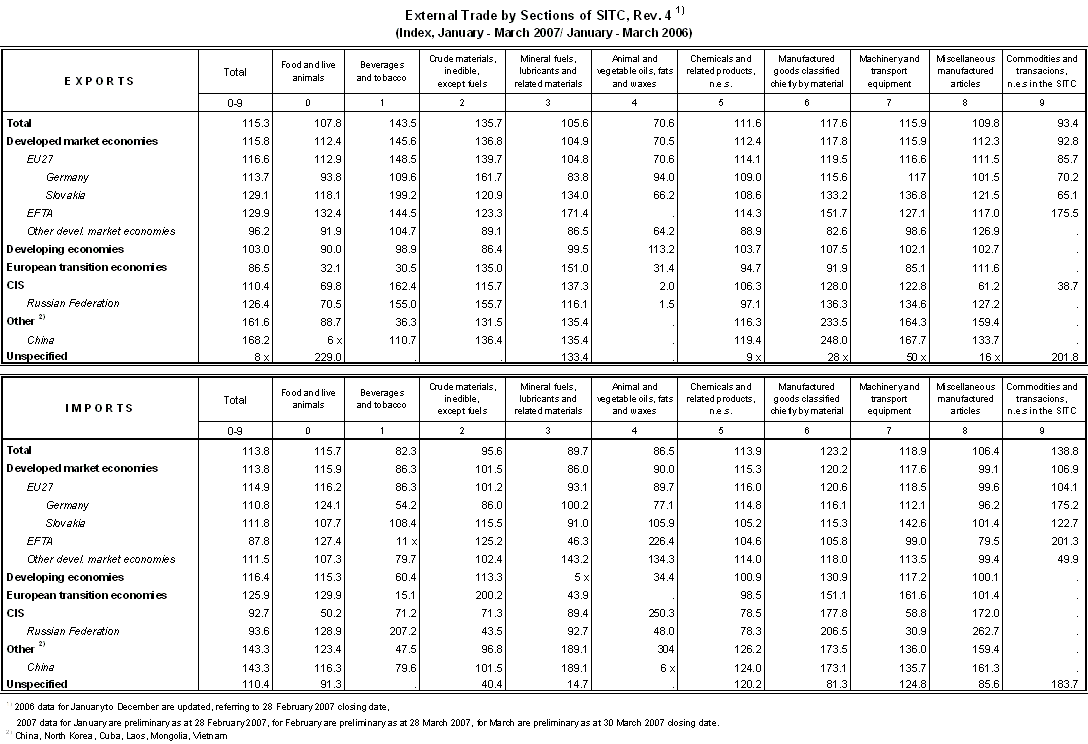
- total exports to all groups of countries increased, with the exception of exports to European transition economies and to other developed market economies (due to lower exports to the United States and Canada). Above-the-average dynamics were observed in exports to EU27 member states, EFTA states (mainly to Norway and Switzerland), and in particular to other states (an impact of growing exports to China) whose share in total exports is, however, still insignificant. Over 92% of the absolute increase in total exports is (under a year-on-year growth of 16.6%) attributable to an increase of CZK 72.3 billion in exports to EU27 member states. The total rise in exports to EU27 member states reflected different dynamics of exports to individual EU27 member states. Exports to the prevailing number of the EU27 member states increased more than the average - for example exports to Hungary, Slovakia, Sweden, Poland, the Netherlands, Slovenia, Italy and the United Kingdom; lower dynamics were recorded for exports to Germany (nevertheless, the absolute growth of CZK 22.8 billion belonged to the highest ones and contributed with more than 29% to the growth of total exports), Austria, Spain, Romania, France and Belgium. Worth mentioning are also higher exports to Russia and lower exports to Ukraine;
- total imports from all groups of countries grew, except imports from CIS countries (mainly due to lower imports from Russia) and from the EFTA states (affected especially by lower imports from Norway and Switzerland). Above-the-average increases were recorded for imports from other states, European transition economies, developing economies and EU27 member states. Imports from other developed market economies rose less than the average of total imports. The achieved dynamics of imports from EU27 member states (+14.9% year-on-year) affected an absolute increase of CZK 51.3 billion in imports, which made up over 72% of the total imports growth. Imports from Hungary, Denmark, Finland, Belgium, France, Sweden, Italy, the Netherlands and Austria grew above the average, imports from the United Kingdom recorded the average growth, imports from Poland, Slovakia, Germany and Spain increased slightly below the average, and imports from Romania dropped. Worth mentioning among other states is the growth of imports from China (by CZK 11.4 billion) and Korea;
- the external trade balance resulted from a surplus with EU27 member states (CZK 112.6 billion) and a deficit with the non-EU27 states (CZK 75.6 billion).
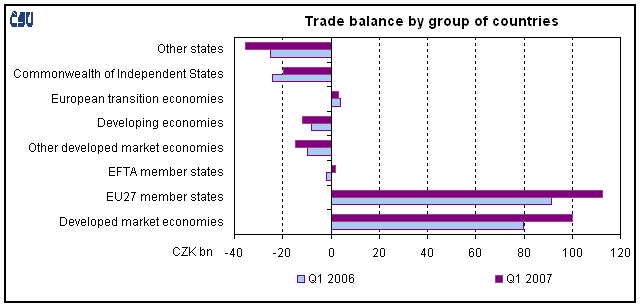
Among the EU27 member states, surplus rose especially in trade with Slovakia, Germany, the United Kingdom, Sweden, Italy, Romania, Spain, Hungary and Austria. The deficit turned into a surplus with Poland and the Netherlands. The active balance with France and Belgium decreased. Among other non-EU27 states is worth mentioning a high deficit of trade with China (CZK 34.7 billion) which was by CZK 10.2 billion higher year-on-year, and with Russia (CZK 17.2 billion) which was by CZK 4.4 billion lower year-on-year. Also deficit with Japan and Korea increased. A turn from surplus to deficit deteriorated the external trade balance with the United States and Canada. The trade balance with Norway and Switzerland improved as the deficit turned into a surplus. A marked decrease in surplus was recorded for trade with Ukraine.
The commodity structure of external trade in the first quarter of 2007, in comparison to the first quarter of 2006, was characterised in:
- machinery and transport equipment by an above-the-average growth of exports and especially of imports and hence by a strengthening of the position of these products in total exports (by 0.3 p.p.) and total imports (by 1.8 p.p.). Higher exports (imports) of ‘machinery and transport equipment’ by CZK 43.8 billion (CZK 37.1 billion) accounted for 55.9% (55.1%) of the increase in total exports (total imports). The surplus of trade in machinery and transport equipment reached CZK 86.2 billion. The highest surplus was produced by ‘road vehicles’ (CZK 55.5 billion), followed by ‘general industrial machinery and equipment, n.e.s., and machine parts, n.e.s.’ (CZK 10.1 billion), ‘office machines and automatic data-processing machines’ (CZK 8.2 billion), ‘machinery specialized for particular industries’ (CZK 5.2 billion) and ‘electrical machinery and apparatus, n.e.s.’ (CZK 3.9 billion);
- manufactured goods classified chiefly by material by above-the-average dynamics of exports and especially of imports and hence by increases of their shares in total exports (from 20.6% to 21.9%) and total imports (from 20.2% to 21.9%). The trade surplus in these goods dropped from CZK 7.3 billion to CZK 3.0 billion year-on-year. This fall was mainly due to the growth of deficits in ‘iron and steel’ from CZK 2.5 billion to CZK 7.0 billion and ‘non-ferrous metals’ from CZK 9.2 billion to CZK 12.9 billion. The highest surpluses were concentrated in ‘manufactures of metals, n.e.s.’ (CZK 8.9 billion), ‘non-metallic mineral manufactures, n.e.s.’ (CZK 7.8 billion) and ‘rubber manufactures, n.e.s.’ (CZK 5.8 billion);
- miscellaneous manufactured articles, commodities and transactions not classified elsewhere in the SITC by below-the-average dynamics of exports and especially of imports, which raised the surplus from CZK 5.3 billion to CZK 7.5 billion and weakened the share of these products in exports by 0.4 p.p. and in imports by 1.7 p.p. A growth of surplus was recorded only for ‘prefabricated buildings, sanitary, plumbing, heating and lighting fixtures and fittings, n.e.s.’ from CZK 3.0 billion to CZK 3.4 billion; surplus in ‘furniture and parts thereof’ dropped from CZK 6.2 billion to CZK 5.6 billion. Deficit in ‘footwear’ decreased insignificantly and deficit in ‘articles of apparel and clothing accessories’ turned into a slight surplus;
- chemicals and related products by below-the-average dynamics of exports and average growth of imports. External trade deficit in these products was the second highest (nearly CZK 25 billion) and rose by CZK 3.7 billion year-on-year. The biggest deficit kept concentrating in ‘medicinal and pharmaceutical products’ (CZK 9.5 billion) and was by CZK 0.8 billion higher year-on-year. Deficits of trade in ‘plastics in non-primary forms’ grew from CZK 3.1 billion to CZK 4.1 billion and in ‘plastics in primary forms’ from CZK 3.8 billion to CZK 4.8 billion;
- crude materials, inedible, and mineral fuels by the highest relative growth of exports among all SITC sections and by a decrease in imports (by 9.0% year-on-year). This resulted in a rise in the share of these products in total exports from 5.0% to 5.2% year-o-year and a fall of their position in total imports from 12.9% to 10.4%. The deficit in this group of products, in spite of a year-on-year drop from CZK 37.3 billion to CZK 26.5 billion, remained the highest among all sections of the SITC. Besides the aforementioned deficit in ‘petroleum, petroleum products and related materials’ and ‘gas, natural and manufactured’, the trade balance was affected by increases of surplus in ‘cork and wood’ and ‘electric current’, and by the deficit turning into a surplus in ‘metalliferous ores and metal scrap’;
- agricultural and food crude materials and products by a below-the-average growth of exports and imports, by a weakening of their position in external trade and by a year-on-year increase in trade deficit from CZK 7.8 billion to CZK 8.4 billion. The deficit in ‘vegetables and fruits’ grew by CZK 0.8 billion, deficit in ‘tobacco and tobacco manufactures’ dropped from CZK 1.8 billion to CZK 0.6 billion, and surplus in ‘cereals and cereal preparations’ decreased.

| Sections of SITC, Rev. 4 | Sections of SITC, Rev. 4 | ||
| 0+1+4 | Agricultural and food crude materials and products | 6 | Manufactured goods classified chiefly by material |
| 2+3 | Crude materials, inedible, and mineral fuels | 7 | Machinery and transport equipment |
| 5 | Chemicals and related products | 8+9 | Miscellaneous manufactured articles, commodities and transactions not classified elsewhere in the SITC |
1 All data are at current prices. Data for January-December 2006 are updated referring to 28 February 2007 closing date. Data for 2007 are preliminary: data for January refer to 28 February 2007 closing date, for February to 28 March 2007 closing date, and for March to 30 April 2007 closing date.
2 In January 2007 Bulgaria and Romania joined the European Union. The accession of these states to the EU caused changes in the membership of the following groups of countries – developed market economies, the EU and European transition economies. To maintain the data comparability, all data for Q1 2006 have been recalculated to the comparable membership effective since 2007.
3 The Commonwealth of Independent States.
4 China, North Korea, Cuba, Laos, Mongolia and Vietnam.
5 The European Free Trade Association.
6 Developed market economies, except the EU27 member states and the EFTA states.
7 Items CZ-CPA 15 to CZ-CPA 36.
8 The import and export price indices in the CR are published later than data on the external trade of the CR.
9 See the CZSO World Price Indices of Industrial Raw Materials and Food in March 2007, CZSO, April 2007.