
External trade - 1. quarter of 2004
Product Code: e-6032-04
External trade in the 1st quarter of 2004
Compared to the 1st quarter of 2003, external trade 1 was accompanied by many changes, which showed themselves in:
- favourable dynamics 2 . The rates of growth of exports and imports contributed to higher external trade turnover (+CZK 77.8 bn, i.e. 11.6%). The value of external trade turnover reached CZK 749.0 bn;
- lower dynamics in terms of EUR and considerably higher dynamics in USD , than in CZK;
- significant decrease in deficit . Trade gap was by CZK 3.0 bn lower, as a result of completely different development in individual months – after a slight deficit in January, the balance of trade was active in February (the coverage of imports by exports reached 103.0%) and passive in March (the coverage of imports by exports was 96.8%);
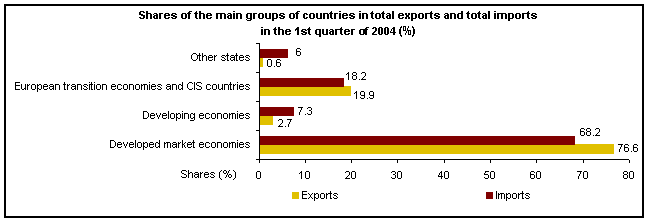
- orientation with respect to groups of countries – by weakening proportion of developed market economies in total exports, with the simultaneous strengthening of their position in total imports. The proportion of European transition economies and CIS countries grew significantly in total exports and decreased in total imports. Related to developed market economies or EU states 3 and to European transition economies and CIS countries, trade surpluses rose, which largely compensated for the continuing fall in trade balance with other states 4 and with other developed market economies (primarily with Japan and the USA);
- commodity structure – by rising exports in all SITC sections (the highest increases were reported for raw products and materials 5 and miscellaneous manufactured articles) and higher imports in all SITC sections, except for mineral fuels, lubricants and related materials (the highest rise in raw products and materials, followed by chemicals and related products n.e.s. where the highest trade gap kept on running);
- currency structure – by a higher share of exports and imports in terms of EUR, with a simultaneous lower share of exports and imports in terms of USD. Exports growing faster than imports affected an increase in surplus of external trade in terms of EUR from CZK 8.0 bn to CZK 14.1 bn, whereas a fall in exports, under simultaneous strongly below-the-average rising imports, raised the trade gap in terms of USD from CZK 18.3 bn to CZK 25.8 bn;
- weakening of the role of inward processing , due to insignificant y-o-y growth rates of exports after inward processing (+1.1%) and imports for inward processing (+2.0%).
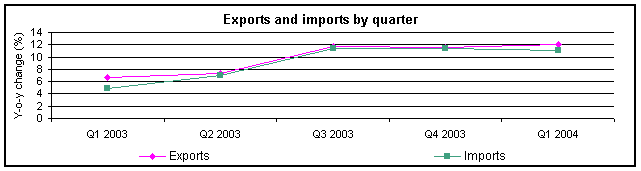
- export and import prices 6 . Together with changes in CZK/EUR and CZK/USD exchange rates, the movement of external trade prices reflected the development of world market prices 7 . In January-February 2004, export prices were up 2.3% and import prices down 0.3% y-o-y. This development was affected by higher export prices in all commodity sections, particularly in mineral fuels, lubricants and related materials, raw products and materials and machinery and transport equipment, and by lower import prices, primarily prices of mineral fuels, lubricants and related materials and machinery and transport equipment. The decrease in import prices was cushioned by higher prices of raw products and materials. January-February 2004 terms of trade reached 102.6 y-o-y. External trade prices had a positive impact on trade gap at current prices. Their effect in January-February 2004 amounted to CZK 5.5 bn (conversely, in the 1st quarter of 2003, these prices acted towards higher deficit of trade at current prices). In January-February 2004, constant price exports and imports grew by 6.0% and 5.9% y-o-y, respectively;
- CZK/EUR and CZK/USD foreign exchange rates , which continued developing quite differently. Compared to the 1st quarter of 2003, CZK depreciated by 3.7% against EUR and appreciated by 12.1% on average against USD. Weak CZK against EUR was in favour of EUR exports, and strong CZK against USD contributed to less expensive USD imports (particularly imports of petroleum, natural gas and consumer goods);
- growth of industrial production and sales in industry , direct export sales (+11.5% y-o-y at current prices in January-February 2004) having approximately a half share in the latter. Higher industrial production (e.g. rise in manufacture of basic metals and fabricated metal products affected, inter alia, by a global boom) raised export funds. Higher industrial production caused, at the same time, higher needs of imports, because production is highly import-intensive;
- domestic consumer demand , which weakened, compared with the preceding period. This is proved by retail sales that grew by only 1.6% y-o-y at current prices in January-February 2004. Domestic investment demand showed certain indications of recovery.
- inward flow of foreign direct investments (according to the monthly balance of payments of the Czech National Bank, net FDI inflow in January-February 2004 was CZK 17.4 bn);
- external demand , primarily affected by economic recovery in the Euro-zone states. This is proved, e.g., by a further increase of Germany’s 8 share in total exports (from 36.6% in the 1st quarter of 2003 to 37.6% a year later).
A closer look at external trade in the 1st quarter of 2004, compared to the 1st quarter of 2003, reveals that:
- exports grew by CZK 40.4 bn, i.e. 12.1%, and reached CZK 373.9 bn; their proportion in the increase of external trade turnover was 51.9%. In terms of EUR and USD, exports were by 7.9% and 25.6% higher, respectively. Exports rose in relation to all the main groups of countries, but the growth rates varied. Above-the-average dynamics (18,1%), recorded for exports to European transition economies and CIS countries, resulted in an increase in exports to these states of CZK 11.4 bn. The growth was contributed to by CEFTA, particularly Poland, Hungary and Slovakia (together +CZK 9.5 bn), exports to Russia went up insignificantly. A high growth rate (+52.8%) was reported for exports to other states, where exports to China played the decisive role (with a 91.4% share). The value of exports to these states remained low, representing a mere 11% of imports from them. Exports to developing economies actually stagnated at the 1st quarter of 2003 level. A below-the-average growth rate, particularly due to a fall in exports to the EFTA states, low increase in exports to other developed market economies and a below-the-average growth rate of exports to EU states, characterised exports to developed market economies. In spite of this, these states accounted for 71.1% of the total growth of export value, of which the EU states 69.1%. Particularly exports to Germany, which rose by CZK 18.8 bn (15.4%), had a positive impact on exports to the EU states. Above-the-average growth was recorded for exports to Austria, Belgium and Italy, which together account for 28.0% of growth in exports to the EU states, low increases were reported for exports to France and Great Britain, exports to the Netherlands even dropped by 8.3% y-o-y;
- imports were up CZK 37.4 bn, i.e. 11.1%, and reached CZK 375.1 bn; their share in the growth of external trade turnover was 48.1%. In terms of EUR and USD, imports rose by 6.9% and 24.4%, respectively. With the exception of developing economies, imports from all the other groups of countries went up. The growth rates varied. An above-the-average increase (+11.6%) was reported for imports from developed market economies, due to higher imports from other developed market economies, particularly from Japan (+35.0%) and the USA (+23.6%). A rise in imports from the EU states of CZK 21.0 bn, i.e. 10.5%, was affected by higher imports from Italy, France and the Netherlands (together +CZK 5.9 bn), and particularly by higher imports from Germany (+CZK 11.0 bn) that accounted for 52.3% of increase in imports from the EU states. The highest relative growth was reported for imports from other states (due to imports from China); the value of these imports was up CZK 4.5 bn (of which China +CZK 4.4 bn). A below-the-average rise in imports from European transition economies and CIS countries was particularly owing to lower imports from Russia (-1.8%), for imports from the CEFTA states (excl. Slovakia) grew at high rates. Imports from developing economies saw a moderate decrease;
- exports after inward processing and imports for inward processing rose insignificantly (+1.1% and +2.0%, respectively), which affected a decrease in the share of inward and outward processing from 28.5% to 25.7% in total exports and from 20.5% to 18.8% in total imports. Exports after inward processing amounted to CZK 96.1 bn and imports for inward processing reached CZK 70.5 bn. The surplus of inward processing remained roughly at the 1st quarter of 2003 level (CZK 25.5 bn as against CZK 25.8 bn), and its positive impact on the total balance of trade was preserved. With a share of 18.8% in total exports after inward processing, computers (in spite of lower exports) were the most important item of exports after inward processing; telecommunication equipment, with a share of 24.6% in total imports for inward processing (+7.1%), was the main item of imports for inward processing;
- commodity structure recorded some changes, particularly in:
. below-the-average rise in exports of machines and transport equipment and above-the-average increase in their imports. The position of these products weakened from 51.4% to 50.2% of total exports and strengthened from 42.1% to 42.3% of total imports. Higher growth of imports than that of exports affected a moderate decrease in the surplus of external trade in machinery and transport equipment; nevertheless, the surplus remained the highest among all SITC sections (CZK 29.1 bn) and compensated for deficits of trade in a number of SITC sections;
. above-the-average dynamics of exports and imports of raw products and materials , which proved the second most important position in total exports (23.3%) and total imports (20.9%). The surplus of external trade in these commodities grew from CZK 7.8 bn to CZK 9.0 bn;
. higher surplus (+CZK 2.4 bn) of trade in miscellaneous manufactured articles , affected by exports rising faster than imports;
. higher growth of imports than that of exports of chemicals and related products n.e.s. , which led to a higher deficit (by CZK 3.1 bn) of trade in these commodities; it was the highest deficit among all SITC sections (CZK 21.8 bn);
. growing exports (+CZK 1.4 bn) and decreasing imports (-CZK 1.7 bn) of crude materials, inedible, and mineral fuels , which led to a lower deficit of trade in these commodities by CZK 3.2 bn. This development was heavily influenced by export and import prices of mineral fuels, lubricants and related materials 9 ;
. increase in the deficit of trade in agricultural and food crude materials and products .
____________________________
1 All the data are given at current prices. The 2003 data are updated as at 17 February 2004 closing date, the January 2004 data are preliminary as at 17 February 2004 closing data, the February 2004 data are preliminary as at 16 March 2004 closing date, and the March 2004 data are preliminary as at 19 April 2004 closing date.
2 This external trade dynamics is also favourable in comparison with external trade trends in the EU15. According to the first estimate for January-February 2004 released by Eurostat on 20 April 2004, EU15 exports and imports to and from third countries fell by 1% and 2% y-o-y, respectively; EU15 Intra-trade stagnated.
3 After joining the EU, export and import orientation of the Czech Republic on the EU will be further strengthened. If external trade of the Czech Republic in the 1st quarter of 2004 with the other acceding countries is added to external trade with the present EU members, exports to the enlarged EU25 would be by CZK 60.5 bn (22.8%) higher and imports from EU25 by CZK 44.3 bn (20.1%) higher. The surplus of trade with the states of the enlarged EU25 would rise by CZK 16.2 bn to reach CZK 61.2 bn, whereas trade with other states (outside the EU) would run a deficit of CZK 62.4 bn. Shifts in external trade orientation by group of countries in favour of EU states will prevail and will largely affect external trade with European transition economies and CIS countries.
4 China, North Korea, Cuba, Laos, Mongolia, and Vietnam.
5 SITC 6 – Manufactured goods classified chiefly by material .
6 Import and export price indices are published in the CR one month later than data on external trade of the CR.
7 The CZSO world price index of industrial raw materials and food (Q1 2004/Q1 2003) stood at 105.5 on average.
8 According to a report released by Deutsche Bundesbank on 19 April 2004, Germany’s GDP rose by roughly 1.25% y-o-y in the 1st quarter of 2004. This Europe’s largest economy has a share of 30% in the economic output of the Euro-zone.
9 In January-February 2004, export prices of mineral fuels, lubricants and related materials grew by 7.6%, while import prices fell by 12.1%; all y-o-y.