Development of the industry - 4. quarter of 2004
Product Code: e-8019-04
Development of the industry in the year 2004
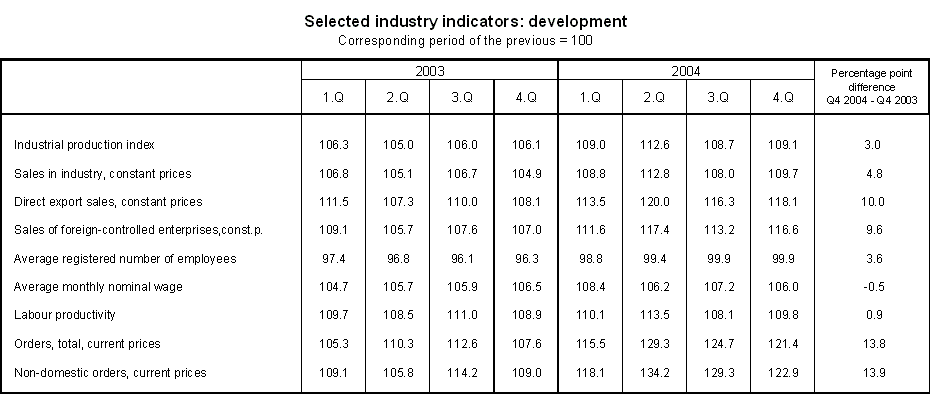
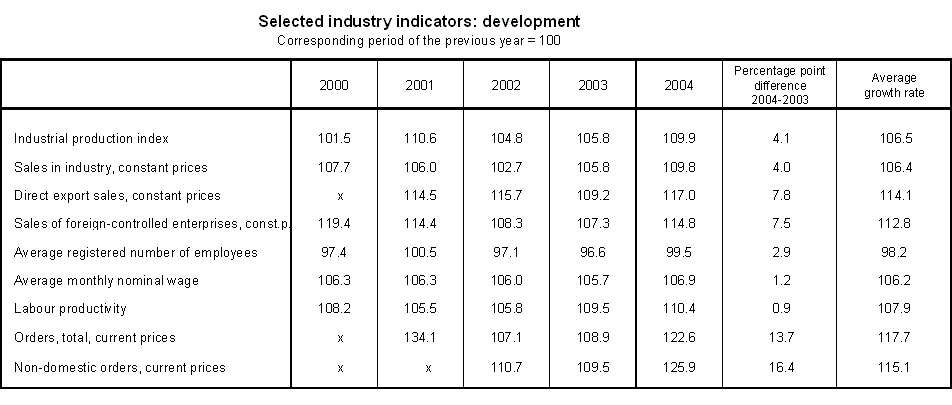
In the year 2004 the industry went on growing significantly, resuming its growth trend of the previous years. Both the industrial output, sales and direct exports of industrial enterprises went up, as also did the labour productivity and average nominal wages.
The key factors of the industrial growth in the year 2004 were:
– continued start-ups of new production capacities, especially of foreign investors (mostly for the production of motor vehicle parts and accessories)
- continued boom in the iron and steel market
- continued revival of non-domestic orders in the electrical engineering
- stable deliveries from energy-producing sector to manufacturing, which covered all demands from the new production capacities
- continued favourable impact of the worldwide economical revival, which significantly affected the exports of industrial enterprises (to the EU in particular).
Production
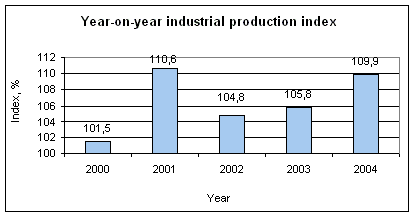
The year-on-year index of industrial production reached 109.9% in the year 2004. The highest growth was recorded in:
- manufacture of basic metals and fabricated metal products (+23.0%)
- manufacture of electrical and optical equipment (+15.3%)
- manufacture of transport equipment (+14.3%).
Industrial production decreased in:
- manufacture of leather and leather products (-5.5%)
- mining and quarrying of energy-producing materials (-2.5%)
- manufacture of textiles and textile products (-0.8%)
In the year 2004, industrial production increased in the following main industrial groupings: capital goods (+15.2%), intermediate goods (+12.9%), consumer durables (+11.2%), consumer non-durables (+2.5%), and energy (+1.6%).
Sales
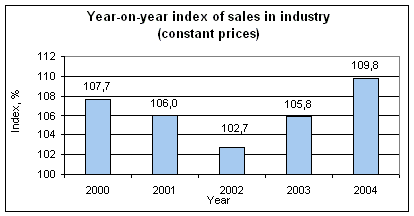
In the year 2004, sales in industry (at constant prices) were higher by 9.8% year-on-year, growing most in manufacture of electrical and optical equipment (+31.4%), manufacture of machinery and equipment (+12.9%), manufacture of transport equipment (+12.4%), and manufacture of rubber and plastic products (+11.8%). They decreased in manufacture of coke and refined petroleum products (-10.5%), mining and quarrying of energy-producing materials (-2.4%), manufacture of food, beverages and tobacco (-1.1%), and manufacture of textile and textile products (-0.6%).
Territorially (breakdown by region of the enterprise’s head office), sales grew fastest in the Moravskoslezský Region (index 124.8%) and slowest in the Hl. m. Praha Region (index 107.8%).
Broken down by size (number of employees) group of enterprises, sales grew fastest in the group of enterprises with 2500-2999 employees (131.4%) and dropped in the group of enterprises with up to 24 employees (81.9%).
Direct exports
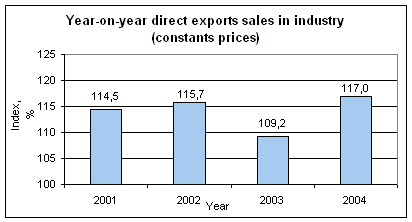
Direct export sales of industrial enterprises increased by 17.0% at constant prices (19.7% at current prices), and their share in total sales of industrial enterprises stood at 49.1%. The largest growth at constant prices occurred in the manufacture of electrical and optical equipment (+37.9%), manufacture of machinery and equipment (+18.9%) and manufacture of rubber and plastic products (+16.6%). The biggest decreases were recorded for electricity, gas and water supply (-35.3%), manufacture of coke and refined petroleum products (-12.0%) and mining and quarrying of energy producing materials (-9.1%).
The average growth rate of direct export sales in January-April 2004 and from 1 May 2004 (after the accession to the EU) stood at 112.9% and 119.0%, respectively.
Foreign-controlled enterprises
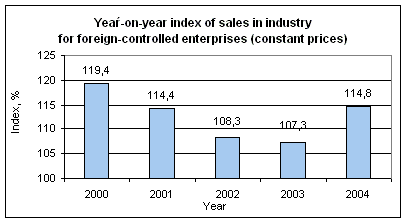
Sales in industry achieved by foreign-controlled enterprises grew by 14.8% at constant prices (17.0% at current prices), and their share in total sales stood at 52.8%. Direct export sales of these enterprises increased by 20.0% (21.6% at current prices) and accounted for 72.8% of total sales.
In the year 2004, there were 1 842 foreign-controlled enterprises operating in the industry; they employed 425.6 thousand persons. The average monthly nominal wage was by 11.9% up on the average monthly nominal wage of the total industry.
Employment
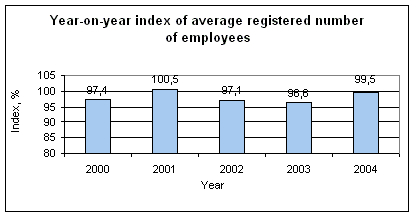
In the year 2004, employment in the industry decreased by 5.7 thousand persons (-0.5%), most in the following industries:
- manufacture of textile and textile products (-8.0%)
- manufacture of leather and leather products (-7.4%)
- mining and quarrying of energy producing materials (-5.2%)
Growth of employment was recorded for:
– manufacture of rubber and plastic products (+5.7%)
- manufacture of electrical and optical equipment (+5.4%)
- manufacture of transport equipment (+3.0%)
The year-on-year development of the number of employed persons in the regions is characterized by relative stability (from 98.2% to 103.8%). The biggest year-on-year drop in the average number of employees occurred in the Jihomoravský Region (index 98.2%, i.e. by 1 990 employees), the Karlovarský Region (index 98.3%, i.e. by 600 employees), the Hl. m. Praha Region (index 98.4%, i.e. by 1 662 employees), the Moravskoslezský Region (index 98.6%, i.e. by 2 005 employees), the Jihočeský Region (index 98.7; i.e. by 878 employees), and the Zlínský Region (index 99.0%, i.e. by 697 employees).
The highest and the only substantial growth of the average number of employees occurred in the Plzeňský Region (index 103.8%, i.e. by 2 669 employees).
Broken down by size group, the employment grew fastest in the group of enterprises with 3000-3999 employees (index 117.5%). The biggest decrease in employment occurred in the group of enterprises with less than 25 employees (index 79.6%).
Wages
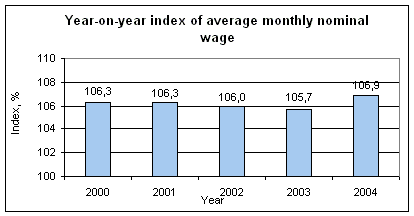
Average monthly nominal wage in the industry reached CZK 17 460 in the year 2004 and was by 6.9% up year-on-year.
The highest level of wages was recorded for:
- manufacture of coke and refined petroleum products
- electricity, gas and water supply
- mining and quarrying of energy-producing material, while
the lowest level of wages was recorded for:
- manufacture of leather and leather products
- manufacture of textiles and textile products
- manufacturing, n.e.c.
The greatest year-on-year growth of the average monthly nominal wage was in the Hl. m. Praha Region (CZK +1 034; +107.0%) and the greatest year-on-year growth rate of the average monthly nominal wage was recorded in the Vysočina Region (CZK +1 383; +109.0%), which is based, however, on the below-average base of 2003 (CZK 15 022).
The smallest year-on-year growth rate of the average monthly nominal wage occurred in the Zlínský Region (105.9%), which, with the very low base of the year 2003 (CZK 15 000), translates into a CZK 887 increase in the average monthly nominal wage.
Generally, the smallest absolute increases in the average monthly nominal wage are seen in regions with a below-average index and a below-average wage in the year 2003. The Olomoucký , Vysočina and Liberecký Regions are exception, as they show an above-average growth of wages and an above-average absolute increase of wages but with the below-average base of the year 2003. Hence, there are still regional differences in the average monthly nominal wage.
Broken down by size groups, wages grew in all of them, but most in the group of enterprises with 5000-9999 employees (index 109.6%). In groups of enterprises with a higher number of employees, the average monthly nominal wage grew even faster.
Labour productivity
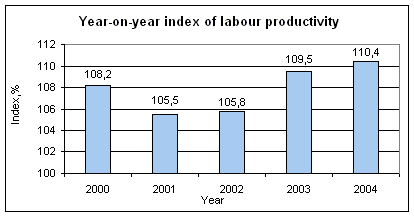
In the year 2004, labour productivity in the industry went up by 10.4%, growing faster than average monthly nominal wage. Unit wage costs dropped by 3.2%.
New orders (selected industries)
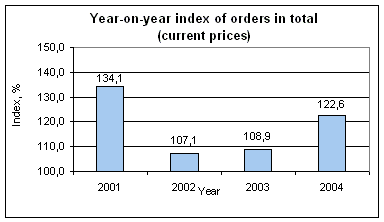
In the year 2004, new orders worth CZK 1 344.8 billion were signed and their volume was 22.6% up on the year 2003. The growth in new orders was ascertained in:
– manufacture of basic metals and fabricated metal products (+39.5%)
- manufacture of office machinery and computers (+36.9%)
- manufacture of other transport equipment (+35.1%).
A drop in new orders was ascertained in:
– manufacture of wearing apparel; dressing and dyeing of fur (-10.7%).
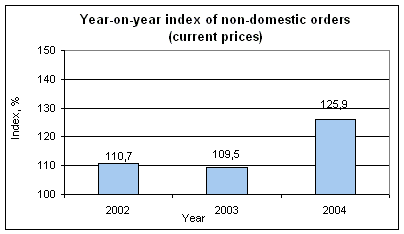
In the year 2004, new non-domestic orders worth CZK 853.3 billion were signed. Their volume was 25.9% up on the year 2003. Increases in the new non-domestic orders were recorded for:
- manufacture of medical, precision and optical instruments, watches and clocks (+46.0%)
- manufacture of electric machinery and apparatus n.e.c. (+39.8%)
- manufacture of basic metals and fabricated metal products (+38.7%).
Decreases in the new non-domestic orders were ascertained in:
– manufacture of other transport equipment (-11.8%)
- manufacture of wearing apparel; dressing and dyeing of fur (-5.9%).
Development of industry in the EU
Change, % | ||||
September 2004 | October 2004 | November 2004 | ||
| Industrial production index (corresponding period of previous year =100) | Eurozone EU 25 EU 15 ČR | 3.5 3.1 2.8 6.8 | 1.1 1.1 0.7 10.8 | 0.5 1.2 0.5 7.4 |
| Index of orders (current prices.) (corresponding period of previous year =100) | Eurozone EU 25 EU 15 ČR | 7.8 6.9 6.6 1.4 | -0.1 0.0 -1.0 20.9 | 12.2 10.4 10.3 20.9 |
| Industrial production index (SA) (previous month =100) | Eurozone EU 25 EU 15 ČR | 0.7 0.6 0.5 0.0 | -0.6 -0.4 -0.5 2.9 | -0.3 -0.2 -0.1 -0.2 |
| Index of orders (SA) (previous month =100) | Eurozone EU 25 EU 15 ČR | 1.6 0.8 1.6 -10.2 | -0.2 0.5 0.1 4.4 | 1.7 0.3 0.7 2.3 |
Source News release - 18 January; Industrial production - Eurostat
News release - 24 January; Industrial new orders - Eurostat
http://europa.eu.int/comm/eurostat/