
Development of the economic activity of the population - 4. quarter of 2004
Product Code: e-3133-04
Development of the economic activity of the population in the 4th quarter of 2004
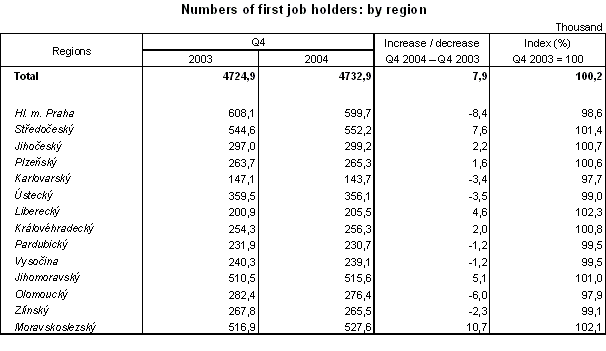
The employment of persons residing in the individual administrative regions of the CR dropped in seven of of the regions, in absolute terms most in Prague and the Olomoucký Region. On the other hand, the number of employed persons increased most in the Moravskoslezský Region, which suffers from chronically high unemployment, and the Středočeský and Jihomoravský Regions. A negative migration balance with some areas of the Středočeský Region noticeably affected the development of the employment in Prague.
The employment in the primary sector (agriculture, forestry, fishing) dropped below 200 thousand persons (198.4 thousand) and only accounted for 4.2% of all first (main) jobholders. The number of persons employed in the secondary sector increased by 8.2 thousand year-on-year to 1 863.0 thousand – i.e. to 39.4% of total employment. This increase was primarily due to a year-on-year 12.6 thousand decrease in employment in the construction which raised the number of employees most in ‘building installations’ (+13.8 thousand), ‘site preparation work’ (+3.8 thousand) and ‘building of complete constructions or parts thereof; civil engineering’ (+3.4 thousand). The employment decreased in ‘building completion’ (-5.3 thousand) as well as in ‘electricity, gas and water supply’, here as a result of a decrease in the number of persons employed in the production and distribution of electricity (-3.5 thousand).
The employment in the sector of services (56.4% of total employment) went up by 15.3 thousand, but the individual branches of the sector developed in an opposing way. It grew especially in ‘health and social care’ (most in human health activities: +27.6 thousand), ‘wholesale and retail trade; repair of motor vehicles, motorcycles and personal and household goods’ (most in ‘wholesale of intermediate products (except agricultural ones), waste and scrap’: +3.6 thousand, and ‘sale of motor vehicles (except for motorcycles’): +3.6 thousand, too), and in ‘education’ (+2.6 thousand in the group ‘adult and other education’).
Conversely, the employment dropped most year-on-year in ‘real estate; renting and business activities‘, by 9.6 thousand, most in ‘miscellaneous business activities n.e.c.’ (-11.5 thousand). ‘Advertising’ classified to this industry recorded an employment increase of 5.5 thousand year-on-year. The employment also dropped in ‘public administration and defence and compulsory social security, by 9.1 thousand, most remarkably in ‘provision of services to the community as a whole’ (-21.8 thousand). A considerable drop in the number of employed persons was measured for transport, storage and communication (-5.7 thousand), the highest being in telecommunications (-3.8 thousand).
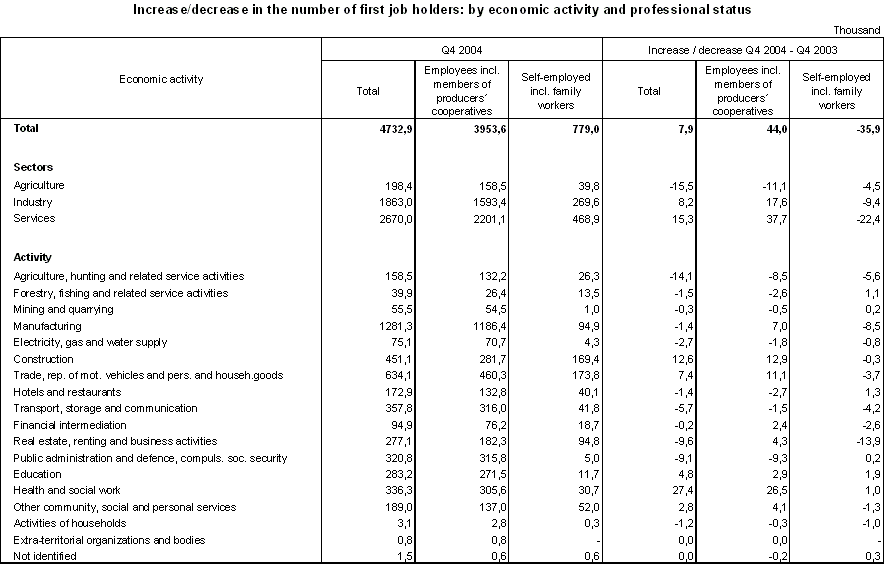
In the secondary and tertiary sectors, the numbers of the employees and the self-employed developed in an opposing way. Typical of the development in the year of 2004 was a drop in the number of the self-employed in most industries . In absolute terms, year-on-year decreases showed themselves most in the group ‘miscellaneous business activities n.e.c.’ (-6.8 thousand), ‘‘building completion’ (-5.5 thousand), ‘other land transport’ (-5.1 thousand), ‘building of complete constructions or parts thereof; civil engineering’ (-4.3 thousand), and ‘other wholesale’ (-4.1 thousand).
The decrease in the self-employed without employees (-30.6 thousand compared to Q4 2003), which considerably cut down on the number of employed persons in the entire business sphere, occurred in many groups of industries (NACE economic activities). The highest decreases in these own-account workers were seen in ‘miscellaneous activities, n.e.c.’ (-5.8 thousand), ‘other land transport’ (-4.1 thousand), ‘non-store retail sale’ (-3.8 thousand), ‘building of complete constructions or parts thereof; civil engineering’ (-3.8 thousand), ‘maintenance and repair of motor vehicles’ (-3.3 thousand), ‘legal and accounting activities, tax consultancy, market research and public opinion polling’ (-3.2 thousand), and ‘building completion’ (-3.1 thousand).
Eurostat data suggest that despite the lower share of the self-employed in total employment in the civilian sector, the share of the business sphere in the Czech Republic still remains above the average in comparison with the other EU member states and Norway. The latest complete data for all the countries are available for Q2 2003, and for information, the following table also lists the latest available data for Q2 2004 which were provided by most of the countries.

The year 2003 saw the highest share of the business sphere in seven of 26 states under observation. Traditionally, the highest share of the self-employed is observed for the Mediterranean states with a high proportion of the primary sector and trade, such as Greece, Portugal, Italy, Cyprus, and Spain, and for two new member states with a high proportion of agricultural small-scale production – in Poland and Lithuania. Similar results are received for Q2 2004 when the share of the self-employed in Ireland exceeded its level in the CR on the one hand, but it dropped below the CR level in Lithuania on the other hand.
Despite the rise in the total employment of the residing population, numbers of unemployed and economically inactive persons increased year-on-year. The number of the unemployed pursuant to ILO methodology was 420.2 thousand in Q4 2004 on average, rising by 5.7 thousand on Q4 2003. The unemployment of older working age persons grew fastest: the number of the unemployed aged 55-59 increased by 17.9% (+4.2 thousand) and of those aged 40-44 by 13.4% (+5.0 thousand), all year-on-year. In spite of the fact that the number of unemployed men (195.9 thousand in total) is lower than that of unemployed women (224.4 thousand), opposite tendencies in the development of these groups of the unemployed are apparent. A year-on-year unemployment growth affected almost the entire group of men aged 15-64 (except the group aged 35-39), whereas the number of all unemployed women dropped by a total of 5.7 thousand over the same period. However, this decrease in the unemployment of women did not occur in women aged 20-29 (a 3.2 thousand increase in unemployed women), 40-44 (+1.5 thousand) and 50-59 (+3.1 thousand).
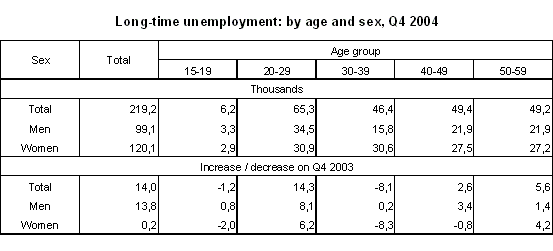
Characteristic of the unemployment development is mainly the fast growth of the number of persons unemployed for a long time (one year or more), by 14.0 thousand. Alarming in particular are increases in numbers of long-time unemployed men aged 20-29 (+8.1 thousand) and women of the same ages (+6.3 thousand) and of unemployed persons aged 50-59 (+5.7 thousand in total, mostly women).
The number of unemployed person with basic education increased by 11.9% year-on-year to 105.7 thousand and of those with secondary education without GCSE by 0.3% to 202.4 thousand. On the other hand, the number of the unemployed with secondary education with GCSE dropped by 5.8% to 97.3 thousand and the number of unemployed university graduates dropped by 0.4% (only 14.8 thousand in total).
The number of the unemployed increased in five regions of the CR, and the increase was considerable especially in the Ústecký and Karlovarský Regions.
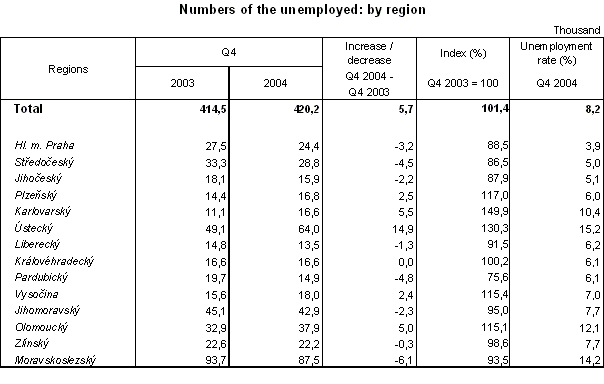
The concurrent growth of the total employment and the number of the unemployed resulted in a relatively low rise in the general unemployment rate, only by 0.1 percentage point to 8.2% year-on-year. The rise only occurred in the male population (+0.4 percentage points to 6.8%), while in the female population the general unemployment rate decreased by 0.3 percentage points to 9.9%.
The number of economically inactive persons aged 15+ (according to LFSS methodology, they are persons who had no job and were not seeking job during last four weeks or failed to meet all conditions laid down for being classified among unemployed persons) increased by 15.0 thousand year-on-year to 3 534.1 thousand in Q4 2004. This category is primarily affected by numbers of pensioners and of persons preparing for their future occupations. The number of basic school pupils decreased by 0.8 thousand. While the number of apprentices dropped by 7.2 thousand, the number of secondary school pupils increased by 5.1 thousand to 378.7 thousand, and that of higher professional school pupils plus university students by 26.4 thousand to 258.5 thousand. The number of economically inactive, normally retired persons who did not actively seek job rose by 4.4 thousand to 1 820.4 thousand, and the number of persons in early retirement dropped by 1.1 thousand to 74.7 thousand. The number of disability pensioners also increased, by 11.5 thousand to 317.5 thousand. These figures cannot accurately correspond to the statistics on pupils and students compiled by the Ministry of Education, Youth and Sports of the CR, or to the numbers of pensioners on records of the Ministry of Labour and Social Affairs of the CR, because the pupils, students or pensioners who qualified for being classified to persons in employment or unemployment in the reference week are not reported as economically inactive. In the other groups of economically inactive persons, a rather marked decrease occurred in the number of persons who cared for family or were house-persons (-9.3 thousand to 325.1 thousand); they were mostly women.