
Development of the economic activity of the population - 3. quarter of 2005
Product Code: e-3133-05
Economic activity of the population in the 3rd quarter of 2005
Employment in the primary sector (agriculture, forestry, fishing) decreased by 16.7 thousand to 190.8 thousand persons and made up only 4.0% of the total number of first (main) job holders. The number of persons employed in the secondary sector (industry, construction) increased by 41.9 thousand year-on-year to 1 895.5 thousand (39.5% of total employment). This growth was mainly affected by the year-on-year increase of 28.2 thousand in employment that occurred in ‘manufacturing’. The number of employed persons went up most in ‘treatment and coating of metals; general mechanical engineering’ (+21.9 thousand), ‘manufacture of other general purpose machinery’ (+8.3 thousand), ‘manufacture of machinery for production and use of mechanical power, except aircraft, vehicle and cycle engines’ (+7.3 thousand) and ‘manufacture of other fabricated metal products’ (+5.7 thousand). Construction (+24.3 thousand in total) saw considerable increases in employment in the areas of building and civil engineering (+18.0 thousand) and building installations (+7.2 thousand).
Employment in the tertiary sector (all divisions of services including transport) increased by 52.3 thousand to 2 707.6 thousand (56.4% of total employment), but it developed in the individual divisions in an opposing way. Employment increased most in ‘education’ (+20.5 thousand), ‘real estate; renting and business activities’ (+19.9 thousand) and ‘public administration and defence; compulsory social security’ (+13.1 thousand). Within the section ‘education’, it grew most in ‘secondary education’ (+10.0 thousand). Within the section ‘real estate; renting and business activities’, the increase showed itself mainly in ‘architectural and engineering activities and related technical consultancy’ and ‘real estate activities on a fee or contract basis’ (both +7.3 thousand). Within the section ‘public administration and defence; compulsory social security’, the number of persons employed in ‘public security, law and order activities’ was up (+10.5 thousand) and the higher number of persons employed in these activities was apparent in a large majority of the regions of the Czech Republic.
On the other hand, employment dropped most year-on-year in ‘wholesale and retail trade; repair of motor vehicles, motorcycles and personal and household goods’ (-18.5 thousand), primarily in ‘retail sale in non-specialized stores’ (-21.5 thousand). Employment dropped also in ‘transport, storage and communications’ (-1.3 thousand), most in ‘transport via railways’ (-4.4 thousand).
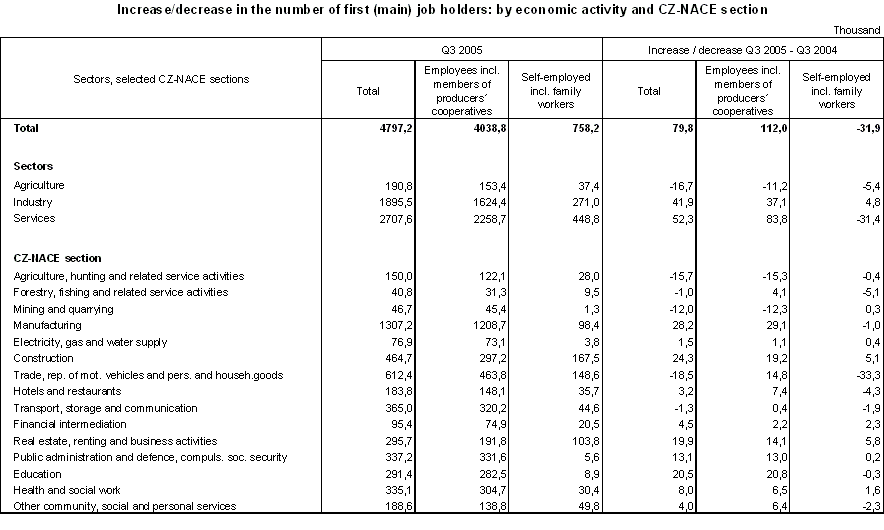
The continuing decrease in the total number of self-employed observed since the beginning of 2004 has been caused in particular by decreasing number of self-employed in ‘trade, repair of motor vehicles, motorcycles and personal and household goods’. Year-on-year decreases in the number of self-employed persons, including contributing family workers, were highest in ‘other retail sale of new goods in specialized stores’ (-10.7 thousand), ‘retail sale in non-specialized stores’ (-5.7 thousand), ‘retail sale not in stores’ (-5.1 thousand), ‘maintenance and repair of motor vehicles’ (except for motorcycles; -4.2 thousand), ‘repair of personal and household goods’ (-3.9 thousand) and ‘wholesale on a fee or contract basis‘ (-3.0 thousand).
The total employment rate of persons aged 15-64 grew year-on-year by 0.8 percentage points to 65.2%. Especially high was the relative increase in the employment of men at working age (+1.0 percentage points to 73.8%), while employment of women was 0.5 percentage points up and reached 56.5%. The employment rate is pushed down by a fast growth of the number of students at universities on the one hand, and, on the other hand, employment of persons throughout the whole working age interval 25-64 is apparently rising.
Compared internationally, the Czech Republic is among the countries with the above-the-average employment intensity in the EU. According to the latest complete data for Q2 2004 released by Eurostat, the employment rate of persons aged 15-64 in the Czech Republic was higher than the total for EU25 and not far from the level in the EU15 (however, we should take account of the fast growth of this indicator in the CR during 2005). Nevertheless, differences in employment rates are considerable, not only if we compare the whole age group 15-64 (in Q2 2004 76.0% in Denmark and only 51.4% in Poland), but also if specific age groups or employment rates of men and women are compared.
According to a decision of the European Council taken in Lisbon 2000 (the Lisbon Strategy) or in Stockholm 2001, the EU member states should reach an employment rate of 70% in the age group 15-64 up to 2010. Four countries (Denmark, the Netherlands, the United Kingdom and Sweden) reached this level in Q1 2005, and some other EU member states are not far from reaching it. It is obvious, however, that some of the new member states (in particular Poland, Malta, Slovakia and Hungary) will have difficulty meeting this goal, and so will some of the EU15 states (especially Greece, Italy and Luxembourg).
The following table shows employment rate for the age group 15-64 and also for the age group 25-54, which leaves aside the young people preparing for their future occupation and a prevailing part of pensioners. Employment rate is given for five-year age groups 55-59 and 60-64. These groups significantly influence the employment level in individual member states. Besides the complete data for Q2 2004, also updated data for Q1 2005 are given.
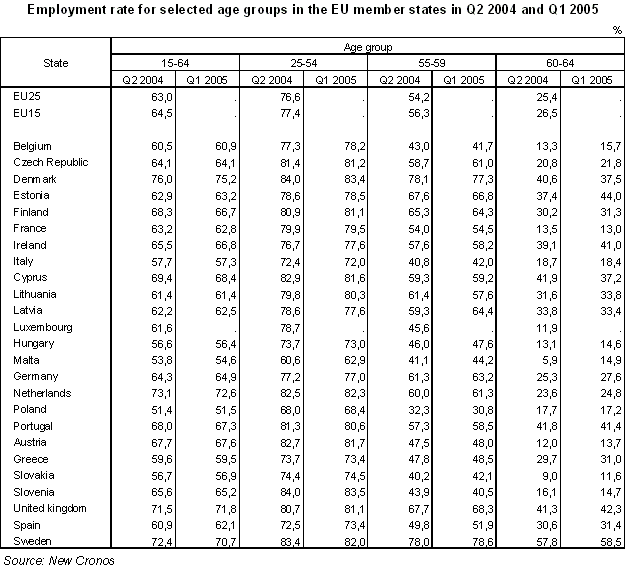
Differences in the employment intensity are considerably affected by legislation in force in individual states, which specifies the age and conditions for normal or early retirement. On top of the aforementioned goal, the Lisbon Strategy supposes that an employment rate of 50% for the age group 55-64 should be reached up to 2010. The CZSO analysis Development of the economic activity of the population in the 2nd quarter of 2005 provided for Q2 2004 detailed data on employment rate of this group of people at the pre-retirement and retirement age for all the EU member states. These data showed that some countries, mainly the Scandinavian ones, but also e.g. the United Kingdom, already met this goal in 2004 and a number of countries were able to raise the employment rate of this age category by more than 10 percentage points in 1998-2004 (for example Finland, Hungary, Latvia and the Netherlands). The Czech Republic is among the countries with the above-the-average growth rate of employment among 55-64-year-old persons not only in the comparable period of 1998-2004, but according to the LFSS results also in the hitherto quarters of 2005. It was just the age group 55-64 where the employment rate in the Czech Republic grew more year-on-year than in any other age group throughout the working age interval (+2.3 percentage points on Q3 2004 to 45.2%).
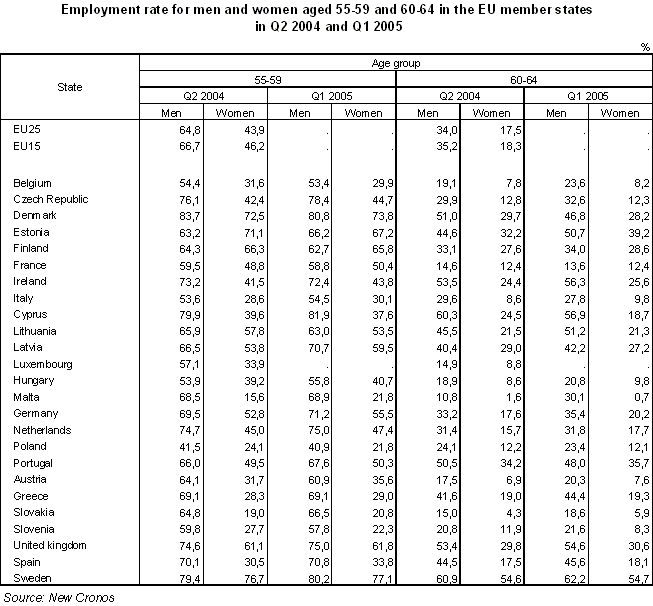
The effect of different retirement age is documented by data on the employment rate of the age groups 55-59 and 60-64 broken down by sex. Whereas the employment rate of men aged 55-59 was in the Czech Republic in Q1 2005 the fourth highest among all the EU member states, employment rate of women was somewhere in the middle of the EU interval. A more difficult situation is in the age group 60-64 where the employment rate in the Czech Republic is rather low among both men and women.
Creation of favourable conditions and job opportunities for persons at the pre-retirement and young retirement age and anticipated changes in legislation should, under the high employment intensity at young and medium working age, decisively influence the employment rate throughout the working age interval 15-64. One of the possibilities is a broader utilisation of part-time jobs, which are in the Czech Republic used by a substantially lower percentage of persons than on average in all the EU25 states, particularly in the EU15. The issue of how frequent part-time jobs are will be dealt with in the analysis of economic activity of the population in Q4 2005.
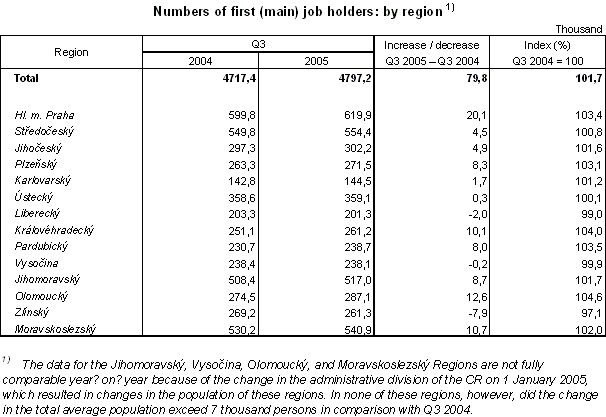
The employment of persons living in the individual regions of the Czech Republic dropped year-on-year in three of them, absolutely most in the Zlínský Region. On the other hand, the number of employed persons increased particularly in the Hl. m. Praha, Olomoucký and Moravskoslezský Regions; the last one chronically suffers from high unemployment.
With the growing total employment of the residing population, the number of the economically inactive and the number of the unemployed decreased. The number of unemployed persons (ILO methodology) reached 404.6 thousand on average in Q3 2005, i.e. a fall of 15.8 thousand year-on-year. The number of the unemployed decreased mainly in young groups of working age, most in the age group 20-24––by 17.9 thousand. The number of unemployed men (178.9 thousand in total) is still below the number of unemployed women (225.7 thousand). Under the total year-on-year drop in unemployment, the unemployment of men decreased by 19.1 thousand, and the decrease was the biggest in the group of 20-24-year-old persons (-13.6 thousand). Over the same period, the number of unemployed women increased by 3.3 thousand in total, and this increase, in spite of a lower number of unemployed young women aged 15-29, occurred in the remaining working age interval of 30-64 years.
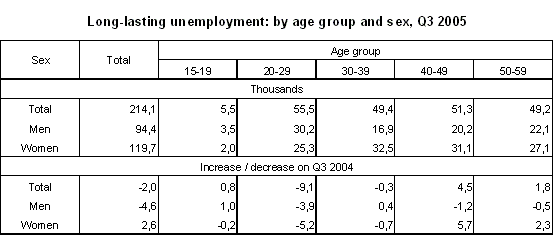
The number of persons unemployed for a long time (1 year or more) fell by 2.0 thousand. In spite of this total drop, a high increase was recorded among women aged 40-59 (+8.1 thousand).
The number of the unemployed with basic education decreased by 9.1% year-on-year to 94.2 thousand and that of unemployed persons with secondary education without GCSE (with secondary vocational education in particular) decreased by 6.0% to 194.6 thousand. The number of the unemployed with secondary (with GCSE) and higher educational attainment somewhat increased, but their unemployment is lower in comparison with the above two groups. The number of the unemployed having secondary education with GCSE grew by 5.0% to 97.5 thousand and the number of unemployed university graduates rose by 8.8% to 18.3 thousand.
Year-on-year, the unemployment dropped particularly in the Olomoucký, Královéhradecký and Pardubický Regions; the situation deteriorated especially in the Zlínský and Karlovarský Regions.
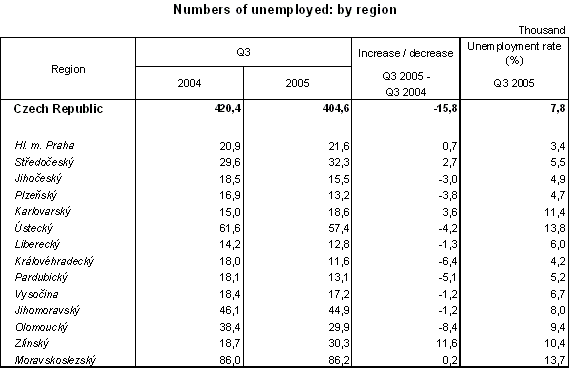
The growth of total employment and the decrease in the number of the unemployed resulted in a relatively high decrease of general unemployment rate (ILO). In comparison to Q3 2004, the general unemployment rate decreased by 0.4 percentage points to 7.8%. It decreased only among the male population (by 0.7 percentage points to 6.2%) and it remained unchanged among the women population (9.8%).
The number of economically inactive persons aged 15+ (according to the LFSS methodology they are persons who had no job and were not seeking a job during last four weeks or did not meet all conditions for being classified among the unemployed) decreased by 16.5 thousand year-on-year and reached 3 522.6 thousand in Q3 2005. This category is primarily affected by numbers of the retired and of persons preparing for their future occupation. The number of basic school pupils increased by 1.7 thousand; the number of apprentices decreased by 2.8 thousand; the number of secondary school pupils went up by 5.6 thousand to 384.9 thousand; the number of university students including higher professional school students grew rapidly, by 17.4 thousand, to 260.9 thousand. The number of economically inactive, normally retired persons not actively seeking job decreased by 9.4 thousand to 1 818.6 thousand and the number of persons in early retirement fell by 6.5 thousand to 67.4 thousand. Furthermore, the number of disability pensioners decreased by 2.3 thousand to 306.9 thousand. These figures cannot accurately correspond to the statistics on pupils and students compiled by the Ministry of Education, Youth and Sports of the CR or to the numbers of pensioners on the records of the Ministry of Labour and Social Affairs of the CR because the pupils, students or pensioners who fulfilled the criterion of being classified among persons in employment or unemployed persons in the reference week are not reported as economically inactive.