Development of the economic activity of the population - 3. quarter of 2004
Product Code: e-3133-04
Development of the economic activity of the population in the 3rd quarter of 2004
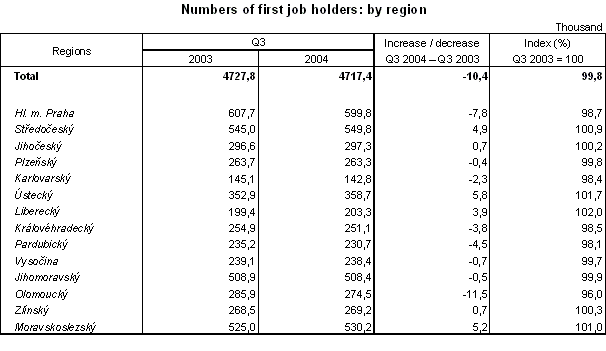
Employment dropped in eight regions of the Czech Republic, most in the Olomoucký Region and in Prague. On the other hand, the number of employed persons increased most in the Ústecký and Moravskoslezský Regions, which chronically suffer from high unemployment, and in the Středočeský Region.
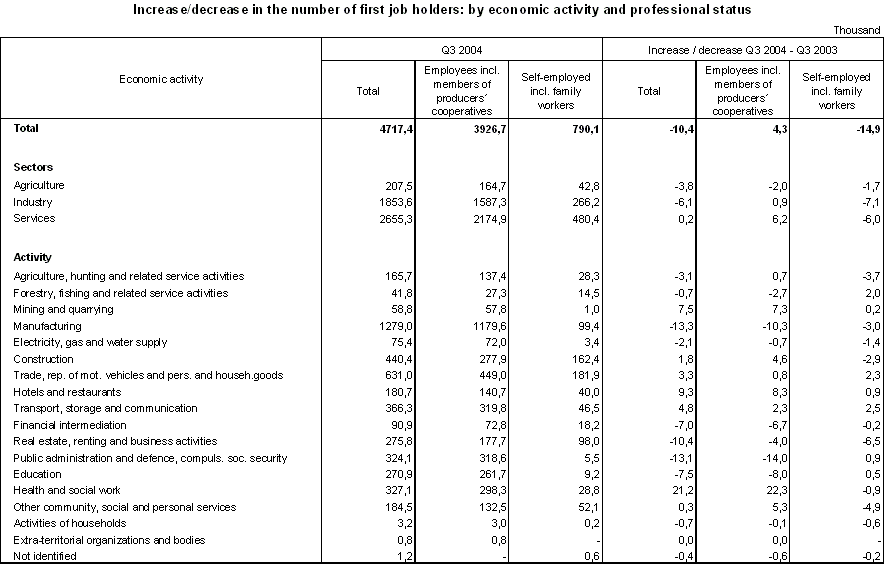
Employment in the primary sector (agriculture, forestry, fishing) dropped below 210 thousand persons (207.5 thousand) and only accounted for 4.4% of total first jobholders. The number of persons employed in the secondary sector decreased by 6.1 thousand year-on-year to 1 853.6 thousand – i.e. to 39.3% of total employment. This decrease was primarily due to a year-on-year 13.3 thousand decrease in employment in manufacturing, with the number of employed persons falling most in manufacture of other non-metallic mineral products (-11.0 thousand), manufacture of wearing apparel (-10.8 thousand), manufacture of machinery and equipment (-8.8 thousand), manufacture of fabricated metal products except machinery and equipment (-8.5 thousand), and manufacture of textiles (-5.7 thousand). On the other hand, more people were employed in manufacture of motor vehicles (+18.3 thousand), manufacture of chemicals and chemical products (+5.7 thousand), manufacture of medical, precision and optical instruments, watches and clocks (+4.4 thousand), and manufacture of electric machinery and apparatus (+3.7 thousand). The higher increase in employment in mining and quarrying was caused first of all by an increase in the number of persons employed in mining and agglomeration of hard coal (+6.3 thousand).
Employment in the sector of services (56.3% of total employment) stagnated, but individual branches of the sector developed differently: the employment grew most in health and social care most in human health activities: +17.1 thousand), hotels and restaurants (most in restaurants and canteens and catering: +3.7 thousand and +3.6 thousand, respectively) and transport (+6.4 thousand in land transport except for transport via railways).
On the other hand, employment dropped most year-on-year in public administration and defence and compulsory social security (-13.1 thousand; especially in provision of services to the community as a whole, -19.5 thousand) and real estate; renting and business activities (-10.4 thousand; most in investigation and security activities, -7.0 thousand). The number of persons employed in education also decreased considerably (-7.5 thousand), of which the number of those in secondary education dropped by 6.1 thousand.
With the decreasing total employment of the residing population, the number of unemployed and economically inactive persons increased year-on-year . The number of the unemployed as defined by ILO methodology was 420.4 thousand on Q3 2004 average, rising by 11.3 thousand year-on-year. The unemployment grew fastest in persons of older working age: the number of the unemployed aged 55-59 increased by 21.3% (+4.7 thousand) year-on-year. In spite of the fact that the number of unemployed men (198.0 thousand in total) is lower than that of unemployed women (222.4 thousand), the opposite tendency in the development of these groups of the unemployed is apparent. The year-on-year growth of unemployment affected the entire group of men aged 15-64, whereas the number of unemployed women dropped by a total of 9.2 thousand over the same period. However, this decrease in the unemployment of women does not concern groups of women aged 25-29 (an increase of +4.1 thousand in unemployed women) and of women aged 55-59 prior to retirement (+1.8 thousand).
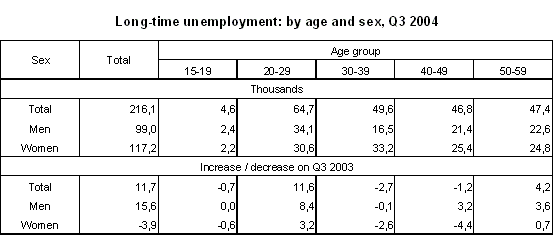
Characteristic of the development of unemployment is the fast growth of the number of persons unemployed for a long time (one year or more) by 11.7 thousand. Alarming in particular is the increase in the number of long-time unemployed men aged 20 to 29 (especially of those with work experience or who had been preparing for their occupation or had been on military service) and of long-time unemployed men in their fifties.
The number of the unemployed with basic education increased by 9.0% year-on-year to 103.6 thousand and of those with secondary education without GCSE by 6.4% to 207.1 thousand. On the other hand, the number of the unemployed with secondary education with GCSE dropped by 10.3% to 92.8 thousand and the number of unemployed university graduates increased by 6.7% (only 16.8 thousand in total).
The rise in unemployment was considerable especially in the Olomoucký and Ústecký Regions, but the unemployed increased in number in most of the other administrative regions of the CR, too.
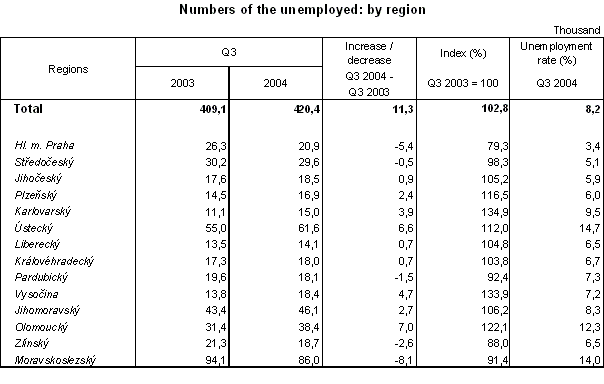
The decrease in total employment and the increase in the number of the unemployed resulted in a relatively high increase in general unemployment rate. This rate rose by 0.2 percentage points to 8.2% year-on-year. Its rise was only observed in the male population (+0.7 percentage points to 6.9%), while in the female population the general unemployment rate decreased by 0.4 percentage points to 9.8%.
The number of economically inactive persons aged 15+ (according to LFSS methodology they are persons who had no job and were not seeking job during last four weeks or failed to meet all conditions for being classified among unemployed persons) increased by 28.5 thousand year-on-year and was 3 539.0 thousand in Q3 2004. This category is primarily affected by the number of pensioners and of persons preparing for their future occupations. The number of basic school pupils rose by 0.4 thousand. While the number of apprentices dropped by 15.9 thousand, the number of secondary school pupils increased by 16.4 thousand to 379.3 thousand and that of higher professional school pupils plus university students rose by 28.3 thousand to 243.5 thousand altogether. The number of economically inactive retired persons who did not actively seek job rose by 15.5 thousand to 1 827.8 thousand and the number of persons in early retirement rose by 1.7 thousand to 73.8 thousand. The number of disability pensioners also increased: by 11.5 thousand to 309.4 thousand. These figures cannot accurately correspond to the statistics on pupils and students of the Ministry of Education, Youth and Sports of the CR or to the numbers of pensioners on records of the Ministry of Labour and Social Affairs of the CR, because the pupils, students or pensioners who qualified for being classified to persons in employment or unemployment in the reference week are not reported as economically inactive. In the other groups of economically inactive persons a rather marked decrease was observed for the number of persons who cared for family or were house-persons (-8.0 thousand to 327.0 thousand); they were mostly women.
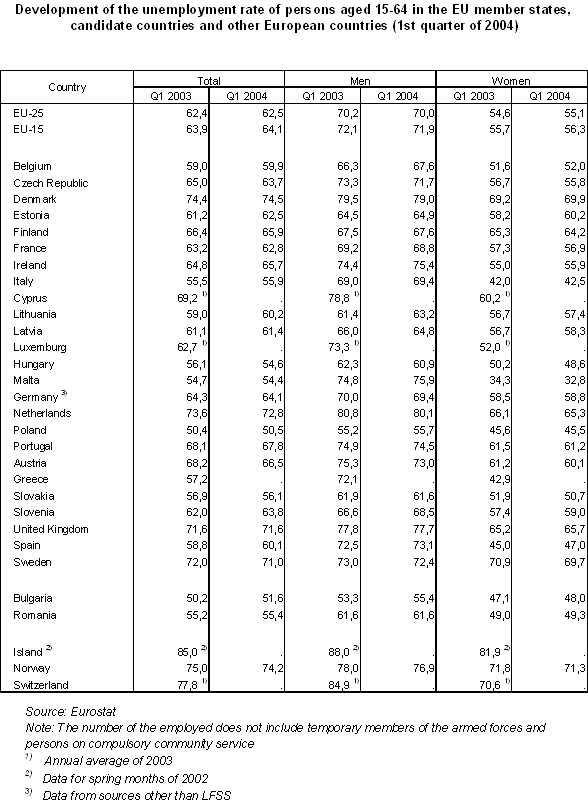
The decrease in the number of the employed and the rise in the number of the unemployed and the economically inactive resulted in a drop in employment rate (the ratio of the number of first jobholders to the number of residents aged 15-64) from 64.7 % in Q3 2003 to 64.4% in Q3 2004. In the framework of its Statistics in Focus series, Eurostat is now preparing information on the labour market development in the 1st quarter of 2004. The information is supposed to include among other things employment rate data for all the EU member states, some candidate countries and other countries such as Island, Norway and Switzerland. The background documents suggest that in the 1st quarter of 2004 the employment rate in the CR was slightly below the average employment rate for the original EU-15. What is rather serious, however, is that this rate shows the strongest tendency to drop in the Czech Republic, and in Austria and Hungary, too.