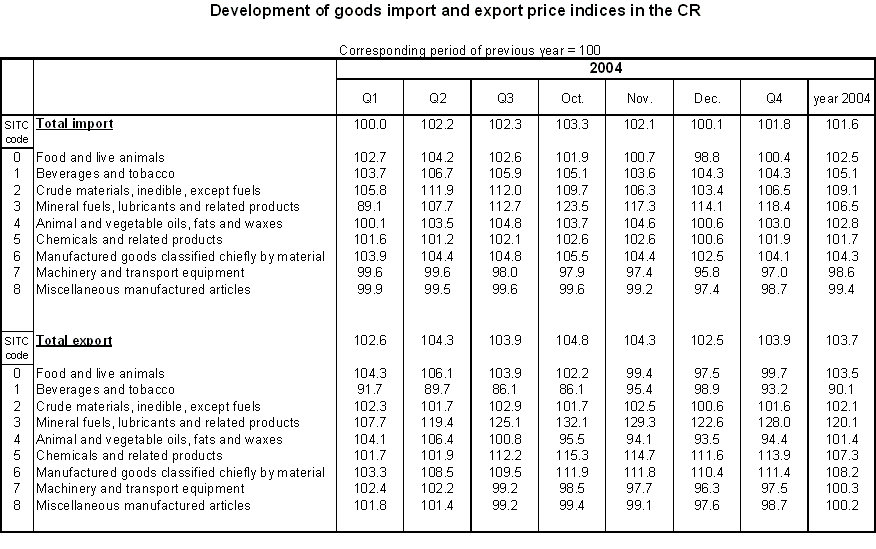
Development of external trade price indices - 4. quarter of 2004 and year 2004
Product Code: e-7232-04
Development of external trade price indices in the fourth quarter of 2004 and 2004
Development of external trade price indices in the fourth quarter of 2004
Month-on-month evaluation:
Import prices were decreasing in the fourth quarter of 2004 in average by 1.0% m-o-m (in the third quarter the average m-o-m growth was 0.5%). Similarly, export prices were decreasing in the fourth quarter in average by 0.5% m-o-m (in the third quarter the average m-o-m growth was 0.4%). Both import and export prices had similar development in the fourth quarter: they were increasing in October and decreasing in November and December. In total, both import and export prices in all significant groups as for weight were decreasing in the fourth quarter.
The biggest price decrease occurred in ‘mineral fuels, lubricants and related materials’; it was -2.7% in imports and –1.8% in exports. In ‘mineral fuels, lubricants and related materials’ also the biggest fall as for percentage points occurred: -6.6% in imports and –5.6% in exports. This development was fully in accord with the price development on world markets; the correlation of m-o-m price indices of petroleum Brent on world markets and the division of petroleum and petroleum products reached the value of 0.90 for imports and 0.88 for exports in 2004. Thus, it was a strong correlation, namely in the situation when the relation of the price of petroleum and petroleum products (significant share in this division especially in exports) is rather loose and, moreover, especially in the situation when petroleum Brent prices are measured in USD on world markets, while external trade price indices are calculated from prices in CZK.
At the same time, relation of external trade price indices to exchange rates of main foreign currencies is very important, even decisive in m-o-m expression as it is exemplified by the following graphs.
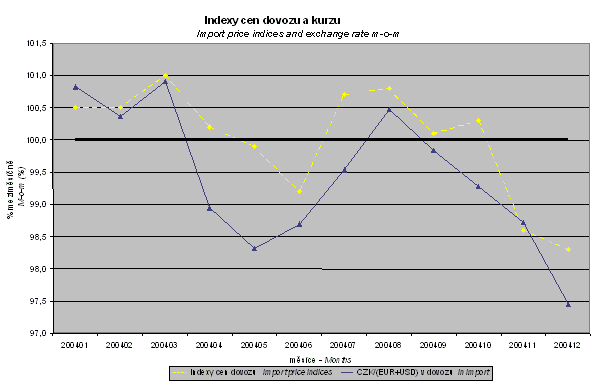
The m-o-m exchange rate index includes two most significant currencies as for the Czech external trade, i.e. EUR and USD; m-o-m exchange rate indices of CZK against these currencies were weighted by the weight pertaining to those foreign currencies in the import price index. The correlation of this total m-o-m import exchange rate index and m-o-m import price index was 0.83 in 2004.
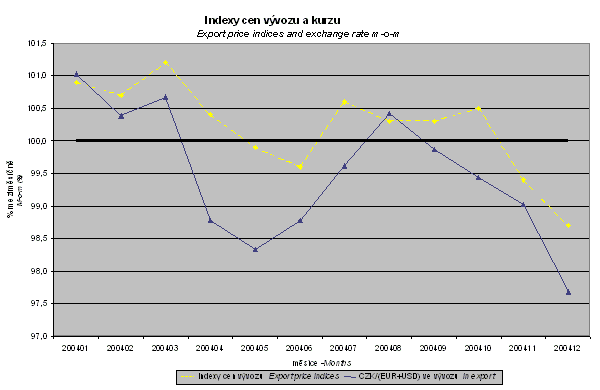
Similarly, when comparing with m-o-m export price indices, the m-o-m exchange rate indices of EUR and USD were weighted by the weight, which pertains to those currencies in the export price index. The correlation of this total m-o-m export exchange rate index and m-o-m export price index was 0.84 in 2004.
Thus, it shows that in the case of both imports and exports, in the m-o-m expression external trade prices have a strong relation to exchange rate influences. It is a rather logical conclusion as contracts with foreign businesses are usually concluded for a longer period, so month-on-month there is “not much happening” in external trade prices on normal conditions at elimination of exchange rate influences.
“Normal conditions”, however, are important for heavy dependence. Marked differences between price and exchange rate indices in the case of imports and exports (as it is obvious also from the graphs) took place besides others especially in May, October and December (usually more than 1 percentage point). In those months, however, world price of petroleum was undergoing a marked change, too, usually by more than 10%.
Year-on-year evaluation:
External trade prices in the fourth quarter were increasing y-o-y, however, their growth was gradually decreasing in individual months. This development was conditioned by strengthening of CZK to main foreign currencies as well as by the development of world prices, especially of petroleum and metals. Y-o-y price index of petroleum Brent was decreasing from 170.3% in October 2004 to 155.0% in November and down to 135.8% in December. Total y-o-y price index of metals on world markets fell from 132.0% to 128.5% and down to 121.5%.
Growth of import prices was decreasing y-o-y during individual months of the fourth quarter from 103.3% to 102.1% and down to 100.1%. In average, import prices increased in the fourth quarter by 1.8%, i.e. by 0.5 percentage point less than in the third quarter. Price growth slowed down y-o-y especially in ‘crude materials, inedible, except fuels’ (112.0% in the third quarter; 106.5% in the fourth quarter) and from that section, in accord with the development on world markets, mainly the division of metalliferous ores and metal scrap, in which prices after a steep increase in the first half-year and a moderate increase in the third quarter started to decrease in the fourth quarter. At the same time, price development of ‘mineral fuels, lubricants and related materials’ (petroleum, petroleum products and related materials in particular) took place in harmony with the development of petroleum prices on world markets: steep growth in October, gradual reduction of increments in the following two months and overall faster growth in the fourth quarter than in the third quarter. Also the most significant section ‘machinery and transport equipment’ deepened its decrease by 1.0 percentage point more (98.0% in the third quarter; 97.0% in the fourth quarter). However, the main reason for that was strengthening of CZK.
Tendencies and influences described for import prices were observed for export prices , too in the fourth quarter. Y-o-y price increase was gradually decreasing in the fourth quarter, however, in comparison with import prices, export prices were increasing in October more rapidly and their decrease in the following two months was slower, so for export prices the y-o-y price growth did not change in the third and fourth quarter – 3.9%. Petroleum price development was reflected again in ‘mineral fuels, lubricants and related materials’ (especially in the price development of petroleum products and coal) – growth +28.0% in the fourth quarter, i.e. by 2.9 percentage points in comparison with the third quarter, however, also for ‘chemicals and related products‘ (mainly for organic chemicals and plastics) – growth +13.9%, i.e. by 1.7 percentage point. In exports, development of prices of metals was reflected especially in ‘manufactured goods classified chiefly by material’ (mainly in the division of iron and steel and manufactures of metals) – increase by 11.4%, i.e. +1.9 percentage point, however, partially also in ‘machinery and transport equipment’ (mainly in the division of metalworking machinery). In total, however, similarly as for import prices, export prices of this section decreased by 2.5% y-o-y, i.e. by 1.7 percentage point more than in the third quarter. Nevertheless, exchange rate influences had main impact there, too.
Terms of trade reached positive value of 102.1% y-o-y in the fourth quarter of 2004 (i.e. by 0.5 percentage point more than in the third quarter of 2004). The highest value was in ‘chemicals and related products‘ (111.8%, mainly due to high export prices of organic chemicals and plastics), followed by ‘mineral fuels, lubricants and related materials’ (108.1%, especially due to high export prices of coal) and 'manufactured goods classified chiefly by material' (107.0%, principally due to still high export prices of iron, steel and manufactures of metals). Terms of trade of ‘machinery and transport equipment’ reached the value of 100.5% in the fourth quarter of 2004, i.e. by 0.7 percentage point less than in the preceding quarter. Of the significant sections as for weights, terms of trade reached negative values only for ‘crude materials, inedible, except fuels’ (95.4%) and ‘food and live animals‘ (99.3%).
Development of external trade price indices in 2004
As it was already shown above, external trade prices are affected by many influences, besides others also by the exchange rate of CZK to foreign currencies. This influence is important and often even decisive, primarily in the m-o-m expression; however, it is not small in y-o-y expression either.
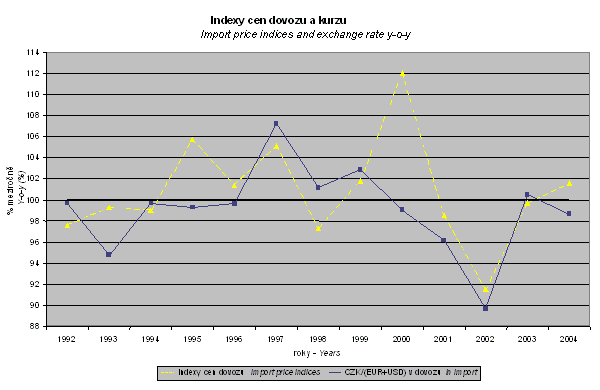
In 1992 to 2004, the correlation of average y-o-y import price indices and exchange rates in import was 0.53. Naturally, it is less than for the m-o-m evaluation (in a longer time horizon, influences of prices themselves are becoming more important); however, it is still an important influence. Total y-o-y exchange rate in import (as well as below also the exchange rate in export) was made in a similar way as for the m-o-m expression.
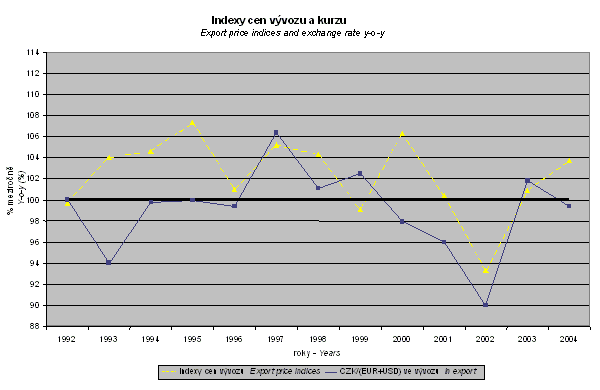
In 1992 to 2004, the correlation of average y-o-y export price indices and exchange rates in export was 0.48. The difference against “import correlation“ results mainly from the different currency basket in the import and export price index.
It is clear from the graph that in certain periods (e.g. in 2001 – 2003) exchange rate development rather well corresponded to the development of external trade price indices, while in other periods (recently namely in 2004) it distinctively differed. And indeed, the correlation between individual months of y-o-y exchange rate- and price indices was –0.21 for imports and –0.17 for exports. However, it obviously does not mean that external trade prices grow thanks to the overall stronger CZK; it is just the opposite way – growth of prices (namely world prices of raw materials and food) was so steep that prices of external trade were increasing despite the appreciating CZK, or that the strengthening of CZK was so small that it did not balance the net price growth. It becomes evident that in 2004 both arguments were valid. Influence of prices was above average (especially of world prices in total, petroleum and metals in particular) and overall influence of exchange rate was the smallest since 1996.
Import prices increased in total by 1.6% y-o-y in 2004, i.e. by 1.9 percentage point more than in 2003. The biggest increase (+9.1%) occurred in prices of ‘crude materials, inedible, except fuels’, especially prices of metalliferous ores in line with the development of prices on world markets. Marked increase was observed also for prices of ‘mineral fuels, lubricants and related materials’ (+6.5%), petroleum, petroleum products and related materials in particular. Prices of this division were also increasing in relation to petroleum price increase on world markets, the correlation reached the value of 0.96. A marked increase (+4.3%) occurred also for prices of ‘manufactured goods classified chiefly by material’, iron and steel and non-ferrous metals in particular (in relation to price growth of metalliferous ores – correlation 0.84 and 0.63, respectively). From measured sections, decreasing were only prices of ‘machinery and transport equipment’ (-1.4%, telecommunications and sound-recording and reproducing apparatus and equipment in particular) and ‘miscellaneous manufactured articles‘ (-0.6%).
Export prices increased in total by 3.7% y-o-y, i.e. by 2.8 percentage points more than in 2003.
The biggest price growth (+20.1%) was in ‘mineral fuels, lubricants and related materials’, coal and petroleum products in particular again in close relation to the price growth of petroleum and natural gas on world markets (+21.5%) and overall increased demand for energies especially in the developing countries. Related to petroleum price growth is also growth of export prices of ‘chemicals and related products‘ (+7.3%), organic chemicals and plastics in particular. The correlation of y-o-y export prices of these divisions and import prices of petroleum and petroleum products reached the value of 0.71 and 0.72, respectively; with a two-month delay of the correlation (the expected technological period between import, manufacture and export of the relevant products) it reached even the value of 0.84 and 0.95, respectively.
Marked growth was recorded also for export prices of ‘manufactured goods classified chiefly by material’ (+8.2%), iron and steel and manufactures of metals in particular. Reflected was especially price growth of metals on world markets and, most of all, growth of import prices of the division of metalliferous ores. The correlations with that section reached 0.89 and 0.90, respectively.
Export prices of ‘machinery and transport equipment’ increased by 0.3%, which was by 0.1 percentage point more than in 2003. Growing were especially prices of the division of machinery specialized for particular industries, in which strong correlation with the growth of import prices of metalliferous ores was reflected.
Y-o-y terms of trade reached in total the positive value of 102.1% in 2004, i.e. by 0.9 percentage point more than in 2003.
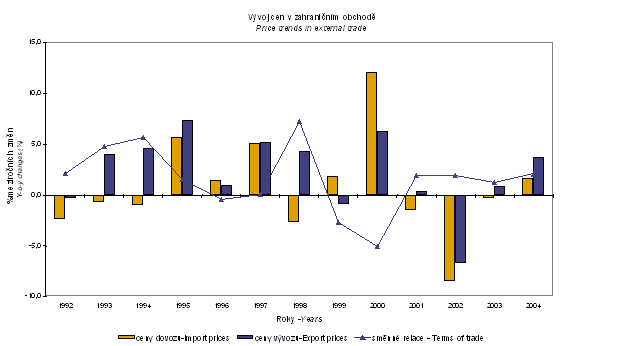
The highest value of terms of trade was in ‘mineral fuels, lubricants and related materials’ (112.8%, i.e. by 13.2 percentage points more than in 2003, mainly due to high export prices of coal) and closely related to that also in ‘chemicals and related products‘ (105.5%). Terms of trade of ‘machinery and transport equipment’ reached the value of 101.7%, i.e. by 0.6 percentage point less than in 2003. From significant sections as for weight the lowest terms of trade value was in ‘crude materials, inedible, except fuels’ (93.6%).
Elaborated by: Jiří Choun, Prices Statistics Department
Director: Jiří Mrázek, phone number (+420) 27405 2533