Development of consumer price indices - 3. quarter of 2006
Product Code: e-7132-06
Development of consumer price indices in the third quarter of 2006
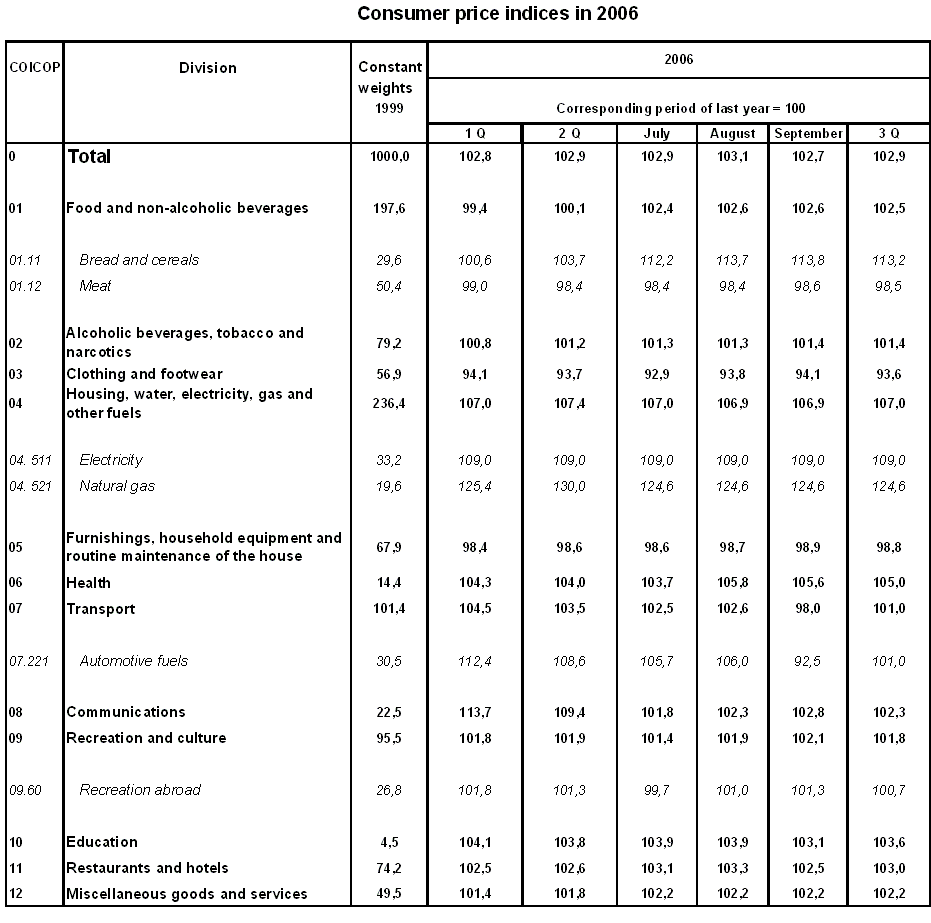
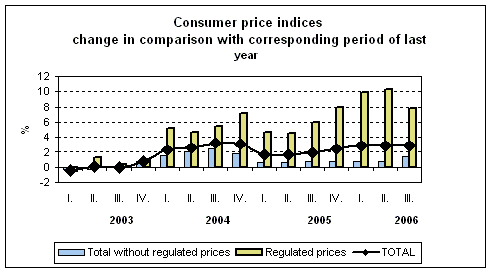
Consumer prices increased in the Q3 2006 in comparison to Q3 2005 the same as in the Q2, i.e. by 2.9%. However, the price development in individual months of the Q3 was more differentiated than in the Q2 both as for the development of the overall consumer price level as well as from the point of view of the price development in individual COICOP divisions of the consumer basket. The price development of the Q3 was influenced especially by an increase of food prices, which was compensated by a slowdown of the price growth in transport and communications. Regulated prices increased by 7.8% (from 10.3% in the Q2 2006) and market prices by 1.4% (in Q2 by 0.8%).
The new pacesetter of the price growth were prices of food and non-alcoholic beverages, which from July became the second COICOP division, which had the biggest influence on the year-on-year increment of consumer prices (second to the traditionally strongest division of housing). It was especially due to an increase of prices of bread and cereals, which grew by 13.2% of which bread by 18.0% and rolls and baguettes by 29.5%. Prices of potatoes were higher by 71.2%, and fresh vegetables by 19.7%. The opposite influence belonged to the price decrease mainly of coffee, cocoa, tea, chocolate and chocolate products, which was caused by a shift of those products to the reduced 5% VAT rate since 15 July 2006. An impact of that change on the month-on-month total increment of consumer prices in August was a decrease by 0.16 percentage points (according to a preliminary analysis of the Czech Statistical Office). Lower were also prices of flour, poultry, vegetable oils, butter, and sugar.
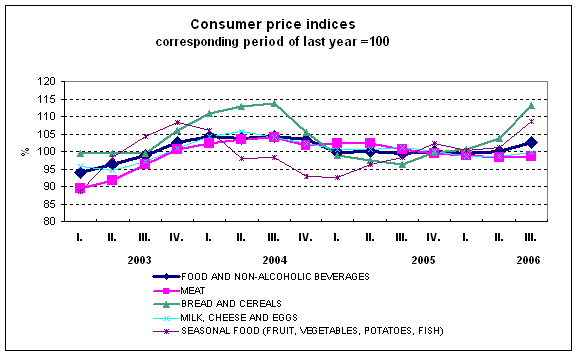
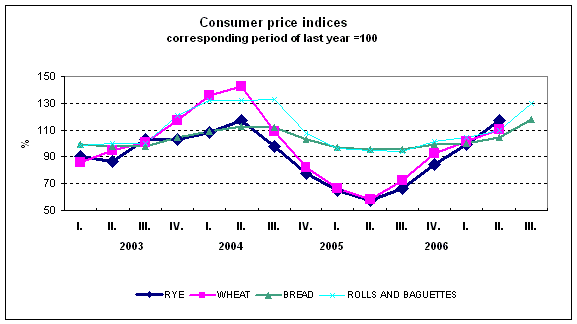
Development of consumer prices of bread and cereals (namely bread, rolls and baguettes) corresponded to the development of prices of cereals of agricultural producers also in the Q1 and, most of all, in the Q2 2006, while during the year 2005 consumer prices reflected the sharp fall of prices of agricultural producers only temperately.
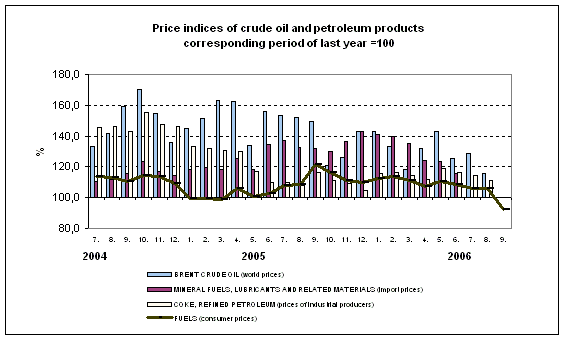
A slowdown of price increase occurred in ‘transport‘ due to price development of fuels, prices of which had in the Q3 2006 (as a result of the month-on-month decrease in September) an average month-on-month growth rate –0.1%, while in the Q3 2005 they recorded a record growth with the average month-on-month growth rate of 5.3%. This different development resulted in a slowdown of the year-on-year price growth of fuels to 1.0% (from 8.6% in the Q2). Development of fuel prices in the Q3 was influenced especially by September, in which prices of fuels were lower year-on-year by
- 7.5%, which was the first year-on-year decrease of fuel prices since March 2005. Prices of other services related to transport increased by 5.7% as a result of introduction of a fee for a test of professional competence to drive a motor vehicle. Lower than last year were prices of cars, motorcycles and bicycles.
Deceleration of year-on-year price increase was observed also among the results of the last known months as for world prices of Brent crude oil, import prices of mineral fuels, lubricants and related materials as well as prices of industrial producers of refined petroleum products.
The biggest changes in price development were in ‘communications‘, in which price increase of public telecommunication services slowed down to 2.7% (from 10.3% in Q2). Price level of public telecommunication services in the third quarter was no longer influenced by a marked price increase caused by cancellation of free minutes in local and distant calls (they were included in lump fees for operation of residential telephone lines), which took place from June 2005. In 2006, three factors influenced the price development of public telecommunication services: decrease of prices for distant calls and calls to mobile networks from a fixed telephone line from April 2006, an increase in lump fees for operation of residential telephone lines from May 2006, and discounts at installation of a residential telephone line.
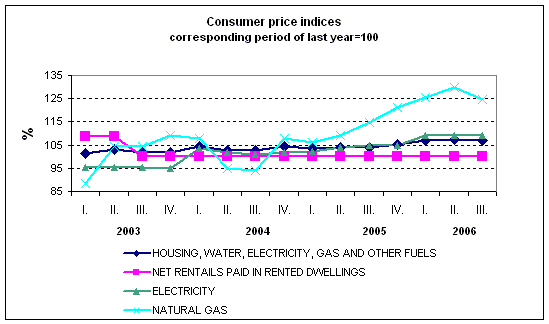
A slight slowdown of the year-on-year price increase in the Q3 in ‘housing, water, electricity, gas and other fuels‘ was in relation to the development of natural gas prices, which were higher by 24.6% (in Q2 by 30.0%). Electricity prices increased by 9.0% and heat prices by 12.0%. Housing continued to have the biggest influence on the year-on-year increment of consumer prices (with the 66% share).
In ‘recreation and culture‘, similarly as in the previous years, there was a marked month-on-month increase of seasonal prices of package holidays in July and August, and their sharp fall in September. Resulting from those movements was an average year-on-year price increase of package holidays in the Q3 2006 by 0.7%.
In education, due to the start of the new school year, there was a month-on-month price increase by 2.6% in September; however, it was lower than in September 2004 (an increase by 3.4%), which resulted in a slowdown of the year-on-year growth in September and thus also in the Q3 2006.
Lower than in the Q3 of 2005 were prices in ‘clothing and footwear‘, ‘furnishings, household equipment and routine maintenance of the house‘. Dropping of prices in ‘clothing and footwear‘, ‘household appliances‘ as well as in ‘equipment for the reception, recording and reproduction of sound and pictures‘ reflect competition pressures on the market with those products, which were caused by the offer prevailing over the demand as well as by import of cheap goods from Asian countries. Moreover, as for electric appliances, their assortment is changing quickly due to technical progress connected with reduction of prices.
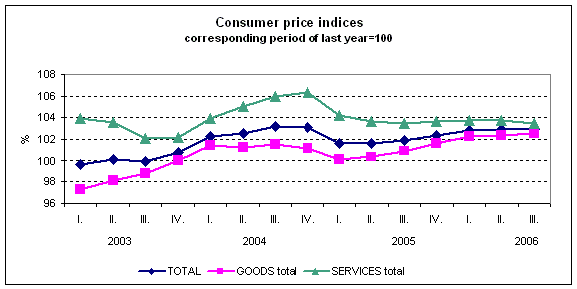
Price increase of goods in total accelerated to 2.6% (from 2.4% in the Q2), while price increase of services slowed down to 3.5% (from 3.8% in the Q2).
Harmonized index of consumer prices in the EU 25
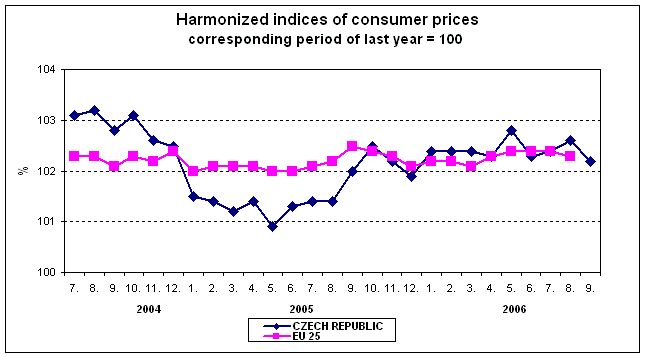
The year-on-year increment of the average harmonized index of consumer prices (HICP) in the EU 25 was +2.4% in July and +2.3% in August, which is by 0.1 and 0.2 percentage points less than in June 2006 (the data are preliminary). The biggest price increase occurred in Latvia (+6.9% and +6.8%), the least in Finland (+1.4% and +1.3%). In Slovakia, price growth accelerated in July and August in the same way to +5.0% (from 4.5% in June). In Germany, price development in July was +2.1% and it slowed down to +1.8% in August. In the Czech Republic, the year-on-year increment of HICP was 2.4% in July and it accelerated to +2.6% in August, while in September it fell to 2.2% according to preliminary data.
While in the year 2005 the HICP for the Czech Republic was for most of the months lower than the HICP of the EU25, in 2006 their values were very close.