Development of consumer price indices - 2. quarter of 2006
Product Code: e-7132-06
Development of consumer price indices in the second quarter of 2006
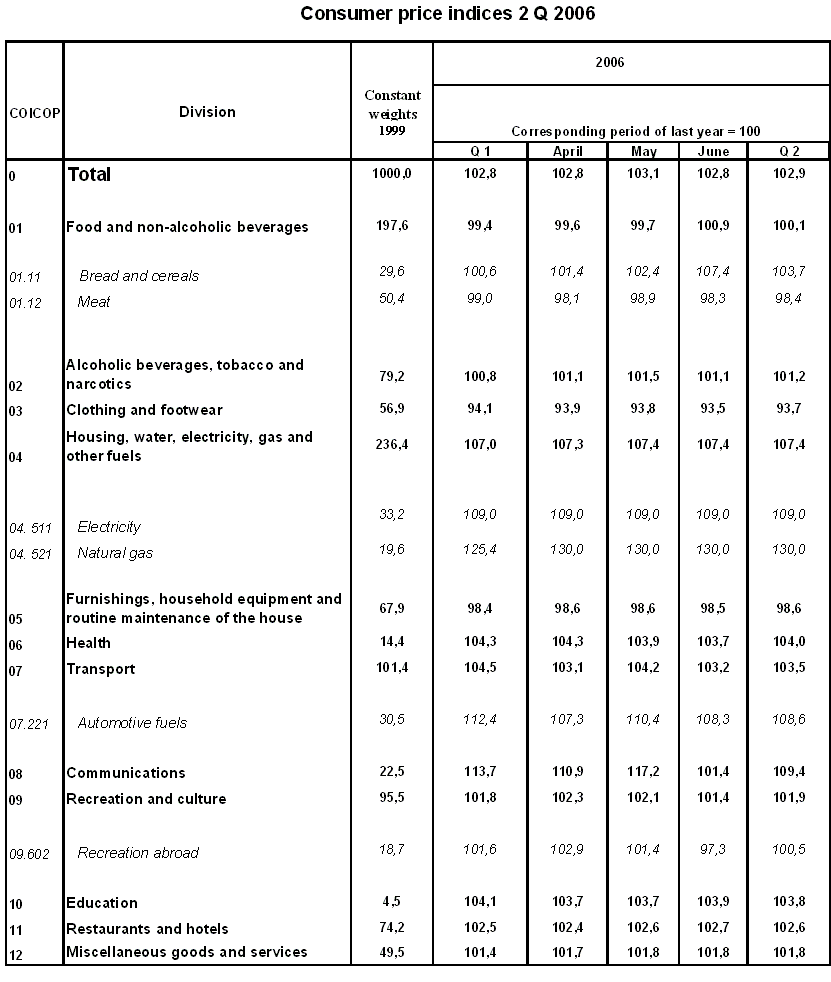
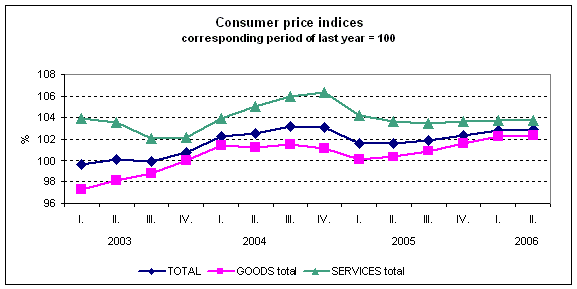
Consumer prices increased in the second quarter in comparison with the same period of the previous year by +2.9%, which is by 0.1 percentage point more than in the Q1. The overall level of consumer prices was both in the Q1 and Q2 stabilised, only in May there was a one-shot price deviation upwards. However, as for some items of consumer basket there were price fluctuations both upwards and downwards, which were sometimes marked. Price development during the second quarter was influenced mainly by a one-shot price increase of natural gas, changes in public telecommunication services, increase of prices of food and development of prices of fuels. Regulated prices increased by 10.3% (from 9.9% in Q1 2006), while market prices increased by 0.8% (in Q1 by 0.7%).

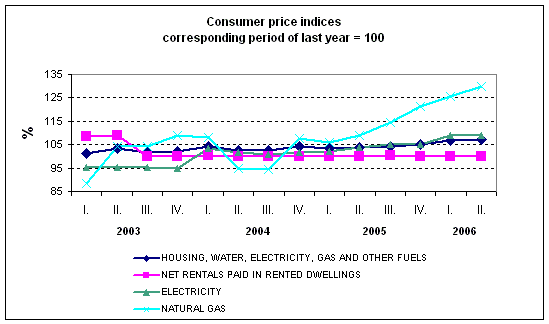
Acceleration of the year-on-year growth in the second quarter was reflected most of all in ‘housing, water, electricity, gas and other fuels‘, in which prices of natural gas increased by 30.0% (from 25.4% in Q1); it is the most since the Q4 2001. Prices of electricity were higher by 9.0% and heat by 12.0%. Influence of housing on the y-o-y increment of consumer prices strengthened to 2.0 percentage points (from 1.9 percentage points in Q1).¨
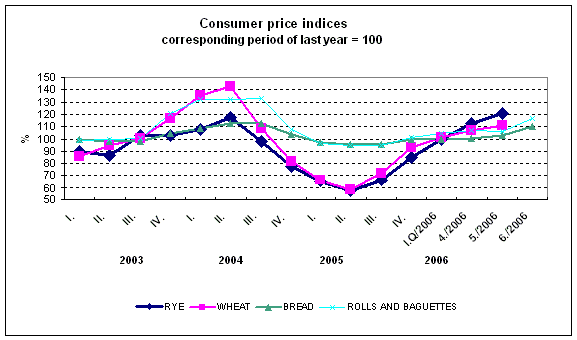
Turnaround in price development occurred in ‘food and non-alcoholic beverages‘, in which prices (after a 6-month y-o-y decrease) were higher in June by 0.9% and thus increased in the second quarter in average by 0.1%. The reason was a price increase in ‘bread and cereals‘ in May and especially in June. Prices of ‘bread and cereals‘ increased by 3.7% (in June by 7.4%), of which bread by 4.2% (in June by 10.0%) and rolls and baguettes by 9.9% (in June by 17.0%). Potato prices were higher by 59.6% (in Q1 by 29.6%). Similarly, also fresh vegetables price growth accelerated to 15.6% from 3.7% in Q1. Lower (by more than 5%) were prices of flour, poultry, vegetable oils, fruit, and sugar.
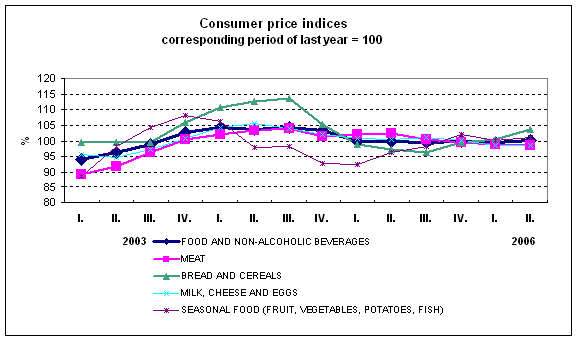
Prices of ‘bread and cereals‘ (bakery products), namely bread, rolls and baguettes increased significantly last time in Q4 2003 and Q1 2004, which was related to a price increase of cereals at agricultural producers. Consumer prices of bakery products corresponded to prices of cereals at agricultural producers also in Q1 and especially Q2 of 2006, while during the year 2005 consumer prices remained almost without reaction on the steep fall of prices of agricultural producers.
The biggest changes in price development were in ‘communications‘, in which price increase of public telecommunication services slowed down to 10.3% (from 14.9% in Q1). Price level of public telecommunication services in the second quarter was influenced by a marked price increase caused by cancellation of free minutes in local and distant calls (they were included in lump fees for operation of residential telephone lines) from June 2005 (it had an influence until May 2006); further influences were: decrease of prices for distant calls and calls to mobile networks from a fixed telephone line from April 2006 and an increase in lump fess for operation of residential telephone lines from May 2006. Share of ‘communications‘ in the year-on-year increment of total consumer price index thus strengthened from the value of 0.3 percentage points in April to 0.4 p.p. in May; in June it fell to 0.1 percentage point.
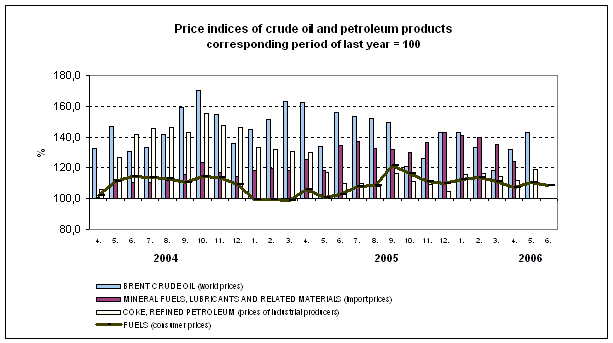
Price increase slowed down also in ‘transport‘, especially due to price development of automotive fuels; their prices increased rather markedly in the Q2 2006 (average month-on-month growth rate was 2.8%); however, in the Q2 2005 the increase was faster (average m-o-m growth rate of 3.6%). It resulted in a slowdown of y-o-y growth rate to 8.6% (from 12.4% in Q1). The slowdown of price growth took place mainly in April and was reflected also in prices of domestic producers of refined petroleum products.
From the beginning of the year 2006, world prices of BRENT petroleum were significantly increasing, which was reflected in domestic prices of automotive fuels only partially. Average price of Brent petroleum in 2005 was USD 55.08 per barrel and during five months of 2006 it grew by 19.7% to the average of USD 65.91 per barrel (USD 71.11 per barrel in May). In the same period, consumer prices of Natural 95 petrol increased by 2.0% (from CZK 28.48 per litre in the year 2005 to the average of CZK 29.06 per litre in 2006; in May it was CZK 30.96 per litre). A similar development was observed in consumer prices of automotive diesel oil. Impact of petroleum price increase on world markets probably had an influence on strengthening of CZK exchange rate against USD and competition on automotive fuel market in the Czech Republic. Prices of transport services increased the same as in the Q1 by 4.6% (+5.2% in road transport). Lower than last year were prices of motorcycles and bicycles.
Lower than in the Q2 of 2005 were prices in ‘clothing and footwear‘, ‘furnishings, household equipment‘. Dropping of prices in ‘clothing and footwear‘, ‘household appliances‘ as well as in ‘equipment for the reception, recording and reproduction of sound and pictures‘ reflects competition pressures on the market with those products, which were caused by the offer prevailing over the demand as well as by import of cheap goods from Asian countries.
Price growth of goods in total accelerated to +2.4% (from +2.3% in Q1) and price growth of services was the same as in Q1, i.e. +3.8%.
Harmonized index of consumer prices in the EU 25
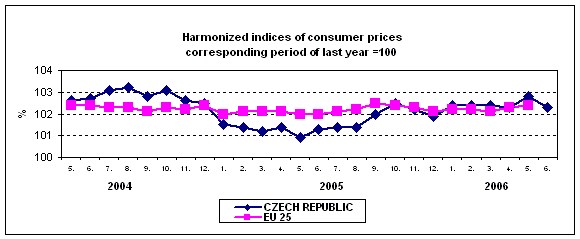
The year-on-year increment of the average harmonized index of consumer prices (HICP) in the EU 25 was +2.3% in April and +2.4% in May, which is by 0.2 and 0.3 percentage points more than in March 2006 (the data are preliminary). The biggest growth was recorded in Latvia (+6.1% and +7.1%), while the lowest was in Poland (+1.2% and +1.5%). In Slovakia, price growth accelerated in April and May to +4.4 and +4.8% (from +4.3% in March). In Germany, price growth was +2.3% in April and in May it slowed down to +2.1%. In the Czech Republic, the y-o-y HICP increment was +2.3% in April, in May it accelerated to +2.8% and in June it was again +2.3% (the data are preliminary).
From January to September 2005, HICP figures for the Czech Republic were under the EU average; from October to December they were almost the same. In 2006, the Czech HICP was slightly higher than HICPEU25 so far.