
Commentary on the development of average wages of employees - 4. quarter of 2004
Product Code: e-3134-04
Commentary on the development of average wages of employees 1
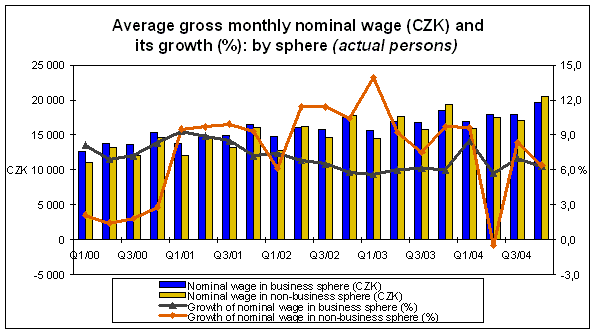
In Q4 2004, the nominal value of the gross average monthly wage per actual persons was CZK 19 890 – it increased by CZK 1 181 (+6.3%) year-on-year. Consumer prices grew by 3.1% and the real wage by 3.1% too. In the business sphere the average wage increased by CZK 1 162 (+6.3%) to CZK 19 686 and the real wage by 3.1%, while in the non-business sphere these wages increased by 6.4% (+CZK 1 244 to CZK 20 573) and 3.2%, respectively.
While the high year-on-year growth of wages in Q1 or Q3 2004 (+8.7% or 7.3%) was contributed to by both the business sphere and the non-business sphere (the former growing by 8.5% or 7.0% and the latter by 9.6% or 8.3%), the low increase in Q2 2004 (+4.2%) resulted from opposing wage developments, namely from wage growth in the business sphere (+5.7%) and simultaneous wage drop in the non-business sphere (0.5%). The latest data for Q4 2004 brought agreement in the year-on-year increase—the business sphere grew by 6.3% and the non-business one by 6.4%. In recent years this has been quite a sporadic case except for Q1 2001 when the increase was by about 3 percentage points higher. Seen in the long run (from 2000 to 2004) the relative year-on-year Q4 increase in the nominal wage in the business sphere ranged between 5.8% (2002) and 8.3% (2000). Over the same period the non-business sphere experienced the highest wage level growth in 2002 (+10.4%) and the lowest in 2000 (+2.8%). The year-on-year wage increase in Q4 2004 is rather close to the lower limit of the interval in the business sphere and in the middle of the interval in the non-business sphere.
As a rule, differences between the two spheres always became wider in Q1’s and Q3’s—the average wage in the business sphere was always higher than in the non-business sphere. In Q2’s and Q4’s, the wage levels rather converged on account of the regularly paid half of additional pay in the non-business sphere; in some periods, the wage level in the non-business sphere exceeded that in the business one. In annual totals of the five-year reference period, though, the nominal wage in the non-business sphere has never ever reached ´the level of the average wage in the business sphere. The wage development in the non-business sphere in 2004 was affected by the adjustment to salaries and wages of employees in public services and administration (due to transition from 12-grade wage scale to 16-grade one, effective as of 1 January 2004) on the one hand and the effect of the reduction in additional pay from 50% to 10% in Q2 or to 25% in Q4 on the other hand. The former measure contributed to the higher rise in wages in Q1 and Q3 2004, whereas the latter measure made wages in Q2 drop year-on-year or grow at a slow pace in Q4.
The comparison of the two spheres would be rather different if the average wage in total per year is evaluated with respect to the fact that the non-business sphere employs more part-time workers than the business one. Hence, all the comparisons below will be on average wage data related to full-time equivalent (FTE) employees as these data take account of the length of work.
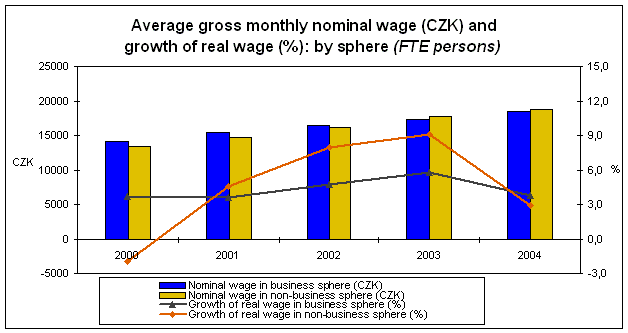
In the year 2004, the average wage per FTE employee amounted to CZK 18 582, which is by CZK 1 136 (6.5%) up on the year 2003. In the same period, consumer prices went up by 2.8% and the real wage by 3.6%. In the business sphere the average wage rose by CZK 1 169 (+6.7%) to CZK 18 544 and the real wage by 3.8%. In the non-business sphere the average wage rose by CZK 1 022 (+5.8%) to CZK 18 713 and the real wage by 2.9%.
Over last five years (2000-2004), the wage in the non-business sphere grew usually faster, closing on the wage level in the business sphere. The latter recorded the highest relative growth in 2001 (8.5%) and the lowest two years later (5.9%). The growth rate in the non-business sphere was the highest in 2002 (9.9%) and the lowest in 2000 (1.9%). The wage growth rate in the non-business sphere in 2000 was exceptional because no adjustment to salaries of pay scales was made that year. Nominally, the difference between the two spheres was around CZK 700 in 2000 and 2001 and CZK 200 in 2002 in favour of the business sphere. The situation changed two years later—the non-business sphere’s employees took home more by about CZK 300 in 2003 and by almost CZK 200 in 2004.
Apart from wage growth the development of the real wage is also affected by the consumer price index – inflation that acts as a factor hampering the growth of real wage. Paradoxically, it may thus happen that real wage increases are low in a period of relatively high increases in nominal wage, and vice versa . It can be exemplified on the data below that higher growth dynamics of real wages occurs under dropping or stagnating growth development of nominal wages and a co-action of price development.
Comparisons run for the period of last five years suggest that the highest wage growth (FTE persons) occurred in 2001 (+8.7%), while the lowest, almost identical increases were recorded in 2000 (+6.4%), 2003 (6.6%) and 2004 (6.5%). And what was the development of real wage like in these years? The year with the highest relative increase in nominal wage (2001) with was compared with the year having almost the lowest increase (2004) and the result was that the growth of real wage had been almost identical in both years—3.8% and 3.6%, respectively. On the other hand, there are considerable differences in the real wage growth if two years with practically the same relative increases in nominal wage are confronted (2000 and 2003)—2.4% and 6.5%, respectively. The influence of inflation, which ranged in the analysed period from 4.7% in 2001 to 0.1% in 2003, on the development of real wage is substantial. A comparison of the two spheres brings the fact that the real wage fell even steeply year-on-year (-1.9%) in the non-business sphere in 2000 because the wage rise in this sphere (+1.9%) did not suffice to cover the inflation (3.9%).
The wage development was also compared for CZ-NACE divisions (two-digit code). It turned out that three industries (employing at least 50 thousand employees, but excluding enterprises with less than 20 employees) having the lowest nominal average wage per FTE person had been the following:
- ‘agriculture, hunting and related service activities’: CZK 13 316 (the average wage was CZK 5 266 down on national average, with a nominal or relative year-on-year increase of CZK +1 165 or +9.6%, respectively)
- ‘manufacture of furniture, manufacturing n.e.c.’: CZK 13 970 (CZK -4 612, CZK +1 096, +8.5%) and
- ‘retail trade except for motor vehicles and motorcycles; repair of personal and household goods’: CZK 14 352 (CZK -4 230, CZK +675, +4.9%).
The lowest average wage was recorded for ‘manufacture of wearing apparel; dressing and dyeing of fur’ (less than 30 thousand employees) at CZK 10 580 (CZK 8 002 down on the national average, with nominal and relative increases of CZK +865 and 8.9%, respectively).
On the other hand, three industries (also with at least 50 thousand employees) having the highest nominal average wage per FTE person were:
- ‘wholesale trade and commission trade, except of motor vehicles and motorcycles’: CZK 23 996 (the average wage was CZK +5 414 up on the national average, with a nominal or relative year-on-year increase of CZK +1 905 or +8.6%, respectively)
– ‘post and telecommunications’: CZK 22 296 (CZK +3 714, CZK +1 022 or +4.8%).
- 'manufacture of motor vehicles, trailers and semi-trailers’: CZK 20 399 (CZK 1 817, CZK +1 288 or +6.7%)
The highest average wage was measured in ‘computer and related services’ (about 20 thousand employees), namely CZK 40 220 (by CZK 21 638 up on the national average, with a nominal or relative increase of CZK +2 557 or +6.8%, respectively).
‘Health and social care’ was an industry, employing at least 50 thousand employees, where the real wage dropped year-on-year (-0.3%). Its average nominal wage reached CZK 17 480 and was CZK 1 102 down on the national average.
On the other hand ‘agriculture, hunting and related service activities’ was the industry (rather significant as far as employment goes) with the highest growth of real wage—an increase of 6.6%, the average nominal wage being CZK 13 316.
Sectorally, the highest average wages are recorded in the long run for financial institutions, insurance companies and pension funds. The average wage in financial institutions is twice as much as the national average. In insurance companies and pension funds it exceeds the national average by two thirds, as distinguished from the sector of households (i.e. unincorporated natural persons) where employees’ wages are about one third below the average. Wages paid in the sector of non-profit institutions serving households account for about 80% of the average wage in the whole country. It should be noted that the non-financial corporations and general government sectors radically affect the average wage. Employees of the two sectors account for next to 95% in the population measured.
___________________________
1 The data refer to business sphere enterprises with 20+ employees (in financial intermediation irrespective of the number of employees) and all non-business sphere organizations. They only refer to employees under employment contract with reporting units. Persons performing public office, such as members of Parliament, senators, full-time councillors at all levels, judges, etc. are excluded. Employees of the non-business sphere make up a quarter of all employees included in the quarterly survey.