
Commentary on the development of average wages of employees - 1. quarter of 2005
Product Code: e-3134-05
Commentary on the development of average wages of employees 1
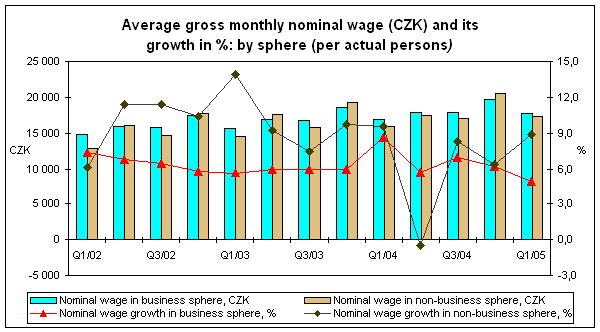
In Q1 2005 , the nominal average gross monthly wage per actual person reached CZK 17 678 and its year-on-year increase amounted to CZK 970 (+5.8%). In the same period, consumer prices went up by 1.6% and the real wage by 4.1%. In the business sphere the average wage increased by CZK 833 (+4.9%) to CZK 17 772 and the real wage by 3.2%. In the non-business sphere the average wage increased by CZK 1 424 (+8.9%) to CZK 17 358 and the real wage by 7.2%.
Last years’ trend towards slowing down the growth of average wage continued. The wage growth in Q1 2005 was the lowest since the CR came into being, compared to average annual growth rates. Nationwide wage development is heavily shaped by the business sphere as employees of this sphere account for more than three quarters of the set of units under observation. While the wage development in the business sphere is rather fluent and affected by economic results of companies, the development in the non-business sphere is jump-like in nature because it depends on legislative measures of the government and on what the budget permits to a large extent.
The Q1 2005 development was also influenced by adjustments to salaries and wages of employees in public services and administration, effective as of 1 January 2005. Apart from the normal year-on-year rise in average salaries, salaries in selected professions rose in a differentiated way. Government Regulation No. 637/2004, Coll. extended the circle of employees whose wage rates are provided according to the scale of increased wage rates (e.g. employees directly providing social care, employees providing administrative social care services and employees engaged in work on roads, collection and processing of municipal waste, etc.). Furthermore, a new scale of increased wage rates was put in place for employees who are members of the Police of the CR, the Prison Service of the CR, the Fire and Rescue Service of the CR, and the Customs Administration of the CR. On 1 January 2005, the payment of additional salaries was cancelled.
Comparisons were made of the wage development in industries at the level of CZ-NACE divisions (two-digit code). They suggested that the following three industries (employing a minimum of 20 thousand people and excluding enterprises with less than 20 employees) had paid the lowest nominal average wage per FTE person :
– manufacture of wearing apparel; dressing and dyeing of fur: CZK 10 328 (the average wage in this industry was CZK 7 911 down on the national average, the nominal or relative year-on-year rise being CZK +118 or +1.2%, respectively)
– agriculture, hunting and related service activities: CZK 12 195 (CZK –6 044, CZK +671 or +5.8%)
– manufacture of textiles and textile products. CZK 12 509 (CZK –5 730, CZK +444 or +3.7%).
On the other hand, the following were three industries (also employing at least 20 thousand individuals) with the highest nominal average wage per FTE person :
– financial intermediation except for insurance and pension funding: CZK 44 896 (the average wage in this industry was CZK 26 657 up on the national average, the nominal or relative year-on-year rise being CZK +6 268 or +16.2%, respectively)
– computer and related services: CZK 44 354 (CZK +26 115, CZK +3 976 or +9.9%)
– electricity, gas, steam and hot water supply: CZK 25 083 (CZK + 6 844, CZK +2 006 or +8.7%).
The above-mentioned comparison suggests that the Q1 2005 earnings of employees in the industry with the highest wage rose 13.5 times faster year-on-year and that the average wage of these employees was about 4.3 times higher than in the industry with the lowest wage. Inter-industry wage differences became wider year-on-year and the coefficient of variation of average wages (by CZ-NACE division) reached 39.8%, which is 3.4 percentage points up on Q1 2004.
Manufacture of wood and wood products was the industry with the lowest growth or drop of real wage among industries employing at least 20 thousand people—the year-on-year drop in real wage amounted to 1.6%. The average nominal wage in this industry stagnated year-on-year; it was CZK 13 836 and thus CZK 4 403 down on the national average.
On the other hand, financial intermediation except for insurance and pension funding was the industry (rather significant as far as employment is concerned) with the highest achieved growth of real wage —an increase of 14.4%.
The comparison of the wage development made from the angle of sector belonging suggests that the highest average wages are paid for a long time in financial institutions, insurance companies and pension funds. The average wage in financial institutions climbed up as high as almost 2.5 times the national average, and the insurance companies and pension funds paid wages about 1.8 times the national average. Wages of employees in the sector of households (i.e. wages of unincorporated natural persons) are about one third below the average. Wages in the sector of non-profit institutions serving households are about 80% of the average wage in the whole of the CR. The average wage level is affected quite fundamentally by the sectors of non-financial corporations and of general government. Employees of these sectors account for about 95% of the set of units measured.
____________________
1 The data refer to business sphere enterprises with 20+ employees (in financial intermediation irrespective of the number of employees) and all non-business sphere organizations. They only refer to employees under employment contract with reporting units. Persons performing public office, such as members of Parliament, senators, full-time councillors at all levels, judges, etc. are excluded. Employees of the non-business sphere make up a quarter of all employees included in the quarterly survey.