
Business cycle survey - July 2006
Confidence remained high
Publication Date: 31. 07. 2006
Product Code: r-1201-06
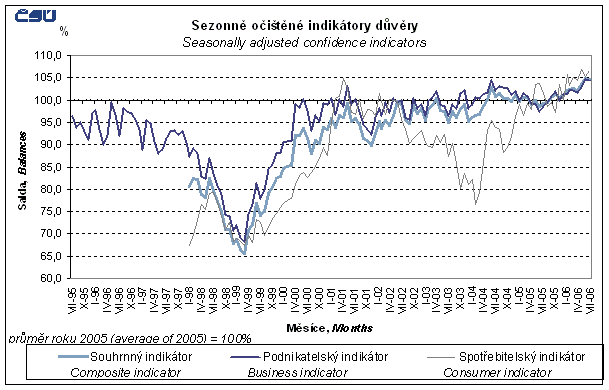
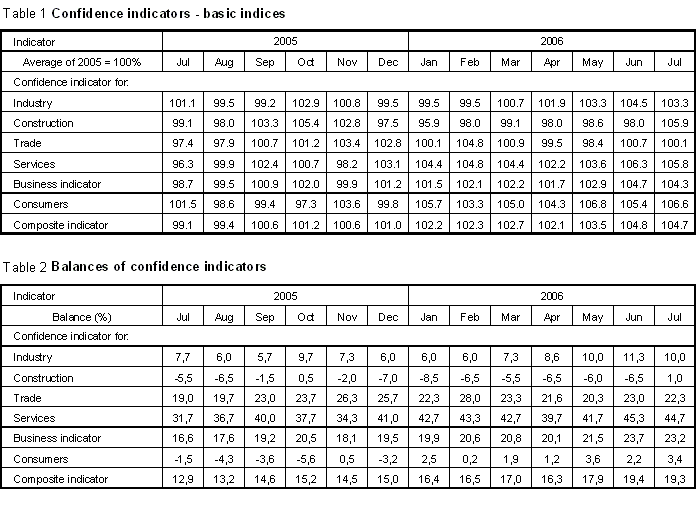
Balance of composite confidence indicator (indicator of economic sentiment) decreased by 0.1 point in July 2006 compared to the previous month to the second highest value in its history, i.e. since January 1998. Balance of business indicator decreased by 0.5 point to the third highest value in its history, i.e. since February 1993 (or since May 2002 after inclusion of services indicator). Balance of consumer confidence indicator increased by 1.2 points and reached the second highest value in its history (since January 1998). Compared to July 2005, the composite confidence indicator balance increased by 6.4 points, business confidence indicator balance by 6.6 points and consumer confidence indicator balance by 4.9 points.
* * *
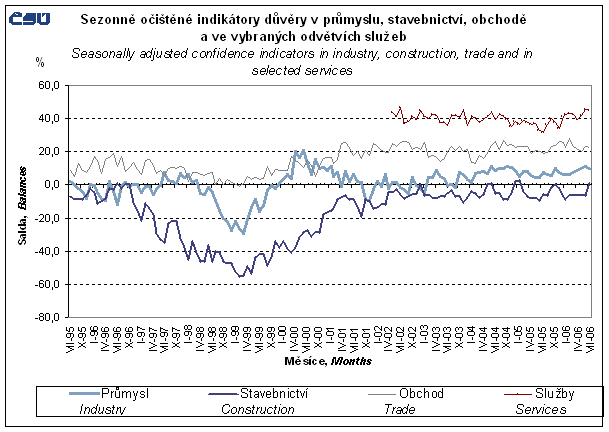
In industry, the confidence indicator balance decreased by 1.3 points month-on-month and in the year-on-year comparison it is 2.3 points up on July 2005. In construction, the confidence indicator balance increased by 7.5 points m-o-m; it is 6.5 points up on July 2005. In trade, the confidence indicator balance decreased by 0.7 points and it is 3.3 points up y-o-y. In selected services, the confidence indicator balance decreased by 0.6 points m-o-m and it is 13 points up y-o-y.
In industry, favourable assessment of the current economic situation improved further in July . The assessment of total demand decreased faintly compared to the previous month; the assessment of foreign demand increased. Stocks of finished goods decreased, respondents say. For next three months, respondents expect favourable development of production activity, even though they anticipate a slow-down due to vacancies; employment will rise slightly. Stable price development is expected by 82.5% of respondents, 15.1% expect a rise and 2.4% a drop. Similarly as in June, respondents expect favourable development of their economic situation in next three as well as six months. The production capacity utilization in manufacturing industry increased slightly compared to the previous quarter and reached 86.6%, which is the second highest value in its history and is above the EU average as well. All in all, the confidence indicator in industry decreased form a very high value in the previous month for the first time in this year; the balance reached 10 points.
In construction, favourable assessment of current economic situation increased further in July when compared with June. The assessment of total demand increased markedly; assessment of external demand increased too. In comparison with June, assessment of current construction activity improved as well. For next three months, the respondents expect maintenance of growth of the number of employees as well as of construction activity. Predominantly, the respondents anticipate no changes in prices; however, 20.0% of respondents expect an increase in prices. Respondents say they have work secured for 10.2 months ahead. Expectations of economic situation development for next three as well as six months are favourable.
Among respondents engaged in trade, assessment of current economic situation decreased slightly m-o-m in July when compared to June. Expected development of economic situation for next three months is rather cautious; for next six months remains favourable. According to respondents, stock of inventories decreased a little in July (balance 1 point down). Stable development of the number of employees is expected by 80.4% of respondents, 15.9% expect a rise and 3.7% a drop. A rise in prices is expected by 9.8% of respondents, 82.9% expect no changes and 7.3% a decrease.
In selected services, respondents assess their current economic situation favourably, similarly as in June; assessment of demand however decreased. Expectations of development of the demand for next three months are favourable. 16.6% of respondents expect a rise in employment in next three months, 54.6% expect no changes and 28.8% expect the number of employees to drop. Expectations of economic situation are favourable for both next three and six months.
The survey taken among consumers in July indicates that they expect increase of both the overall economic situation (balance up by 0.8 points) and their own financial situation (balance up by 2.4 points). Compared to June 2006, the percentage of consumers expecting higher unemployment increased (balance up by 1 point). Percentage of the respondents who intend to save money increased by 2.7 points. All in all, the consumer confidence indicator in July increased by 1.2 points compared to June and reached the second highest value in its history (since January 1998).
Porovnání vybraných ukazatelů za jednotlivá odvětví v červenci 2006
Comparison of selected indicators in individual branches in July 2006

Note
Contact: Marie Hörmannová, phone (+420) 274052049,
e-mail marie.hormannova@csu.gov.cz
Data source: CZSO business survey, GfK Praha consumer survey
End of data collection: 24 July 2006
End of data processing: 27 July 2006
More information at: 1201-06 Business Cycle Survey in Enterprises of Industry, Construction,
Trade and Selected Services
Methodological explanatory notes :
Since January 2006 the Composite confidence indicator (Economic sentiment indicator) is in compliance with the EU methodology presented as a weighted average of seasonally adjusted confidence indicators in industry, construction, trade, selected services and consumer confidence indicator. Business confidence indicator is a weighted average of seasonally adjusted confidence indicators in industry, construction, trade and selected services.
Since January 2006, due to the inclusion of confidence indicator in selected services, a new weighting system is being used : confidence indicator in industry has 40% weight, in construction and trade it is 5% each, in services 30% and consumer confidence indicator has 20% weight. Indicators are presented as basic indices, with the average of 2005 as a base.
Time series of composite and business confidence indicators are recalculated by the new weighting system – back to May 2002 (the beginning of the business cycle survey in selected services). Whole time series of basic indices are then recalculated to the average of 2005; data are comparable.