
Business cycle survey - December 2005
Composite confidence indicator decreased
Publication Date: 28. 12. 2005
Product Code: r-1201-05
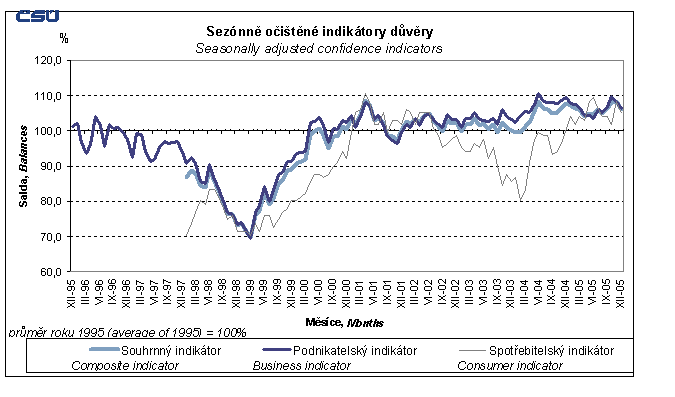
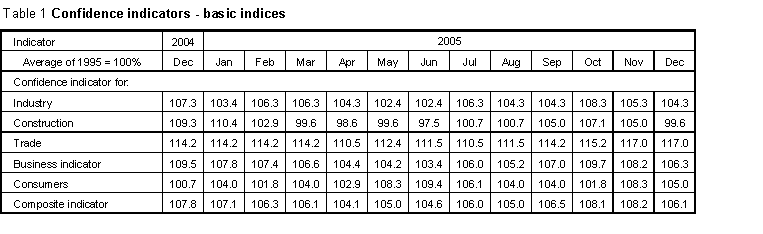
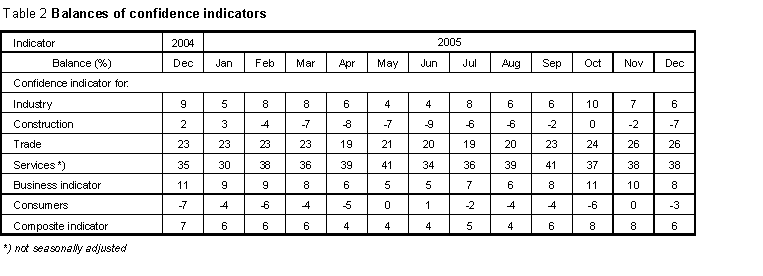
Balances of confidence indicators decreased in December 2005 when compared to their high values in the previous two months; however, they reached values above the average of last 5 years. The composite confidence indicator balance decreased by 2 points month-on-month as well as the business confidence indicator balance. The consumer confidence indicator balance decreased by 3 points.
* * *
In comparison to December 2004, the composite confidence indicator balance is by 1 point lower, the business confidence indicator is 3 points lower, but the consumer confidence indicator balance is by 4 points higher.
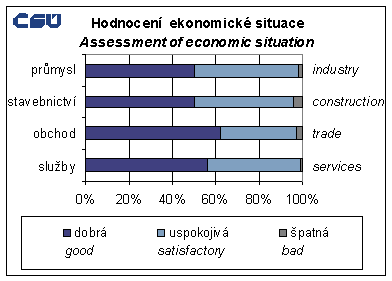
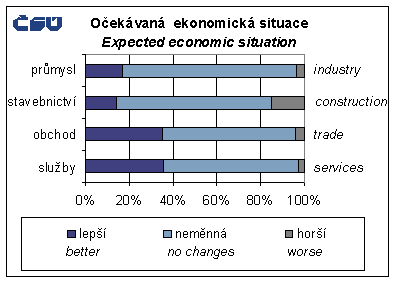
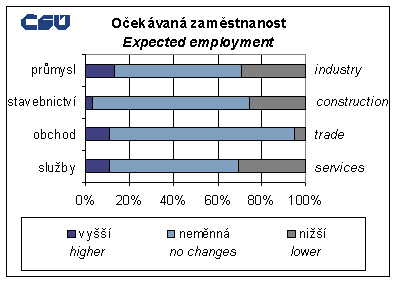
In industry (911 respondents), favourable assessment of current economic situation prevails in December. More than a half of the respondents considered their economic situation good, 47.6% satisfactory and 2.2% bad. Assessment of both current total and foreign demand (order books) for enterprise output increased. Stocks of finished goods decreased slightly, the respondents say (balance 1 point down). For next three months, 29.1% of respondents expect an increase in the production activity, 61.0% expect no changes and 9.9% a decrease, while the employment will remain unchanged. All the data are seasonally adjusted. The survey on investment activity suggests that according to the respondents in manufacturing industry, the level of investment in 2006 should be higher than this year (approximately by 10%). The investment should mainly go into renewal of original equipment or production and extension of production capacities.
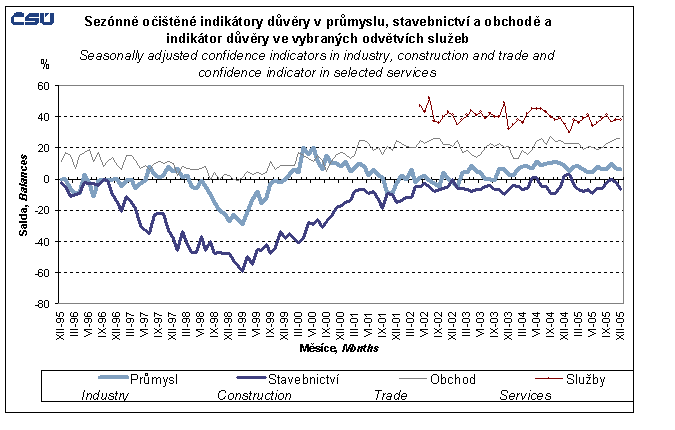
On the whole, the balance of confidence indicator for industry slightly decreased (by 1 point); in terms of year-on-year comparison, it was 3 points down on December 2004.
In construction (537 respondents), half of the respondents considered the economic situation of their enterprise in December as good, 46% as satisfactory and only 4% as bad. Assessment of December total demand (order books) for enterprise output decreased m-o-m; however, the high level of both current and expected construction activity suggests overall high coverage by orders. For next three months, respondents expect the employment to increase, too. All the data are seasonally adjusted. For next six months, 71.1% of the respondents anticipate no changes in the economic situation (72.0% in November), 14.0% predict improvement (11.4% in November) and 14.9% expect worsening (16.6% in November). Generally, the balance of confidence indicator for construction decreased due to December decrease in demand by 5 points m-o-m; y-o-y it is 9 points down.
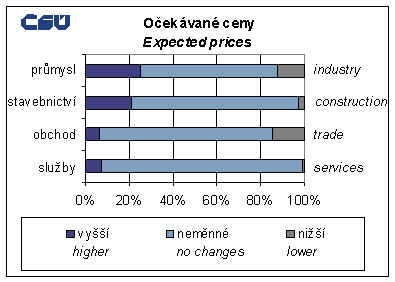
Among respondents engaged in trade (309 respondents), 61.7% considered the economic situation of their enterprise in December good, 35.6% as corresponding to the season and 2.7% bad. In terms of m-o-m comparison and seasonally adjusted, this translates into a 4-point increase in the balance. On the whole, trade decreased its stock of inventories (balance 2 points down). Unchanged price development is expected by 78.6% of the respondents, while 6.6% expect prices to grow and 14.8% to drop. For next six months, 35.0% of the respondents predict improvement in the economic situation (39.0% in November), 60.9% anticipate no changes (59.6% in November) and 4.1% expect worsening (1.4% in November). The overall balance of confidence indicator for trade did not change m-o-m; in terms of y-o-y comparison, it is 3 points up on December 2004.
In selected services (786 respondents), 55.8% of the respondents assessed their current economic situation in December as good, 43.1% as corresponding to the season and 1.1% as bad, which was a slightly better assessment than in November. 37.8% of the respondents expect the demand (order books) to rise, while 57.1% anticipate no changes and 5.1% assume that the demand will decrease; these expectations are also slightly better than in November. According to 92.0% of the respondents no changes in price development should occur, 7.0% envisage a rise in prices and 1.0% a drop. The number of employees is expected to decrease (30.5% of the respondents), remain unchanged (58.8%) or to increase (10.7% of the respondents). The overall balance of confidence indicator for selected services did not change in December; in the y-o-y comparison it is 3 points up.
The survey taken among consumers (1,000 respondents) in December suggests a decrease in the balance of the indicator of expected overall economic situation (9 points down) as well as in the balance of their financial situation in next twelve months (3 points down). Compared to November 2005, the percentage of consumers expecting higher unemployment increased slightly. The percentage of the respondents going to save money decreased slightly. The overall consumer confidence indicator decreased by 3 points in comparison to the previous month but it is 4 points up year-on-year.
Note
Contact: Marie Hörmannová, phone (+420) 274052049,
e-mail marie.hormannova@csu.gov.cz
Data source: CZSO business survey, GfK Praha consumer survey
End of data collection: 21 December 2005
End of data processing: 23 December 2005
More information at: https://csu.gov.cz
Methodological explanatory notes :
Since January 2006 the Composite confidence indicator (Economic sentiment indicator) will be presented as a weighted average of seasonally adjusted confidence indicators in industry, construction, trade, selected services and consumer confidence indicator. Business confidence indicator will be a weighted average of seasonally adjusted confidence indicators in industry, construction, trade and selected services. Indicators will be presented as basic indices, with the average of 2005 as a base. Detailed information will be contained in methodological notes in January 2006. Time series will be recalculated – back to May 2002 (the beginning of the business cycle survey in selected services); all data will be comparable.